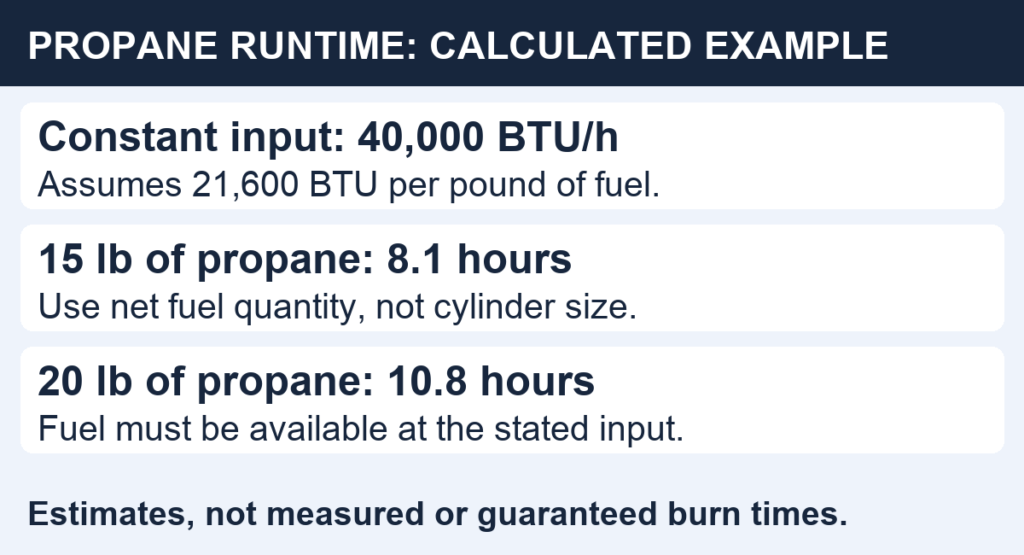
At a constant 40,000 BTU/h gas input, 20 lb of propane gives about 10.8 hours of calculated runtime; 15 lb gives about 8.1 hours. At 46,000 BTU/h, those estimates fall to about 9.4 and 7.0 hours. These are fuel-energy calculations, not measured burn times or guaranteed operating durations.
Start with how much propane is actually in the cylinder and the heater’s gas-input rate at the setting you use. The cylinder’s familiar “20 lb” size does not prove that it currently contains 20 lb of fuel.
Check fuel quantity before using a runtime chart
Blue Rhino states that its exchange tanks contain 15 lb of propane. Use the net fuel quantity on your supplier’s label or receipt, not the weight of the steel cylinder plus fuel. Other suppliers may provide a different amount. If the cylinder has already been used, the original purchase quantity overstates what remains.
For the same burner input, 15 lb supplies 75% of the calculated runtime of 20 lb. That difference is large enough to matter when planning an evening, even though both fills may be sold in the same cylinder size.
Calculate hours from pounds and BTU per hour
Estimated hours = propane remaining (lb) × 21,600 ÷ gas input (BTU/h).
The propane-properties table in A. O. Smith’s technical reference lists approximately 21,600 BTU per pound. This guide uses that rounded fuel-energy value consistently. The calculation assumes the stated input continues throughout operation and the counted fuel is available to the appliance.
Example: 15 × 21,600 ÷ 40,000 = 8.1 hours. Use the appliance’s documented gas input, not an estimate of heat reaching your seats. If its manual gives consumption in lb/h instead, divide fuel pounds by that consumption rate directly.
| Constant gas input (BTU/h) | 15 lb fuel | 20 lb fuel |
|---|---|---|
| 30,000 | 10.8 hours | 14.4 hours |
| 40,000 | 8.1 hours | 10.8 hours |
| 46,000 | 7.0 hours | 9.4 hours |
| 48,000 | 6.8 hours | 9.0 hours |
| 50,000 | 6.5 hours | 8.6 hours |
Figures are rounded to one decimal place. These rows are calculation examples, not claims about particular heater models. A model-specific consumption or runtime specification is useful additional evidence, especially when it states the tested setting and fuel quantity.
Lower settings and weather need separate treatment
A lower documented input rate gives a longer calculated runtime. But a control marked “medium” does not establish half the maximum input, and half a knob’s travel does not prove half the fuel use. Use the manual’s rate for that setting; if it is absent, do not assign a precise low-setting duration.
Wind can leave people feeling colder and lead you to choose a higher setting or run the heater longer. It is not a numerical multiplier in this formula. For a manually set heater, do not assume the burner automatically increases its input to compensate for cold air. If performance changes or the flame goes out, a fuel-energy estimate cannot diagnose the cause.
The wind guide addresses comfort and placement. If the heater stops unexpectedly, use the gas-flow guide rather than concluding the tank is empty or repeatedly trying to relight it.
Plan an evening and estimate fuel cost
A six-hour session at a constant 40,000 BTU/h calculates to 240,000 BTU, or about 11.1 lb of propane. A newly supplied 15 lb fill exceeds that calculated requirement; a partly used cylinder may not. Do not schedule an event to finish exactly at the theoretical empty point.
Estimated fuel cost per hour = fuel purchase cost ÷ calculated hours from that purchased fuel. For illustration only, a hypothetical $25 purchase containing 15 lb, used at 40,000 BTU/h, is $25 ÷ 8.1 ≈ $3.09 per hour. Replace both price and fuel quantity with your receipt. This is not a current local propane-price quote; a cylinder deposit or purchase charge is separate from repeat fuel cost.
Keep fuel planning separate from changing the equipment
Use only the cylinder size and connection arrangement specified for the heater. A runtime table does not authorize a larger cylinder, adapter or fuel conversion. The Bromic Tungsten Portable US manual, for example, specifies its cylinder requirements and prohibits storing a spare cylinder near the appliance. Follow your own model’s shutdown, cooling and cylinder-change instructions; do not plan on swapping a cylinder while it runs.
If you smell gas or suspect a leak, leave the area, avoid ignition sources and call your propane supplier, 911 or the fire department from a safe location. Stay away until cleared to return; do not remain beside the heater to diagnose it. See PERC’s leak-response guidance.
For purchasing decisions, pair this fuel estimate with the patio heater sizing guide. Plan from actual fuel quantity and documented input, then allow for uncertainty instead of treating “one tank lasts ten hours” as a promise.