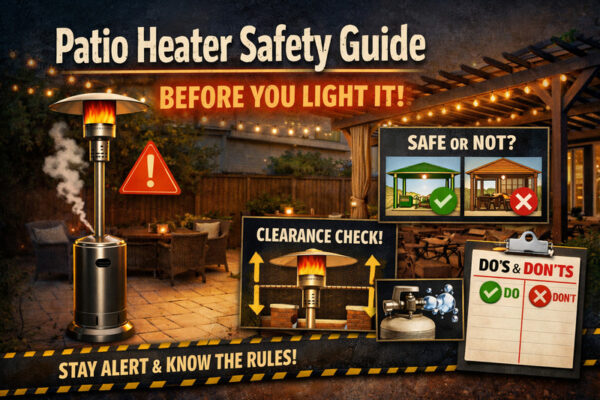
This patio heater safety guide is for anyone who wants a warmer patio without turning a simple outdoor heater into a fire, carbon monoxide, or tipping hazard. Using a patio heater sounds easy at first — wheel it outside, light it up, and enjoy the warmth — but the details matter fast when you start asking the real questions. Can you use one under a covered patio? Is propane okay on a screened porch? How much clearance do you need? What about garages, pergolas, wind, and storage?
That’s where people get tripped up. Patio heaters can make outdoor spaces much more comfortable, but they also bring real risks if you use them in the wrong place or skip the boring stuff like leak checks, clearances, and proper storage. The good news is that most common mistakes are easy to avoid once you know what actually matters.
This patio heater safety guide breaks it down in plain English. We’ll cover where different heaters can and can’t be used, how to place them safely, what to check before turning them on, and the maintenance habits that help prevent bigger problems later.
What’s covered
- Why fuel type matters for safety
- Where patio heaters can be used safely
- How to place a heater the right way
- The quick pre-use check most people skip
- Safe operation habits that actually matter
- Maintenance, storage, and warning signs
Patio Heater Safety Guide: the quick version
If you only remember one thing from this patio heater safety guide, make it this: the space matters just as much as the heater.
| Question | Quick answer |
|---|---|
| Can you use a propane patio heater indoors? | No — never |
| Can you use a gas heater on a screened porch? | Usually no |
| Can you use a heater under a covered patio? | Electric usually makes more sense; gas only if the manual clearly allows it |
| Do patio heaters need clearance? | Yes — always |
| Should you check for gas leaks before use? | Yes |
| Can you leave one unattended? | No |
| Should propane tanks be stored indoors? | No |
| Is a level surface really important? | Yes — tipping is a real risk |
Simple rule: if the space traps heat, fumes, or smoke even a little, stop and double-check before using a gas heater there.
Patio Heater Safety Guide by fuel type
Not all patio heaters create the same risks. That’s the first thing to understand, because a lot of bad advice comes from treating electric and gas heaters like they’re basically the same. They’re not.
Electric patio heaters are usually the easiest from a safety standpoint because they don’t burn fuel. That means no open flame, no propane tank, and no carbon monoxide from combustion. They still need clearance around them, and you still need to keep cords, plugs, and mounting hardware in good shape, but they’re often the safer choice for covered patios, pergolas, and screened spaces when the manufacturer allows it.
Propane and natural gas patio heaters need more respect. They create heat with combustion, which means they can produce carbon monoxide and create fire risk if they’re too close to walls, furniture, umbrellas, or overhead structures. They also bring fuel-related risks like gas leaks, worn hoses, bad fittings, and improper cylinder storage.
That’s why the first question in any patio heater safety guide shouldn’t be “Which heater looks best?” It should be “What kind of space am I heating?”
Quick comparison: safety by heater type
| Heater type | Main safety advantage | Main risk to watch | Best fit |
|---|---|---|---|
| Electric | No combustion fumes | Electrical issues, heat clearance | Covered patios, pergolas, screened spaces if approved |
| Propane | Portable, easy to place | Gas leaks, CO, open flame, tank storage | Open patios with strong airflow |
| Natural gas | No tank swapping | Combustion gases, fixed installation issues | Properly installed outdoor setups |
| Wood-burning fire pit / chiminea | Simple fuel source, ambiance | Sparks, smoke, embers, open flame | Open outdoor spaces with lots of clearance |
Patio Heater Safety Guide for covered patios, porches, and open patios
This is where people make the biggest mistakes. Just because a heater is sold for patios doesn’t mean it’s safe in every outdoor setup.
An open patio is the easiest case. Freestanding propane heaters are commonly used there because there’s enough airflow to reduce the risk of fumes building up. You still need to follow the required clearances, but open-air use is what these heaters are built for.
A covered patio, pergola, or gazebo is trickier. Many people assume “outside is outside,” but overhead coverage changes the safety picture. Gas heaters may be unsafe there unless the manufacturer specifically says the model is approved for that setup and gives exact clearance rules. In many covered spaces, an electric heater is the better fit because you’re not dealing with combustion gases.
A screened porch is where people often push their luck. Screens don’t make the space fully open. They still limit airflow compared with a truly open patio. For that reason, gas-fired patio heaters are usually a bad idea there. Electric models are generally the safer option if the product instructions allow it.
A garage is a no-go for propane patio heaters. Even with the door open, it’s still an enclosed space compared with a patio. If you want garage heat, look at heaters specifically designed and approved for garage use.
Best heater choice by space
| Space | Electric heater | Propane heater | Natural gas heater |
|---|---|---|---|
| Open patio | Good fit | Good fit if clearances are met | Good fit if installed properly |
| Covered patio | Usually the safer choice | Only if the manual clearly allows it | Only if specifically approved |
| Pergola / gazebo | Often the better option | Riskier because of overhead clearance | Riskier because of installation rules |
| Screened porch | Usually the better option | Usually not recommended | Usually not recommended |
| Garage | Only if designed for garage use | No | No |
| Indoors | No patio heater belongs here | No | No |
Quick decision path
Open patio?
→ Electric, propane, or natural gas may work depending on the model.
Covered patio or pergola?
→ Start with electric.
→ Use gas only if the manufacturer clearly approves that setup.
Screened porch?
→ Electric is the safer route.
Garage or indoor space?
→ Don’t use a propane patio heater there.
Patio Heater Safety Guide placement rules
Good placement does a lot of the safety work for you. Bad placement creates problems before you even turn the unit on.
Start with the ground. A patio heater should sit on a flat, stable, level surface. That sounds obvious, but it matters more than people think. Freestanding heaters are tall, and once wind hits them or someone brushes past them, a wobbly setup becomes a tipping hazard fast. If your patio pavers are uneven, fix that first instead of hoping the base is heavy enough to compensate.
Next is clearance. Keep the heater well away from anything that can burn or get heat-damaged — furniture cushions, umbrellas, curtains, plants, decorations, low eaves, and tree branches. Different models require different clearances, so the manual wins every time. As a general habit, more space is better, especially above the heater where heat collects.
Also think about foot traffic. Don’t stick a heater in a narrow path where people constantly squeeze past it. That’s especially important around kids, pets, and outdoor dinners where chairs get moved around.
One more thing people forget: wind. Even if the heater stands up fine, wind can blow out flames, disrupt burner performance, and make the whole thing less predictable. If your area gets gusty, look for anti-tilt shutoff and flame-failure protection, and don’t force patio-heater use on nights when conditions clearly aren’t a good fit.
Placement cheat sheet
| Keep the heater away from… | Why |
|---|---|
| Furniture cushions | They can scorch or ignite |
| Umbrellas | Fabric and ribs can get too hot |
| Curtains or drapes | Easy fire risk |
| Low ceilings / beams | Heat builds up above the unit |
| Plants and branches | Dry material plus heat is a bad mix |
| Walkways and exits | People can bump the heater |
| Kids’ play areas / pet paths | Reduces accidental contact and tipping |
Patio Heater Safety Guide pre-use checklist
Before you turn on a gas patio heater, do a quick check. It takes maybe two minutes, and it can save you from the kind of mistake that ruins the evening.
First, look at the hose and connections. If you see cracks, wear, looseness, or anything that looks off, don’t use it. Gas components are not the place for “it’s probably fine.”
Second, check for leaks. The simple soap-water test still works. Brush or spray soapy water onto the connections, then watch for bubbles. If bubbles form, gas is escaping. Shut everything down and fix the issue before using the heater.
Third, smell for gas. If you smell gas, don’t light the heater. Don’t “just try once.” Shut it off, move away from the area, and figure out the problem first.
Fourth, check the ignition and burner area. Dirt, dust, spiders, and outdoor debris love heater components. If the igniter is slow, the flame pattern looks strange, or the unit hasn’t been used in a while, clean and inspect it before relying on it.
For electric heaters, the pre-use check is different but just as important. Look at the cord, plug, mounting hardware, and outlet. Don’t use a damaged cord, loose outlet, or sketchy extension setup. Outdoor heating is not the place for a tired power strip.
Pre-use checklist
| Check | What you’re looking for | What to do if something’s wrong |
|---|---|---|
| Hose and fittings | No cracks, wear, looseness | Don’t use the heater until repaired |
| Gas leak test | No bubbles with soap-water test | Shut off gas and fix the leak |
| Gas smell | No propane odor | Don’t light it |
| Burner area | No debris, nests, insects, or dirt buildup | Clean it before use |
| Ignition | Lights normally without repeated failed attempts | Stop and inspect |
| Cord and plug (electric) | No damage or looseness | Don’t use damaged electrical parts |
| Surface stability | Heater sits flat and solid | Reposition before turning on |
Patio Heater Safety Guide while the heater is running
Once the heater is on, the job isn’t over. Patio heaters aren’t “set it and forget it” appliances.
The biggest rule is simple: don’t leave it unattended. That applies even if the model has good safety features. Anti-tilt switches, thermocouples, and automatic shutoffs are great backups, but they are backups. They are not permission to walk away and ignore the heater for an hour.
Keep kids and pets away from the base and hot surfaces. A patio heater can look harmless once it becomes part of the background, especially during a gathering. That’s exactly when someone bumps it, leans against it, or moves a chair too close.
If you’re using propane, shut off the gas completely when finished. Don’t just turn the control knob to off and call it good. Close the cylinder valve too. And never move a gas heater while it’s running or still hot.
If the heater doesn’t light right away, don’t keep clicking endlessly. Turn it off and give any unburned gas time to clear before trying again. Rushing that step is how small mistakes become dangerous ones.
“Looks safe” vs “actually safe”
| Situation | Looks fine at first glance | Actually safe? |
|---|---|---|
| Heater under a low pergola roof | Cozy | Only if the heater is approved and clearances are met |
| Heater near dining chairs | Convenient | Risky if people keep brushing past it |
| Screened porch use | Feels outdoorsy | Usually not okay for gas |
| Leaving heater on while you run inside | “Just for a minute” | Not safe |
| Using a damaged hose one more time | “Still works” | Not safe |
| Storing propane in a shed corner indoors | Easy | Not safe |
Patio Heater Safety Guide for maintenance and storage
A lot of patio heater problems don’t start during use. They start in the weeks and months between uses.
Outdoor equipment collects dust, moisture, insects, leaves, and grime. Over time, that buildup can affect ignition, burner performance, and safe airflow. That’s why it helps to clean the burner and reflector, wipe down the exterior, and inspect the air passages before the season starts. A heater that sat uncovered through rain and debris deserves a closer look before it goes back into service.
Storage matters too. Cover the heater when not in use, especially if it stays outside. Rain, snow, and debris can shorten the life of the unit and create issues you won’t notice until the next time you try to fire it up.
For propane cylinders, keep them upright, closed, and stored in a well-ventilated area away from heat and flammable materials. Don’t store propane cylinders indoors. Don’t leave them baking in direct sun unnecessarily. And don’t keep using old damaged tanks just because they still technically work.
A good habit in any patio heater safety guide is a full once-over at the start of each cool season: inspect the hose, fittings, igniter, surfaces, and stability, then test everything before the first real gathering.
Simple maintenance schedule
| When | What to do |
|---|---|
| Before the season starts | Clean burner and reflector, inspect hose, test ignition, check for leaks |
| Before each use | Check stability, clearances, gas smell, and visible wear |
| Monthly during heavy use | Recheck fittings, wipe down surfaces, inspect for rust or grime |
| After storms or windy weather | Look for shifted placement, water exposure, or debris |
| End of season | Deep clean, let it dry, cover it, store the cylinder properly |
Patio Heater Safety Guide: do this, not that
A quick checklist helps because most patio heater accidents come from the same handful of mistakes.
| Do this | Not that |
|---|---|
| Read the manual before first use | Assume all patio heaters follow the same rules |
| Use gas heaters only in properly open, well-ventilated outdoor areas | Use them in garages, enclosed porches, or indoors |
| Keep the heater on a flat, level surface | Balance it on uneven pavers and hope for the best |
| Check hoses and fittings for leaks before use | Ignore cracks or loose connections |
| Keep proper clearance from furniture, umbrellas, ceilings, plants, and overhangs | Cram the heater into a tight seating corner |
| Choose anti-tilt shutoff and flame-failure protection when possible | Assume every heater includes them |
| Shut off the heater and fuel supply when you’re done | Leave the tank open after use |
Red flags in any patio heater safety guide
Stop using the heater if you notice any of these:
- You smell gas before lighting it
- The flame looks uneven or keeps blowing out
- The igniter clicks but won’t light properly
- The unit wobbles or leans
- The hose looks cracked, brittle, or loose
- The burner area is dirty or clogged
- The heater got drenched or sat outside uncovered for a long time and hasn’t been inspected since
Bottom line
The simplest mindset in this patio heater safety guide is this: patio heaters are useful, but they’re not casual. Treat them like real fuel-burning equipment, because that’s exactly what they are.
Match the heater to the space, give it enough clearance, keep it stable, check for leaks, and don’t use gas heaters where airflow is limited. If you do that — and don’t ignore obvious warning signs — you’ll avoid most of the mistakes that get people into trouble. The goal isn’t to be paranoid. It’s to be the person whose patio setup feels warm, easy, and uneventful for all the right reasons.