Hiland HLD032-CG Table Top Patio Heater Review — Cozy Up Close, Picky About Wind
At a Glance
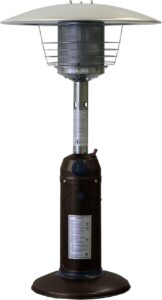
KEY FEATURES
- Heat output: 11,000 BTU (radiant propane heat)
- Fuel: propane (also listed as propane / butane compatible)
- Tank options: 1 lb disposable canister inside the base, or use an adapter hose to connect to a 20 lb tank
- Controls: variable heat control knob (customer feedback suggests lighting requires patience with the pilot step)
- Safety: thermocouple + anti-tilt safety device; weight plate for stability
- Included: regulator included (tank not included)
- Certifications: CSA approved (listed)
PROS
- Best-case warmth feels great within a few feet
- Perfect “take the chill off” heater for calm, mild evenings
- Many say assembly is quick once you figure out the base
- Looks good on patios and doesn’t block conversation much
- Works far better with a 20 lb tank adapter hose
- Some customers report helpful, responsive parts support
CONS
- Limited heat radius — table-center placement can feel weak
- Lighting can be finicky (pilot timing, many clicks, lighter needed)
- 1 lb bottles burn fast and can freeze / lose pressure
- Wind easily disrupts flame and comfort
- Build quality / packaging issues reported (thin metal, sharp edges, missing hardware)
- Reliability complaints (shutdowns, regulator / thermocouple problems)
Editor's Choice
Based on rigorous testing & Amazon customer feedback
🔥 Will This Heater Work For Your Room?
Answer a few quick questions about your space to see if this heater is a good match.
Outdoor hangouts have a predictable ending once the temperature drops: everyone starts doing the subtle shoulder-hunch, then the group slowly migrates indoors.
A tabletop propane heater can stop that — but only if it’s the right kind of heat for the way you actually sit outside.
This review is based on real customer experiences with the Hiland HLD032-CG and the story is pretty consistent: it can feel genuinely cozy, it looks nice on a patio, and it’s surprisingly useful for small setups. It also has a learning curve (lighting), and it’s not going to heat your whole backyard like a full-size restaurant heater.
Quick verdict
If you want a compact outdoor heater to make a small seating area more comfortable — think two chairs, a small patio table, a porch smoking spot, or a covered deck — customer feedback says this style can be a solid win.
If your goal is “warm the whole patio” or “feel heat from across the table,” reviews suggest you’ll likely be underwhelmed.
What it feels like in real life
The best comments come from people using it for close-range comfort. A common setup is simple: place it near where people actually sit (not just where it looks symmetrical), keep the night relatively calm, and let it do what 11,000 BTUs can realistically do.
Owners describe it as the kind of heater that makes your hands stop stinging, keeps shoulders and faces warmer, and makes a cool evening feel more livable — as long as you’re within a few feet.
Where expectations go wrong is distance. A lot of buyers expected “table centerpiece warmth,” then realized they couldn’t feel much while sitting back in dining chairs. The fix, according to many reviews, is placement: put it closer to people (between chairs, near the edge of the table, or even on the ground in front of seating when it’s colder).
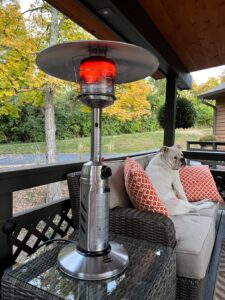
Heat expectations: cozy zone, not a wide-radius blanket
Think of this as a “comfort bubble” heater.
When you’re close, plenty of people say it’s great. When you’re not, the warmth drops off fast. Customers who bought it for small patios, bar stools, or tight conversation areas are the happiest. People trying to use it like a full-size dome heater are the ones most likely to call it weak.
Several reviews put a practical limit on it: it’s nice in the 50s and low 60s, especially when you’re sheltered. Colder than that, you’re back to coats — and possibly moving the heater closer to your legs to feel the benefit.
The big tip customers repeat: use a larger propane tank if you’ll use it often
Disposable 1 lb propane bottles are convenient, but reviewers repeatedly mention two downsides:
- They don’t last long on high (often around 1–2 hours).
- As they drain, heat can feel weaker, and some people report freeze-ups or pressure drop.
A lot of owners solve that by using an adapter hose to run it from a standard 20 lb grill tank (or a small refillable tank under the table). The payoff is obvious in feedback: longer runtime, less waste, and less “are we out already?” mid-evening.
Lighting: doable, but it rewards patience
This is one of the biggest themes in customer reviews.
Many people say it lights reliably once they learn the rhythm, but the “first week experience” can be frustrating. The recurring advice is to follow the pilot step exactly, hold the knob long enough, and don’t rush the thermocouple warm-up. A few reviewers even suggest trying the first light at dusk so you can actually see the pilot flame and avoid the “is it lit or not?” spiral.
There’s also a smaller set of reports where the igniter button didn’t work well from day one, or stopped working later. Those users often switched to a lighter, or repositioned a loose wire, or contacted support.
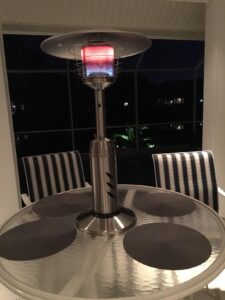
Wind changes everything
Even owners who like the heater are blunt about wind: breezes can knock down the comfort and sometimes blow out the flame.
If your patio is exposed, customer feedback suggests you’ll get better results by placing the heater in a sheltered corner, using it under a covered area, or pairing it with a simple wind break. Calm nights are where this style shines.
Build quality and reliability: mixed, with a “you get what you pay for” vibe
A lot of customers feel it’s well worth the price — especially when it works as intended for small areas. At the same time, there are repeated complaints about inconsistent build quality: thin metal, sharp edges, holes that don’t quite line up, missing hardware, labels peeling, and units arriving beat up.
Reliability also splits the room. Some people use it for seasons with no drama. Others report shutdowns after several minutes, finicky safety switches, regulator issues, or units that become harder to light over time unless cleaned and maintained.
Customer support: both good stories and bad ones
There are reviews where support is described as friendly, quick to respond, and helpful with replacement parts or troubleshooting.
There are also reviews describing the opposite — slow responses, unhelpful return handling, or being pushed into DIY troubleshooting that felt out of scope.
The best way to think about it: support is not a guaranteed highlight, but it can be a helpful one when you get the right rep at the right time.
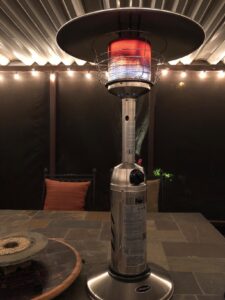
Who it’s best for
This heater makes the most sense if you want:
- close-range warmth for 1–2 people (or a small seating cluster)
- a compact heater for a covered patio, porch, or tight outdoor setup
- a tabletop heater that looks good and doesn’t dominate the space
- a setup that can run off a larger propane tank with an adapter hose
Who should skip it
You may want a different heater if you need:
- wide heat coverage across a large, open patio
- strong performance in wind
- “set it and forget it” reliability with zero tinkering
- maximum heat output over compact size
Pros & Cons Analysis
Based on extensive testing and Amazon customer feedback
Pros
- Good "close-in" warmth — many say it comfortably warms 2 people (or a small table zone) when you're within a few feet, especially on calm nights
- Great for mild chill — lots of "takes the edge off" feedback in ~50–60°F weather (best in sheltered patios)
- Looks nice on a patio — the bronze / gold finish and "mini patio heater" vibe gets compliments (a few call it a fun "mini-me" of full-size heaters)
- Easy assembly for many — plenty of owners say setup is straightforward (10–30 minutes once you get the hang of the base)
- Works much better with a 20 lb tank adapter — lots of people recommend an adapter hose; several say heat output improves and runtime becomes practical
- Ignition is fine once learned — many say it lights reliably if you follow the exact "pilot hold" timing; a few suggest trying first light at dusk so you can see the pilot flame
- Solid for specific use cases — smokers on porches, camping (if you can fit it), bar-height table zones, and covered patios show up as "happy owner" scenarios
- Support can be helpful — some customers report prompt replies and replacement parts (like switches / small components) shipped out
- Good value when expectations are realistic — many "for the price, it's worth it" comments when used as a small-area heater
Cons
- Heat reach is limited — a big theme is "you have to be very close"; several say they couldn't feel much heat when it sat centered on a dining table
- Not for cold or big open spaces — multiple reviewers were disappointed below ~50°F, in wind, or when trying to warm a larger patio area
- Quality is inconsistent — reports include thin metal, sharp edges, misaligned holes, missing hardware, peeling label, and occasional "arrived dusty / used-looking" packaging
- Instructions can be confusing — "translated poorly," missing clarity, and steps that don't match what's already pre-assembled are common complaints
- 1 lb canisters are a pain — frequent notes about short runtime (often ~1–2 hours on high), waste, freeze-ups, and pressure drop leading to weak heat
- Hard-to-light stories are common — repeated reports of long priming, many igniter clicks, pilot not staying lit, igniter button failing, or needing a lighter
- Wind sensitivity — multiple people say the flame blows out easily and performance drops fast in breezy conditions
- Support can also be frustrating — others report poor return handling, unhelpful responses, voicemail full / no response, and being pushed into DIY troubleshooting
- Reliability complaints — reports include shutdowns after 5–10 minutes, regulators acting up, thermocouple issues, gas leaks, and units failing within a season or two
Our Verdict
As a tabletop patio heater, this one can be a genuinely useful upgrade — but it's happiest when you use it like a personal comfort tool, not like outdoor central heating.
Set it up close to where people actually sit, protect it from wind, and plan for a larger tank if you'll use it regularly. Do that, and customer feedback suggests it delivers exactly what most people want on a chilly evening: a reason to stay outside a little longer.
Frequently Asked Questions
Is this tabletop heater actually warm, or is it more of a 'nice idea'?
Customer feedback says it can feel genuinely cozy — but only at close range. People who place it near seating (between two chairs, bar stools, or right next to the table edge) tend to be happy. People who expect it to heat a wide patio or feel strong from across the table are more likely to be disappointed.
How far away can you feel the heat?
Most real-world comments point to 'a few feet' as the sweet spot. Several owners say they needed to sit very close to feel it, and some moved it from the center of the table to the side or even onto the ground between chairs to get better warmth.
What temperatures is it best for?
Reviews commonly describe it as a 'take the chill off' heater in the 50–60°F range, especially in low wind. Below that, many people say they still need coats — and some say it's not worth it in colder weather unless you're very close and sheltered.
Do the 1 lb propane bottles last long?
Most customers say no — runtime on high is usually around 1–2 hours, and some report even shorter effective heat once pressure drops. A popular recommendation is using an adapter hose with a larger tank for longer, steadier sessions.
Does it work better with a 20 lb propane tank adapter?
Yes — this is one of the most repeated tips. Many owners say the heater becomes much more practical on a larger tank, and a few even felt heat output improved compared with small bottles.
Why do some people say it's hard to light?
The most common pattern is that lighting takes patience. Owners describe holding the knob in 'Pilot' for a full minute (sometimes longer), clicking the igniter repeatedly, and continuing to hold briefly after the pilot lights so the thermocouple heats up. Several people said it got easy after a few tries — but the learning curve is real.
Any tip for the first-time ignition?
A customer tip that comes up: try first lighting at dusk or in lower light so you can actually see whether the pilot flame is lit. Also, follow the manufacturer steps exactly and don't rush the pilot hold time.
Does wind affect it a lot?
Yes. Multiple reviews mention flame blow-outs and weak performance in breezy conditions. Owners with covered patios or sheltered corners report better results than those using it in open, windy layouts.
Why does it shut off after a few minutes for some users?
Some owners report shutdowns after 5–10 minutes or 30–50 minutes. Theories in reviews include a finicky tip-over switch, regulator behavior, or pressure issues with small bottles. Some people solved it by carefully following lighting steps, using a larger tank setup, or contacting support for replacement parts.
Is the igniter reliable?
Mixed. Many say it lights on the first or second click once everything is working. Others say the igniter stopped working early, required repositioning a wire, or they switched to lighting with a handheld lighter.
Is it safe for a covered patio?
People do use it under covered patios — but you should follow your manual's clearance requirements and local fire guidance. Several buyers chose this style specifically because they didn't want a tall heater near a roofline. Always keep it away from combustibles and never use it in enclosed indoor spaces.
Do I need any maintenance?
Some long-term owners report the pilot area can clog over seasons (dust, bugs, pollen), making starts harder. They mention cleaning as part of seasonal upkeep. If you're not handy, that's worth knowing up front.
What's the biggest 'before you buy' takeaway from reviews?
Buy it for close-range comfort — not for heating a whole patio. Plan on an adapter hose and a bigger tank if you'll use it often, and expect wind to reduce both warmth and reliability.
Technical Specifications
| Brand | Hiland |
|---|---|
| Model / SKU | HLDS032-CG (ASIN: B000G7SX3I) |
| Heater type | Portable outdoor tabletop propane patio heater |
| Form factor | Tabletop / pedestal |
| Heating method | Radiant (propane/gas) |
| Heating element | Propane burner + emitter screen (radiant heat) |
| Max heat output | 11,000 BTU (≈ 3,224 W) |
| Voltage | N/A (gas-powered; no plug-in power required) |
| Amperage | N/A (gas-powered) |
| Coverage (manufacturer claim) | Not specified (tabletop heaters are close-range; wind and distance greatly affect warmth) |
| Temperature range | Not specified (manual dial control) |
| Speeds / levels | Variable heat control knob (Low–High) |
| Noise level | Not specified (generally quiet aside from normal burner sound) |
| Oscillation | No |
| Controls | Manual ignition + adjustable control knob |
| Timer | No |
| Power source | Propane / gas |
| Mounting / placement | Tabletop mount (free-standing) |
| Dimensions (D × W × H) | Not specified (listed height: ~38" tall) |
| Weight | Not specified (product listing data varies; check retailer listing for exact weight) |
| Color | Bronze / Gold (hammered finish) |
| Special features | Portable; access door design; weight plate for stability; burner screen guard; thermocouple + anti-tilt safety devices; regulator included; CSA approved |
| Safety certification | CSA (approved) |
| Included in the box | Tabletop patio heater, regulator (propane tank not included) |
| Warranty | 1-year against manufacturer defects (AZ Patio Heaters statement) |
| Recommended room types / uses | Outdoor patio, deck, balcony, porch, covered patio seating, small gatherings |
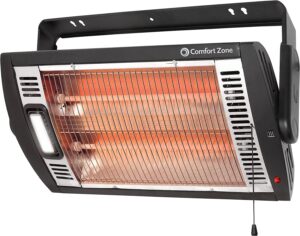
Comfort Zone Ceiling-Mounted Dual Quartz Heater Review — Quick Warmth for Workbench Zones
There are two kinds of cold. The “put on a hoodie” kind, and the “my fingers won’t work” kind —…
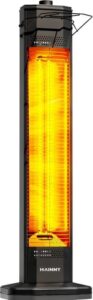
HAIMMY UEH520 Review — Fast, quiet infrared heat outside
There’s cold, and then there’s patio cold — the kind where you tell yourself you’ll only sit outside for five…
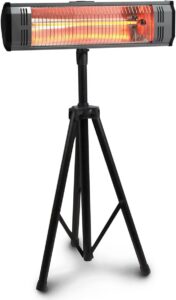
Heat Storm Tradesman Tripod Infrared Heater Review — Big, Silent Warmth for Garages and Patios
Some heaters warm a room. This one warms you. That’s the big takeaway from customer feedback on the Heat Storm…
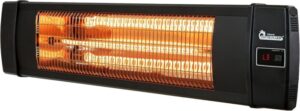
DR. Infrared Heater DR-238 Review — Quiet, Instant Warmth for Garages and Covered Patios
Some heaters try to warm the whole room. This one is more like a comfort spotlight. Owners keep describing the…


