Buying a patio heater sounds easy — until you start comparing models and every brand seems to describe coverage differently.
One heater claims a 15-foot radius. Another says 100 square feet. Another leads with 48,000 BTU like that number alone should answer everything. Then you actually use one outside and realize the real question isn’t just “How much heat does it make?” It’s “How warm will my patio actually feel?”
That’s where most people get burned — not literally, hopefully. Outdoor heat is messy. Wind steals it. Open layouts dilute it. And two heaters with similar specs can feel completely different depending on where the heat goes.
This guide keeps it practical. We’ll break down what BTU actually means, when it matters, when it doesn’t, and how to size a patio heater based on the space you really use — not just the biggest number on the box.
What’s covered:
- What BTU actually means
- Why coverage claims feel inconsistent
- A simple way to size gas heaters
- Why electric heaters play by different rules
- Real-world factors like wind, layout, and mounting
- When to use multiple heaters
- Quick tables and charts to make sizing easier
Quick answer: what size patio heater do most people need?
For a small seating area or balcony, compact electric or tabletop heaters are usually enough.
For a typical dining or lounge area, most people end up in the 30,000 to 50,000 BTU gas heater range or use one to two electric mounted heaters.
For a bigger open patio, one heater usually isn’t enough — multiple units tend to work better than one oversized model.
Patio heater sizing cheat sheet
| Patio use area | Typical size | What usually works |
|---|---|---|
| Small balcony / bistro set | 40–80 sq ft | Tabletop propane or compact electric infrared |
| Small dining set / loveseat area | 80–120 sq ft | 1 tabletop heater, 1 compact freestanding heater, or 1 mounted electric |
| Standard patio seating zone | 120–200 sq ft | 1 full-size propane heater or 1–2 mounted electric heaters |
| Large dining + lounge setup | 200–350 sq ft | 2 full-size heaters or a multi-unit mounted setup |
| Large open entertaining patio | 350+ sq ft | Multiple heaters, zoned placement |
That table won’t replace common sense, but it gets you in the right neighborhood fast.
What BTU actually means — and what it doesn’t
BTU stands for British Thermal Unit. For patio heaters, it’s basically a heat-output number for gas models. More BTU usually means more potential heat output.
But here’s the part that trips people up: BTU is not a comfort guarantee.
A 48,000 BTU patio heater sounds powerful — and it is — but that doesn’t mean your whole patio will feel evenly warm. Outdoor heat escapes fast. The moment you add wind, open sides, or distance from the heater, comfort drops.
Think of BTU as the engine size. It tells you something important, but it doesn’t tell you the full driving experience.
BTU reality check
| BTU range | Typical use | Real-world feel |
|---|---|---|
| 5,000–15,000 BTU | Tabletop / compact heating | Close-range warmth only |
| 25,000–35,000 BTU | Smaller freestanding or directional heating | Good for small seating zones |
| 40,000–50,000 BTU | Full-size propane patio heaters | The classic “restaurant patio” range |
| 50,000+ BTU | Large gas / mounted commercial-style use | Better for larger or more exposed spaces |
A common mistake is assuming more BTU always means better. Sometimes it just means more fuel use, more bulk, and still not enough comfort if the layout is wrong.
Why patio heater coverage claims feel all over the place
Because brands aren’t always talking about the same thing.
Some are describing maximum range. Some are describing ideal coverage. Some are describing where you can “feel” heat, not where you’ll actually feel comfortably warm.
That’s why two similar heaters can sound wildly different on paper.
The three numbers shoppers mix up
| Term | What it means | Why it matters |
|---|---|---|
| Heat output | BTU or watts | Raw power |
| Coverage area | Total space warmed | Useful, but often optimistic |
| Heat pattern | How heat spreads | This changes everything |
A mushroom-style propane heater spreads warmth around itself. A wall-mounted infrared heater throws heat forward. A tabletop heater keeps warmth tight and local. Same idea, very different real-life result.
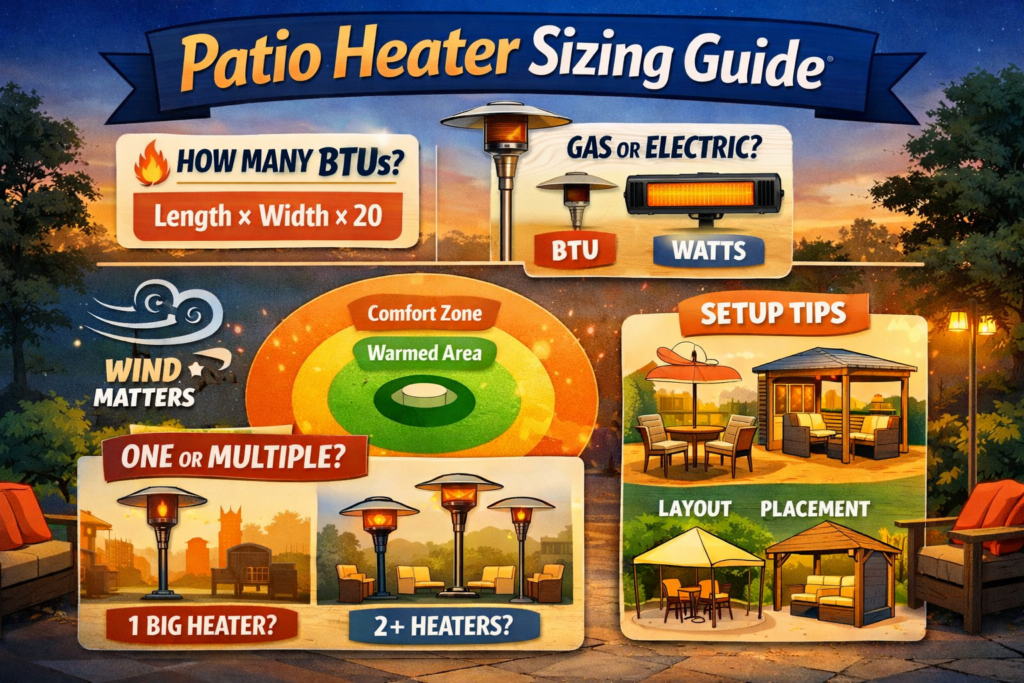
What “coverage” usually feels like
Best comfort zone        = close to heater
Useful comfort zone      = normal seating distance
Outer edge of warmth     = you can tell it's on, but it may not feel cozy
That outer edge is where a lot of marketing claims live.
How to size a gas patio heater without overthinking it
A common rule of thumb for gas patio heaters is:
Length × width × 20 = estimated BTUs needed
So if your main seating area is 12 × 15 feet:
12 × 15 = 180 sq ft
180 × 20 = 3,600 BTUs
That looks tiny compared to real patio heaters, which is why this formula is only a starting point. Outdoors, you usually size up a lot because heat gets lost so easily.
Better way to use the formula
Don’t treat it like a final answer. Use it as a reminder to ask the right questions:
- What part of the patio are you actually heating?
Not the whole backyard — just the zone people use. - Is it open or sheltered?
Covered patios hold comfort better. - What type of heater are you using?
Freestanding 360-degree heat feels different from directional mounted heat. - How close will people sit?
Close-range warmth is much easier to achieve than edge-to-edge coverage.
Real-world sizing examples
| Seating area | Formula result | What usually makes sense |
|---|---|---|
| 8 × 10 ft bistro zone | 1,600 BTU | Tabletop or compact electric |
| 10 × 12 ft conversation set | 2,400 BTU | 1 smaller freestanding or 1 mounted electric |
| 12 × 15 ft dining area | 3,600 BTU | 1 full-size propane heater or 1–2 mounted electrics |
| 15 × 20 ft patio zone | 6,000 BTU | Usually 2 heaters, not 1 |
| 20 × 20 ft open patio | 8,000 BTU | Multi-heater setup strongly preferred |
The pattern matters more than the math. Once the patio gets moderately large, layout beats raw BTU.
Electric patio heaters don’t size the same way
Electric patio heaters make sizing more confusing because a lot of them use infrared or radiant heat. That means they warm people and surfaces directly instead of trying to heat all the surrounding air.
That’s why an electric heater can look weak on paper next to a propane model, then still feel great over a dining table or sofa under a covered patio.
Gas vs electric sizing — quick comparison
| Feature | Gas patio heater | Electric infrared heater |
|---|---|---|
| Main sizing number | BTU | Watts |
| Best for | Open patios, portable use | Covered patios, targeted heat |
| Heat style | Broad ambient warmth | Directional radiant warmth |
| Wind resistance | Fair to poor, depending on design | Usually better |
| Placement flexibility | Great for propane | Great if mounted well |
So don’t compare gas and electric as if they should “match” exactly. A propane heater is usually trying to create a warm zone in open air. An electric infrared heater is usually trying to warm the people sitting in a specific spot.
Wind, layout, and ceiling cover matter more than people expect
This is the part that decides whether buyers love their heater or regret it.
Real-world performance chart
| Condition | What happens to comfort |
|---|---|
| Calm, covered patio | Heater feels strongest |
| Calm, open patio | Good close-range warmth |
| Light breeze | Comfort zone shrinks |
| Windy patio | Heat falls off fast |
| Corner / protected placement | Feels warmer than center-open placement |
Simple visual: same heater, different conditions
Calm + covered patio       ██████████  excellent
Calm + open patio          ████████    very good
Light breeze               ██████      decent
Open + chilly + breezy     ████        only okay up close
Windy / exposed            ██          disappointing
That’s why two buyers can own the same heater and have completely different opinions of it.
If your patio gets regular wind, don’t size based on perfect conditions. Size for the patio you actually have.
One big heater vs multiple smaller heaters
A lot of shoppers assume one large heater is the cleanest solution. Sometimes it is. But very often, two smaller heaters work better.
Why? Because patios are rarely perfect circles with everyone sitting at the same distance from the heater.
When multiple heaters make more sense
| Situation | Better choice |
|---|---|
| Long narrow patio | Two smaller heaters |
| Dining area + lounge area | Two-zone setup |
| Frequent entertaining | Multiple heaters |
| One small centered seating group | One heater can be enough |
| Covered patio with fixed furniture | Mounted multi-heater layout |
If you’ve got a 20-foot-long patio with one dining set at one end and a lounge area at the other, one center heater usually leaves both zones half-happy. Two smaller heaters placed well usually feel much better.
That’s also why commercial patios often use multiple units instead of chasing one monster output number.
What type of patio heater matches your sizing goals?
Quick style guide
| Heater type | Best for | Real expectation |
|---|---|---|
| Tabletop | Small tables, balconies | Warm hands, laps, close seating |
| Mushroom propane | General-purpose patio warmth | Best all-around freestanding option |
| Pyramid propane | Ambiance + nearby warmth | Better vibe than wide coverage |
| Wall-mounted electric | Covered seating areas | Excellent targeted comfort |
| Ceiling-mounted electric | Clean look, fixed seating | Great if placed correctly |
This is one of the most useful mindset shifts: don’t just size the heater — size the heater style to the job.
A pyramid heater may look amazing, but if your goal is plain practical warmth across a dining table, a classic mushroom heater or a mounted directional unit may serve you better.
Common patio heater sizing mistakes
Mistake 1: Heating the whole patio when people only use one zone
Measure the part people actually sit in.
Mistake 2: Believing the biggest coverage claim
That’s usually best-case, not everyday reality.
Mistake 3: Ignoring wind
Wind changes everything outdoors.
Mistake 4: Choosing by BTU alone
Heat direction matters just as much.
Mistake 5: Buying one heater for a multi-zone patio
That’s where cold spots happen.

Leave a Reply