If your patio heater pilot light keeps going out, it can turn a simple evening outside into an annoying cycle of relighting, waiting, and watching the flame die again.
That’s what makes this problem so frustrating. The heater looks close to working. It’s not completely dead. It’s not obviously broken. It just won’t stay running — the patio heater won’t stay lit no matter how many times you relight it.
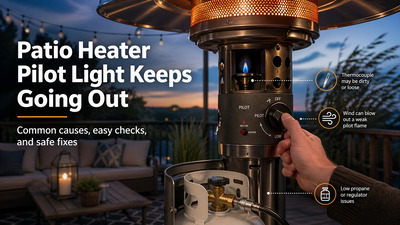
In most cases, that points to one of a few common issues — a weak pilot flame, a dirty thermocouple, low gas pressure, air in the line, or a breeze hitting the flame at just the wrong angle.
The good news is that this kind of problem is usually pretty traceable once you know what to look for. This guide walks through the likely causes, the safest checks to try first, and the signs that tell you whether this is a quick cleanup job or a replace-the-part situation.
If you want a broader breakdown of all common ignition and gas flow problems, see our complete patio heater troubleshooting guide.
Quick diagnosis table
Before you start taking anything apart, use the symptom to narrow down the problem.
| What the heater does | Most likely cause | First thing to try |
|---|---|---|
| Pilot lights, then dies the second you release the knob | Thermocouple not heating properly, weak pilot flame, or not holding the knob long enough | Hold the knob 30 to 60 seconds and inspect flame shape |
| Pilot stays lit briefly, then goes out after a minute or two | Drafts, weak gas flow, dirty burner or pilot area | Move heater to a sheltered spot and check tank and regulator |
| Pilot lights, but the flame looks tiny or weak | Dirty pilot orifice, low propane pressure, air in line | Try a full tank and clean the pilot area |
| Pilot flame is yellow or flickering | Dirty pilot, blocked air path, poor combustion | Clean accessible buildup and inspect the flame again |
| Heater works only sometimes | Loose regulator, borderline thermocouple, intermittent airflow problem | Re-seat the tank connection and check flame contact on the sensor |
| Heater starts better with a fresh tank | Pressure issue or nearly empty or too-cold tank | Replace or refill the tank first |
That table alone can save a lot of random guessing.
Why a patio heater pilot light keeps going out
Most gas patio heaters use a simple safety chain. The pilot flame lights first. That flame heats the thermocouple, which tells the gas valve, “Yes, the flame is real — it’s safe to keep feeding gas.” If the thermocouple doesn’t get enough heat, the gas shuts off.
So when a patio heater pilot light keeps going out, the heater is often doing exactly what it was designed to do. That’s also why a propane patio heater keeps shutting off — the safety system cuts gas flow when it doesn’t detect stable flame conditions. It’s detecting a problem — or what it thinks is a problem — and cutting gas flow.
That’s why this issue can feel confusing. The flame may light just fine for a moment, which makes it seem like ignition isn’t the problem. But staying lit is a different step.
If your heater won’t spark at all and never lights in the first place, that’s usually a different issue entirely — see why a patio heater igniter won’t spark. At that point, the heater needs three things to line up:
- a steady pilot flame
- enough flame contact on the thermocouple
- consistent gas flow
If any one of those is weak, the pilot goes out.
First checks when a patio heater pilot light keeps going out
Start with the easy stuff. A lot of patio heater problems come from things that are simple, boring, and easy to miss.
1) Hold the knob longer than you think
Many people let go too soon. After lighting the pilot, keep the control knob depressed for 30 to 60 seconds. Some heaters really do need that full minute.
2) Try a full propane tank
A tank can still have some fuel left and still cause weak flame behavior. Pressure drops matter — especially in cool weather.
3) Make sure the tank valve is fully open
Half-open valves create half-working heaters.
4) Check the regulator connection
If the regulator isn’t seated cleanly, gas flow can get weird fast.
5) Think about recent changes
Did you just install a new tank? Move the heater? Store it for months? Those clues matter. Air in the line, dust buildup, or a bumped thermocouple are all common after storage or moving.
Quick-fix checklist
Here’s the short version if you want the fastest safe path:
| Check | Why it matters | Easy fix |
|---|---|---|
| Knob hold time | Thermocouple may not be hot enough yet | Hold 30 to 60 seconds before releasing |
| Propane level | Low tank can weaken flame | Swap in a full tank |
| Wind exposure | Draft can push flame off sensor | Move to a more sheltered location |
| Pilot dirt or debris | Weakens or distorts flame | Clean the accessible pilot area |
| Thermocouple surface | Dirt or carbon reduces sensing | Gently clean the sensor |
| Hose or regulator | Low flow means unstable pilot | Inspect for kinks, twisting, or a loose fit |
Pilot flame problems that make the heater shut off
The pilot flame tells you a lot. If it’s healthy, it should usually look blue, steady, and properly aimed at the thermocouple. If it looks weak, split, fluttery, or yellow, that’s your clue that the issue may be dirt, pressure, or airflow — not necessarily a failed part.
Pilot flame guide
| Flame appearance | What it usually means | What to do |
|---|---|---|
| Strong blue flame | Pilot is probably okay | Move on to thermocouple positioning and checks |
| Small blue flame | Low gas flow or partial blockage | Check tank, regulator, and pilot opening |
| Flickering flame | Draft or unstable flow | Move heater and recheck |
| Yellow or orange flame | Dirt, poor air mix, or clogging | Clean pilot and burner area |
| Flame not touching the sensor properly | Thermocouple can’t stay hot | Inspect sensor alignment |
Outdoor heaters collect all kinds of junk — dust, spider webs, carbon, pollen, and grime. A small amount of debris in the pilot area can be enough to make the flame look just good enough to light, but not good enough to stay lit.
That’s the frustrating middle zone a lot of people end up in.
Thermocouple issues behind a patio heater pilot light that keeps going out
If the pilot lights normally but goes out when you release the knob, the thermocouple is one of the first things to suspect.
We cover how thermocouples, regulators, and gas valves work together in our full propane patio heater troubleshooting guide.
This part sits near the pilot flame and acts like a flame-confirmation sensor. If it’s dirty, slightly out of position, or simply worn out, the heater shuts off gas as a safety measure.
Signs the thermocouple may be the problem
- The pilot lights every time, but dies as soon as you let go
- The pilot flame looks decent, but shutdown still happens
- Cleaning the pilot helps only a little or not at all
- The heater became unreliable after being moved or bumped
What you can safely do
- Gently clean visible carbon or dirt from the thermocouple
- Check whether the pilot flame is actually reaching it properly
- Inspect for obvious bending or looseness
What not to do
Do not bypass the thermocouple. That safety part is there to stop gas flow if the flame goes out. Removing or defeating it is not a real repair — it just makes the heater less safe.
Gas flow issues can cause the same symptom
If the heater lights but you suspect restricted or inconsistent fuel delivery, see our guide on patio heater gas not flowing and what causes it.
A patio heater doesn’t need a huge amount of gas to keep the pilot going, but it does need steady gas flow. That’s where tanks, regulators, hoses, and line restrictions come in.
The tricky part is that a gas flow problem can look almost identical to a sensor problem. The pilot lights, seems okay for a second, then dies. From the outside, both issues look the same. The difference is in the flame.
If gas flow is weak, the pilot flame often looks undersized, lazy, or unstable. If the flame looks strong and well-positioned but the heater still shuts off, the thermocouple becomes more likely.
Gas flow trouble spots
| Part | Possible issue | Result |
|---|---|---|
| Propane tank | Low fuel, cold tank, weak pressure | Weak pilot flame |
| Regulator | Poor connection or failing regulator | Unstable gas delivery |
| Hose | Kinked, twisted, cracked | Restricted flow or unsafe leak risk |
| Pilot tube or orifice | Dust or clogging | Tiny or distorted flame |
| Gas valve | Internal fault | Inconsistent operation |
If you smell gas, hear unusual hissing, or see damaged hose material, stop there. That’s not the kind of problem to just keep testing. You can review essential patio heater safety guidelines before attempting further checks.
Wind and placement mistakes that affect the pilot flame
Because patio heaters live outside, airflow matters more than people expect. A light cross-breeze can shift the pilot flame just enough that it stops heating the thermocouple properly. The heater then shuts down, even though nothing is technically broken.
This is why some heaters act fine in one spot on the patio and terrible in another. It’s also why people sometimes replace parts unnecessarily when the real problem is placement.
Setup mistakes that can cause shutdowns
- Putting the heater in a direct wind path
- Using it near an open corner with constant air movement
- Placing it where reflected airflow swirls under the burner area
- Assuming “just outdoors” means wind doesn’t matter
You still want proper outdoor ventilation, of course. This isn’t about boxing the heater in. It’s about avoiding obvious draft lanes that keep smothering or shifting the pilot flame.
DIY or call for help?
This is where a lot of people waste time. Some issues are reasonable DIY checks. Others are better left alone.
| Situation | DIY okay? | Notes |
|---|---|---|
| Holding the knob longer, trying a full tank | Yes | Easiest first step |
| Cleaning accessible dirt around the pilot area | Yes | Gas off first |
| Inspecting visible hose kinks or tank connection | Yes | Stop if anything looks damaged |
| Gently cleaning the thermocouple | Usually | Be careful, don’t bend or damage it |
| Replacing regulator or hose assembly | Maybe | Fine if you’re confident and using the correct parts |
| Gas leaks, damaged valves, repeated ignition failure | No | Time for qualified service |
| Bypassing safety parts | No | Never a real fix |
A good rule: if you’re staying in the lane of basic checks, cleaning, and obvious external parts, that’s usually reasonable. If it involves leaks, valves, or safety bypasses, stop.
Simple troubleshooting flow for patio heater pilot light problems
Use this if you want a cleaner sequence:
Step 1: Light the pilot and hold the knob for 30 to 60 seconds
Step 2: If it dies, swap in a full tank
Step 3: Check whether the flame is blue, steady, and contacting the thermocouple
Step 4: Clean visible dirt around the pilot and sensor
Step 5: Move the heater to a less windy spot
Step 6: Inspect regulator fit and hose condition
Step 7: If the flame looks good but it still dies, suspect the thermocouple
Step 8: If gas flow seems weak or inconsistent, suspect regulator, hose, or tank issues
Step 9: If it still won’t stay lit, stop guessing and replace the failed part or get service
If repeated shutdown issues persist even after part replacement, compare reliable upgrade options in our best propane patio heaters guide.
That order keeps you from jumping straight to expensive conclusions.
When it makes more sense to replace the heater
If your patio heater pilot light keeps going out even after cleaning the pilot area, checking the thermocouple, trying a full tank, and inspecting the regulator, it may be more practical to replace the unit — especially if it’s older, heavily rusted, or showing multiple issues at once.
At that point, putting money into replacement parts can cost nearly as much as upgrading to a newer, more reliable model. You can compare current options in our guide to the best propane patio heaters, or if wind exposure has been part of the problem, see our picks for the best patio heater for windy patios.
Bottom line
If your patio heater pilot light keeps going out, the problem usually comes down to one of four things: the pilot flame is weak, the thermocouple isn’t sensing heat properly, gas flow is inconsistent, or the flame is getting pushed around by wind.
Start with the simple checks first — longer hold time, full tank, flame inspection, light cleaning, and a better location out of direct drafts. If the flame still looks good but the heater won’t stay lit, the thermocouple becomes the main suspect. And if you smell gas or see damaged parts, stop there and treat it like a safety issue, not a patience issue.