How to reduce wind problems with patio heaters is one of those questions people usually ask after a setup that felt great on a calm night suddenly feels weak, annoying, and almost useless once the breeze picks up. The flame struggles, the warm zone disappears, and suddenly everyone is crowding around the one chair that still gets a little heat.
That’s what makes windy patios so frustrating. The heater may not be broken at all. It may just be fighting a bad setup, the wrong placement, or conditions that the heater style was never that good at handling in the first place.
The good news is most wind problems are pretty predictable. This guide breaks down what wind actually does to patio heaters, which fixes help the most, and when it’s smarter to change the layout — or even switch heater styles — instead of just turning the knob higher and hoping for the best.
What’s covered:
- Why wind ruins patio heater performance
- The easiest fixes that help fast
- How to stop freestanding heaters from wobbling or tipping
- Windbreak ideas that actually work
- Which heater styles handle wind better
- A quick decision flow for windy patios
Why patio heaters struggle in wind
Wind doesn’t just make the air feel colder. It creates three separate problems:
- It pushes warmth away from people
- It can disturb the flame or heating pattern
- It makes tall freestanding heaters less stable
That’s why one patio can feel fine with the same heater that feels terrible somewhere else. The issue isn’t always output. Sometimes the heater is making plenty of heat — it’s just losing the fight against moving air.
Here’s the simple version:
| Wind problem | What it does | What you notice |
|---|---|---|
| Heat blow-off | Pushes warm air away from seating | “It’s on, but I still feel cold” |
| Flame disruption | Messes with propane burner performance | Uneven flame, relighting, weak heat |
| Instability | Shifts or rocks freestanding units | Wobble, vibration, tipping risk |
Quick reality check
A patio heater that works well in calm weather can feel much weaker in wind even if nothing is technically wrong.
Wind impact on comfort:
Calm air ██████████ Feels strongest
Light breeze ████████
Moderate breeze █████
Gusty conditions ██
Strong wind ░ Usually not worth it
That chart isn’t a lab test — it’s a practical comfort picture. Once the patio gets gusty, setup matters more than raw heater specs.
How to reduce wind problems with patio heaters with better placement
Before buying accessories or blaming the heater, look at where it’s sitting.
A heater placed in the most exposed part of the patio has to fight direct wind from the start. Move that same heater closer to a wall, corner, railing, fence, or column, and it often performs noticeably better without any other changes.
If you’re trying to figure out how to reduce wind problems with patio heaters without replacing the whole setup, placement is usually the fastest thing to fix.
Best placement rules
- Put the heater on a flat, hard, stable surface
- Avoid the most open edge of the patio
- Keep it in a semi-sheltered outdoor zone
- Don’t place it where people keep bumping past it
- Try to position it so wind pushes heat toward seating, not away from it
Bad vs better placement
| Bad placement | Why it fails | Better move |
|---|---|---|
| Open corner of deck | Gets hit by crosswind from multiple sides | Shift toward a wall or more protected side |
| Middle of a walkway | More likely to get bumped | Move outside traffic paths |
| Grass or uneven pavers | Base feels less stable | Move to concrete, tile, or level stone |
| Right by door swings | Repeated movement and accidental contact | Relocate a few feet away from entry points |
Simple layout idea
WIND →
-----------------------------------
| Open edge                        |
|                                  |
|      ❌ Heater here = exposed     |
|                                  |
|  Seating area                    |
|                                  |
| Wall / fence / railing           |
|           ✅ Better heater spot   |
-----------------------------------
Sometimes a move of 3 to 6 feet makes a bigger difference than turning the heater to max.
How to reduce wind problems with patio heaters with more stability
Wind problems are partly about heat — but they’re also about stability.
Most freestanding patio heaters are tall and a little top-heavy. That’s just the design. So when the base isn’t weighted properly, wind turns a comfort problem into a safety problem.
Best ways to stabilize a freestanding patio heater
1. Fill the base reservoir
Many patio heaters have a built-in compartment for sand or water.
- Sand is usually the better long-term choice
- Water is easier to add and remove, but may evaporate over time
2. Add external base weight
If the heater doesn’t have a built-in reservoir, external weights or heat-safe sandbags can help.
3. Anchor or bolt it down
For permanent patios, rooftops, or commercial spaces, bolting the base to concrete can make sense.
4. Use heat-safe tie-downs carefully
In some setups, securing the heater to a stable structure helps — but only if you maintain proper clearance from hot surfaces.
Stability options at a glance
| Method | Best for | Pros | Cons |
|---|---|---|---|
| Fill base with sand | Long-term home use | Heavy, low-maintenance | Harder to move |
| Fill base with water | Temporary setup | Easy to remove | Needs checking |
| External weights | Heaters without reservoir | Flexible | Can look bulky |
| Bolt to ground | Permanent installations | Most secure | Not portable |
| Tie to structure | Windy fixed-use zones | Extra support | Must be done safely |
What helps most?
Light breeze:
Placement ████████
Base weight ██████
Windbreak ████Moderate breeze:
Placement ███████
Base weight ███████
Windbreak ████████Gusty patio:
Placement █████
Base weight ███████
Windbreak █████████
Mounted heater ██████████
The bigger the wind problem, the more layout and heater type matter.
Windbreaks that help reduce patio heater wind problems
If the patio is naturally breezy, a windbreak often helps more than people expect.
The goal is not to trap heat in a sealed space. The goal is to reduce direct gusts so the heater can keep a more consistent warm zone. For many patios, the simplest answer to how to reduce wind problems with patio heaters is blocking direct wind instead of just chasing more BTUs.
Good windbreak options
- Glass panels
- Fixed privacy screens
- Solid fencing
- Partial walls
- Pergola side panels
- Heavy outdoor dividers
What not to do
- Don’t use a flimsy screen that can blow over
- Don’t crowd the heater with combustible materials
- Don’t block required ventilation or clearances
- Don’t create a “sail” that becomes another hazard in wind
Windbreak comparison table
| Windbreak type | Looks | Effectiveness | Best for |
|---|---|---|---|
| Glass panel | Clean, modern | High | Dining patios, covered patios |
| Fence / wall | Functional | High | Homes with existing boundaries |
| Heavy screen | Flexible | Medium | Temporary layout control |
| Pergola panel | Stylish | Medium to high | Covered seating zones |
Easy rule: Block the wind path, not the heater itself.
Best heater types for windy patios
This is where a lot of people get stuck. They try to make a portable open-flame heater do the job of a mounted infrared unit in an exposed space.
That usually ends in disappointment.
Heater types vs wind
| Heater type | Wind performance | Best use case | Main weakness |
|---|---|---|---|
| Freestanding propane mushroom | Fair to poor | Flexible patios with mild wind | Flame and heat affected by gusts |
| Pyramid propane heater | Fair | Lounge areas, ambiance | More vibe than wind-proof performance |
| Wall-mounted infrared | Good | Covered patios, garages, seating zones | Less portable |
| Ceiling-mounted infrared | Good to very good | Permanent layouts | Needs installation |
| Wind-shielded commercial infrared | Best | Rooftops, restaurants, exposed patios | More expensive |
Quick pick guide
| Your patio situation | Better choice |
|---|---|
| Calm to mildly breezy backyard | Freestanding propane can work |
| Covered patio with repeat seating layout | Wall- or ceiling-mounted infrared |
| Rooftop, waterfront, exposed deck | Wind-resistant mounted heater |
| Restaurant patio with year-round use | Fixed infrared setup |
If your patio is windy more often than not, a mounted heater usually makes more sense than endlessly tweaking a portable one.
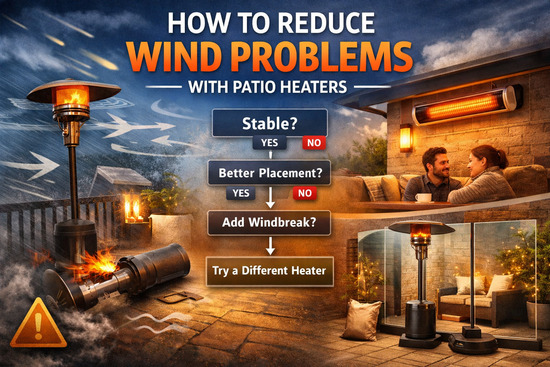
A quick decision flow for windy patios
Use this when your current setup feels weak or annoying.
Is the heater stable?
├─ No → Weight or anchor the base first
└─ Yes
    ↓
Is it in an exposed wind path?
├─ Yes → Reposition toward shelter
└─ No
    ↓
Does a windbreak make sense?
├─ Yes → Add one safely
└─ No
    ↓
Still struggling in wind?
├─ Yes → You may need a different heater style
└─ No → Setup is probably good enough
That’s the practical order: stability first, placement second, windbreak third, heater type fourth.
Common mistakes that make windy patios worse
A lot of wind problems come from the same few mistakes over and over.
1. Putting the heater in the most open spot
It may look centered, but it also gets hit from every direction.
2. Assuming more BTUs solve everything
More heat output helps, but it doesn’t stop wind from blowing warmth away.
3. Ignoring the base
People focus on the flame and reflector, but stability starts at the bottom.
4. Using flimsy screens as windbreaks
If the barrier itself becomes unstable, you’ve created another problem.
5. Using the wrong heater type for the space
Portable heaters aren’t magic. Some patios really need mounted infrared.
Quick symptom checker
| What’s happening | Most likely cause | First thing to try |
|---|---|---|
| Heater feels weak in breeze | Heat is blowing off target | Reposition closer to shelter |
| Flame keeps struggling | Direct wind exposure | Move unit out of wind path |
| Heater wobbles | Base too light or uneven surface | Fill or weight the base |
| Guests only feel heat in one chair | Heat pattern is misaligned | Re-aim or reposition seating/heater |
| Windy patio always feels disappointing | Wrong heater style | Consider mounted infrared |
Bottom line on how to reduce wind problems with patio heaters
The best way to reduce wind problems with patio heaters is usually a mix of better placement, better stability, and smarter shelter. Put the heater on a solid surface, move it out of the worst wind path, and make sure the base is weighted properly before you assume the heater itself is the problem.
Once you know how to reduce wind problems with patio heaters, the usual answer is layout first and heater upgrade second. And if your patio is windy all the time, don’t keep forcing a portable heater to do a job it’s bad at. That’s when a mounted infrared or more wind-resistant setup usually becomes the better long-term answer.