Picking an electric patio heater should be simple. You want more warmth, less hassle, and something that won’t trip a breaker every time you turn it on.
But once you start looking at specs, it gets confusing fast. One heater plugs into a normal outlet. Another needs 240V. Then you run into wattage, amperage, breaker size, wire gauge, hardwired vs plug-in, and suddenly you’re not shopping for a heater anymore — you’re trying to decode an electrical panel.
That’s what this guide is for. We’ll break down electric patio heater power requirements in normal language, show what the numbers actually mean, and help you get a realistic sense of what works for a small balcony, covered patio, garage hangout, or larger outdoor seating area.
What’s covered:
- What watts, volts, and amps actually mean
- 120V vs 240V patio heaters
- Breaker and wire size basics
- Real-world examples by heater size
- Running cost tables
- Common setup mistakes
- A quick patio heater planning checklist
The quick version
If you don’t want the full explanation yet, here’s the cheat sheet:
| Heater Type | Typical Power | Voltage | Installation Style | Best For |
|---|---|---|---|---|
| Small plug-in heater | 1200W–1500W | 120V | Standard outlet | Small patios, balconies, close-range warmth |
| Mid-size mounted heater | 2000W–3000W | 240V | Usually hardwired | Covered patios, dining zones, garages |
| Larger mounted heater | 4000W–6000W | 240V | Hardwired | Bigger outdoor living spaces, commercial setups |
Simple rule: If you want light spot heat, 120V may be enough. If you want serious patio heating, you’ll usually end up in 240V territory.
What wattage, voltage, and amperage actually mean
These three numbers tell you almost everything important about the electrical side of a patio heater.
Wattage is how much power the heater uses. In practical terms, more watts usually means more heat output. A 1500W unit is the classic “plug it in and feel some warmth” option. A 4000W or 6000W unit is more like “this is part of the patio plan.”
Voltage is the type of power supply the heater needs. In the U.S., smaller heaters often use 120V, which matches a regular household outlet. Bigger heaters often use 240V, which is more common for larger appliances and dedicated circuits.
Amperage is the amount of current the heater draws. This is the number that affects breaker size, wire size, and whether your existing circuit can safely handle the heater.
The formula is easy:
Amps = Watts ÷ Volts
So if your heater is 3000W and runs on 240V:
3000 ÷ 240 = 12.5 amps
That’s why you’ll see people talking about amperage even when the heater is sold by wattage.
A quick visual — how power demand changes
Here’s a simple look at amp draw for common 240V heater sizes:
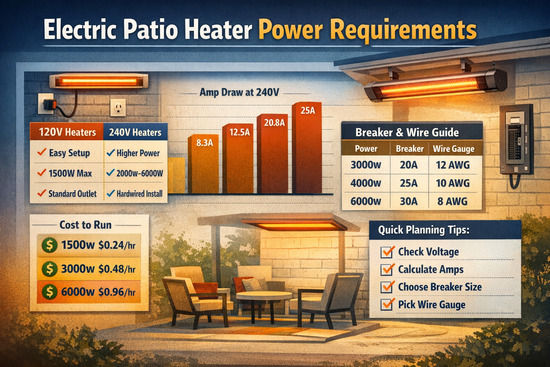
Amp draw at 240V2000W  | ████████  8.3A
2500W  | ██████████ 10.4A
3000W  | ████████████ 12.5A
4000W  | ████████████████ 16.7A
5000W  | ████████████████████ 20.8A
6000W  | █████████████████████████ 25A
The important part isn’t the bars — it’s the pattern. Once you move past 3000W, you’re no longer in “easy casual setup” territory. The electrical side starts to matter a lot more.
120V vs 240V — which one makes more sense?
This is usually the biggest practical decision.
120V heaters
These are the easiest to live with because many can plug into a normal outlet. They’re great when you want:
- light warmth near a chair or small table
- something portable
- no electrician involved
- a simple seasonal setup
The catch is that most 120V patio heaters top out around 1500W. That’s enough for close-range comfort, but not enough to make a large open patio feel warm in cold or breezy conditions.
240V heaters
These are the stronger options. Many mounted electric patio heaters in the 2000W to 6000W range use 240V because it supports higher output more efficiently.
They make more sense when you want:
- a ceiling- or wall-mounted setup
- a cleaner permanent installation
- more noticeable heat
- coverage over a dining or lounge area
Side-by-side comparison
| Feature | 120V Heater | 240V Heater |
|---|---|---|
| Setup difficulty | Easier | More involved |
| Typical output | Lower | Higher |
| Portability | Better | Usually less portable |
| Best use | Small spaces, spot heat | Bigger spaces, mounted heat |
| Outlet compatibility | Standard outlet | Dedicated 240V circuit often needed |
| Installation cost | Lower | Higher |
Quick takeaway: 120V is for convenience. 240V is for performance.
How to calculate electric patio heater power requirements
You don’t need to be an electrician to do the first-pass math.
Step 1: Find the heater wattage
Look at the spec sheet or rating label.
Step 2: Find the voltage
Usually 120V or 240V.
Step 3: Use the formula
Amps = Watts ÷ Volts
Here’s a reference table with the math already done:
| Heater Power | Voltage | Amp Draw |
|---|---|---|
| 1500W | 120V | 12.5A |
| 2000W | 240V | 8.3A |
| 2500W | 240V | 10.4A |
| 3000W | 240V | 12.5A |
| 4000W | 240V | 16.7A |
| 4500W | 240V | 18.75A |
| 5000W | 240V | 20.8A |
| 6000W | 240V | 25A |
Step 4: Leave room for proper circuit sizing
This is where people mess up. A heater’s amp draw is not automatically the breaker size you should use. In real installations, circuit sizing often includes a safety margin, which is why a 12.5A heater often ends up on a 20A circuit instead of a 15A one.
So the math gets you in the ballpark. The manufacturer instructions and local code decide the final answer.
Breaker size and wire gauge cheat sheet
This is one of the most useful tables to include because it’s what readers actually want.
| Power | Voltage | Heater Draw | Common Breaker Range | Common Wire Gauge* |
|---|---|---|---|---|
| 1500W | 120V | 12.5A | 15A | 14 AWG |
| 2000W | 240V | 8.3A | 15A | 14 AWG |
| 2500W | 240V | 10.4A | 15A–20A | 12 AWG |
| 3000W | 240V | 12.5A | 20A | 12 AWG |
| 4000W | 240V | 16.7A | 20A–25A | 10 AWG |
| 4500W | 240V | 18.75A | 25A | 10 AWG |
| 5000W | 240V | 20.8A | 30A | 10 AWG |
| 6000W | 240V | 25A | 30A | 8 AWG |
*General reference only. Final wire sizing depends on conductor type, run length, installation method, ambient conditions, and local code.
Why this table matters
The lower the AWG number, the thicker the wire. So:
- 14 AWG = smaller wire
- 12 AWG = thicker
- 10 AWG = thicker again
- 8 AWG = larger still
That’s why bigger heaters often push you into heavier wire and more serious installation work.
Real patio scenarios — what usually makes sense?
This kind of section helps the post feel more useful and less textbook-ish.
| Space Type | Typical Need | Heater Type That Usually Fits | Power Range |
|---|---|---|---|
| Small balcony | Personal warmth near one or two seats | Plug-in electric | 1200W–1500W |
| Small covered patio | Dining or loveseat zone | Compact mounted or stronger plug-in | 1500W–3000W |
| Medium covered patio | Real seating area warmth | Wall/ceiling-mounted electric | 3000W–4000W |
| Large covered patio | Multiple seating zones | Multiple mounted heaters | 4000W–6000W each |
| Open patio in windy area | Tougher heating job | Often needs more output or different layout | Usually 240V setups or multiple heaters |
A big mistake people make is expecting one small heater to “heat the whole patio.” Electric patio heaters are usually best when they provide targeted comfort, not when they’re asked to heat wide-open outdoor air like an indoor furnace.
Plug-in vs hardwired — the part that changes the whole project
The difference here is bigger than most shoppers expect.
Plug-in heaters
Plug-in heaters are easy. That’s their entire pitch. If the unit is designed for a standard outlet, setup is simple and the upfront cost is lower.
But that convenience comes with a ceiling. Most plug-in heaters stay around 1500W, because that’s about as far as a normal U.S. outlet setup comfortably goes for this kind of appliance.
Hardwired heaters
Hardwired heaters are where you go when you want more heat, cleaner looks, and a permanent setup. They’re common for ceiling-mounted and wall-mounted infrared patio heaters.
They usually mean:
- 240V power
- dedicated circuit planning
- professional installation
- better performance in real patios
Quick comparison
| Setup Type | Pros | Cons |
|---|---|---|
| Plug-in | Easy, cheap, portable | Lower output, outlet-dependent |
| Hardwired | Cleaner install, stronger heat, better for larger spaces | Higher cost, more planning, electrician usually needed |
What electric patio heaters cost to run
This is one of the easiest ways to make the post more engaging, because readers love real numbers.
Use this formula:
(Watts ÷ 1000) × electricity rate = cost per hour
Here’s what it looks like at $0.16 per kWh:
| Heater Size | kWh Per Hour | Cost Per Hour |
|---|---|---|
| 1500W | 1.5 | $0.24 |
| 2000W | 2.0 | $0.32 |
| 3000W | 3.0 | $0.48 |
| 4000W | 4.0 | $0.64 |
| 5000W | 5.0 | $0.80 |
| 6000W | 6.0 | $0.96 |
And here’s the same info as a quick visual:
Estimated operating cost at $0.16/kWh1500W  | ██████ $0.24/hr
2000W  | ████████ $0.32/hr
3000W  | ████████████ $0.48/hr
4000W  | ████████████████ $0.64/hr
5000W  | ████████████████████ $0.80/hr
6000W  | ████████████████████████ $0.96/hr
That doesn’t make electric heat “bad.” It just means bigger heaters need to be used intentionally. A 1500W heater during dinner is one thing. A 6000W heater running for hours, several nights a week, is a different budget conversation.
Common mistakes to avoid
A table works really well here too.
| Mistake | Why It’s a Problem | Better Move |
|---|---|---|
| Assuming any outlet will work | Circuit may already be loaded | Check the circuit before plugging in |
| Using a cheap extension cord | Overheating and fire risk | Plug directly into the wall if allowed |
| Buying by looks only | Nice heater, wrong power setup | Check wattage and voltage first |
| Ignoring panel capacity | New breaker may not mean enough available load | Have panel capacity reviewed |
| Expecting one heater to warm a huge patio | Unrealistic performance expectation | Use targeted zones or multiple heaters |
| Skipping clearance and outdoor rating details | Safety and weather issues | Follow the manual and installation specs |
A quick planning worksheet
This kind of section gives readers something practical to do.
Before you buy, answer these five questions:
| Question | Your Answer |
|---|---|
| Is this heater plug-in or hardwired? | |
| Does it use 120V or 240V? | |
| What is the heater wattage? | |
| How many amps will it draw? | |
| Do I have the right circuit available already? |
If you can’t answer the last question confidently, that’s usually the point where it makes sense to bring in an electrician before buying the heater.
Bottom line
Electric patio heater power requirements really aren’t that mysterious once you break them into pieces. Start with wattage, check the voltage, calculate the amp draw, and then make sure the circuit and wiring make sense for that heater. That’s the core of the decision.
The bigger practical point is this: small plug-in heaters are about convenience, while larger 240V mounted heaters are about performance. If you match the heater to the space — and don’t cheap out on the electrical side — you’ll end up with a setup that feels a lot more useful and a lot less frustrating.