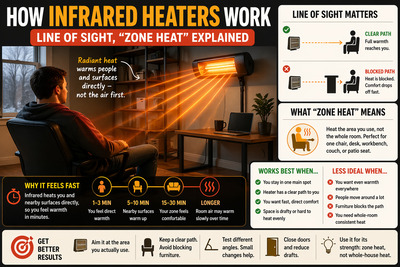
Infrared heaters seem easy to understand — until you actually use one. You turn it on, feel warm almost right away, and think, “Great, this thing works.” Then you stand up, walk across the room, and suddenly it feels cold again. That’s the part that confuses a lot of people.
The problem is that infrared heat doesn’t behave like the warm air from a ceramic or fan heater. It feels faster, more direct, and sometimes a little uneven if you don’t know what to expect. That’s why terms like line of sight and zone heat matter so much. They’re not just buzzwords — they explain why infrared can feel amazing in one setup and disappointing in another.
This guide breaks it down in plain English. We’ll cover how infrared heaters work, why placement matters so much, what “zone heat” really means, and how to tell if infrared is a smart fit for your room.
Quick answer — how do infrared heaters work?
Infrared heaters warm people and objects directly instead of mainly heating the air first. The heat travels outward in straight lines, gets absorbed by surfaces, and makes those surfaces warmer.
That’s why it often feels fast. You don’t have to wait for the entire room’s air to warm up before you feel comfortable. But it also means placement matters a lot. If the heater can’t “see” you clearly, you won’t feel the full effect.
At a glance
| Question | Short answer |
|---|---|
| Do infrared heaters heat the air first? | Not mainly — they heat people and surfaces first |
| Why do they feel fast? | You feel direct radiant warmth quickly |
| What is line of sight? | The heater works best on what it can directly “see” |
| What is zone heat? | Heating one area you use, not the entire room |
| Best use? | Desks, couches, workshops, patios, spot heating |
| Main drawback? | Heat can feel uneven if you move around or block it |
What infrared heat actually is
Infrared heat is radiant heat. The easiest way to picture it is sunlight. On a cool day, the air might still feel chilly, but if you stand in the sun, your skin and clothes warm up. That’s radiant heat at work.
An infrared heater does something similar. It sends out energy that travels through the air and gets absorbed by surfaces like:
- your body
- the floor
- a chair or couch
- walls and nearby furniture
Those surfaces warm up first. Some of that warmth can later help warm the surrounding air, but the first effect is direct comfort.
That’s the big difference between infrared and convection-style heating. A convection heater warms the air and lets that warm air spread through the room. An infrared heater sends heat where it’s pointed.
Infrared vs convection — simple comparison
| Feature | Infrared heater | Convection / ceramic heater |
|---|---|---|
| Heats first | People and objects | Air |
| Warmth feels | Fast and direct | More gradual and even |
| Best for | Spot heating | Whole-room comfort |
| Performance in drafts | Often better for direct comfort | Warm air can drift away |
| Placement sensitivity | High | Medium |
| Noise | Often quieter | Often has fan noise |
Why line of sight matters so much
This is the part most shoppers miss.
Infrared heat travels in straight lines. If the heater has a clear path to you, you feel warm. If something blocks that path, the warmth drops off fast.
That’s what line of sight means. The heater works best on what it can directly “see.”
Here’s a simple visual:
GOOD SETUP
[Heater]  -------->  [You sitting in chair]BLOCKED SETUP
[Heater]  --->  [Desk panel / coffee table]  X  [Your legs]
In real life, this shows up in small but annoying ways:
- Your upper body feels warm, but your feet stay cold under a desk
- Your chair feels cozy, but the rest of the room still feels cool
- The heater works great until you move a few feet to the side
- A coffee table or ottoman steals more heat than you expected
What line of sight looks like in practice
| Setup | What happens |
|---|---|
| Heater aimed directly at your chair | Fast personal warmth |
| Heater blocked by furniture | Weak or patchy warmth |
| Heater off to the side | One side of your body feels warmer |
| Heater too far away | You feel less direct heat |
| Heater pointed into open floor space | Wasted comfort |
If you only remember one thing from this guide, remember this: infrared comfort depends heavily on what the heater can directly reach.
What “zone heat” really means
“Zone heat” sounds like marketing language, but it’s actually pretty simple. It means heating the part of the room — or the part of the building — that you actually use.
Instead of trying to make every inch of the room equally warm, you heat the area where you sit, work, or relax.
That’s why infrared is often a good fit for:
- a home office desk
- a reading chair
- a couch corner
- a workbench
- a garage bay
- a covered patio seat
- a reception area
If you’re only using one area, it often makes more sense to warm that zone instead of spending energy trying to raise the temperature everywhere.
Zone heat examples
| Situation | Why infrared makes sense |
|---|---|
| Home office | You sit in one spot for hours |
| Workshop | You want warmth near a bench, not the whole garage |
| Covered patio | Direct warmth matters more than air temperature |
| Warehouse station | Workers stay in one zone |
| Couch corner | You want fast comfort where you sit |
Where zone heat is less ideal
| Situation | Why it may disappoint |
|---|---|
| Kids doing homework and moving around | They leave the warm zone constantly |
| Large open living room | Far side of room may stay cooler |
| Busy shared room | Comfort feels uneven from person to person |
| Whole-bedroom overnight heat | You may want more even warmth |
So no — zone heat doesn’t mean “better heat.” It means targeted heat.
Why infrared feels fast — but the room may still feel cool
This is one of the biggest misunderstandings with infrared heaters.
You feel warm quickly because the heater is warming you, not waiting to change the temperature of all the air first. That’s a real advantage. If you’re sitting in front of one, it can feel comfortable much faster than a heater that’s trying to warm the whole room evenly.
But here’s the catch: the room itself may still feel cool, especially in corners or farther away from the heater.
A simple comfort timeline
| Time after turning it on | What you may notice |
|---|---|
| 1-3 minutes | You feel direct warmth in front of the heater |
| 5-10 minutes | Nearby surfaces start feeling warmer |
| 15-30 minutes | Your immediate area feels more comfortable |
| Later on | Some room air may feel warmer, but not always evenly |
That’s why people sometimes say, “It works, but only when I’m right in front of it.” That isn’t a flaw — it’s just how infrared works.
If you want whole-room air warmth, convection is often easier to live with.
If you want fast comfort where you sit, infrared can be the better fit.
Where infrared heaters work best — and where they don’t
Infrared heaters work best when your comfort needs are predictable.
Best use cases
| Space | Good fit? | Why |
|---|---|---|
| Desk / home office | Yes | One person, one position, easy to aim |
| Couch / reading chair | Yes | Strong zone-heating use case |
| Workshop / garage station | Yes | Good for spot comfort in drafty spaces |
| Covered patio | Yes | Direct radiant warmth helps outdoors |
| Small bedroom corner | Sometimes | Good for one area, not always whole-room comfort |
| Open living room | Mixed | Can help, but may feel uneven |
| Large room with constant movement | No | Warmth won’t follow people around |
Infrared is usually strongest when:
- you stay in one main spot
- you want warmth quickly
- the heater has a clear path
- the space is drafty or hard to heat evenly
It’s usually weaker when:
- you want even warmth everywhere
- multiple people need equal comfort
- furniture blocks the path
- you move around a lot
How to get better results from an infrared heater
A lot of “bad infrared heater” complaints are really bad placement complaints.
Here’s how to make one work better.
Placement checklist
| Do this | Why it helps |
|---|---|
| Aim it at the area you actually use | Direct heat is the whole point |
| Keep a clear path to your body | Blocks reduce effectiveness |
| Test different angles | Small changes make a big difference |
| Close doors if possible | Helps keep your zone more comfortable |
| Use it for one area, not the whole house | Better expectations = better results |
Common mistakes
| Mistake | Result |
|---|---|
| Pointing it into empty floor space | You waste most of the benefit |
| Setting it too far away | Direct warmth weakens |
| Blocking it with furniture | Patchy comfort |
| Using it like central heat | Disappointment |
| Expecting silent whole-room heating from a tiny unit | Unrealistic results |
A simple example: if you work at a desk all day, place the heater where it can reach your legs and torso without the desk panel blocking the beam. That one change often matters more than buying a bigger unit.
Quick decision guide — is infrared right for you?
Use this simple chart:
| If you want… | Infrared a good choice? |
|---|---|
| Fast warmth at one chair or desk | Yes |
| Quiet spot heating | Yes |
| Heat in a drafty workspace | Often yes |
| Whole-room warmth for a family room | Usually not the best |
| Heat that feels the same everywhere | No |
| Warmth that follows you as you move around | No |
If your goal is “make my seat comfortable”, infrared often makes sense.
If your goal is “make the whole room evenly warm”, you’ll usually be happier with convection heat.