If you’ve ever had a patio heater shut off halfway through dinner or right when people finally got comfortable, you already know why this question matters. Nobody wants to guess whether a tank will make it through the night.
The problem is that most answers online are either too vague or too technical. You’ll see “about 10 hours,” which is helpful, but it doesn’t explain why one tank sometimes lasts one evening and sometimes lasts two.
This guide makes it simple. You’ll get the quick answer, the easy runtime math, and the real-world factors that make a propane tank last longer or burn out faster.
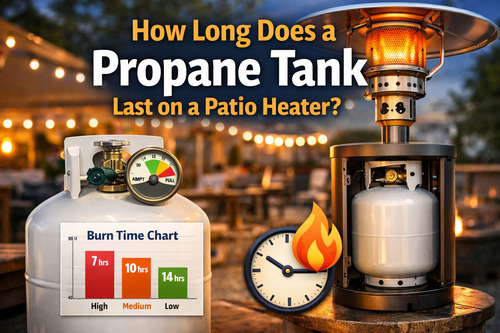
Quick answer: A standard 20 lb propane tank usually lasts about 9 to 10 hours on high with a typical full-size patio heater. In lighter use, it can stretch to 12 to 15 hours.
At a glance
| Tank size | Typical patio heater output | Estimated runtime |
|---|---|---|
| 20 lb | 40,000 BTU | 10.8 hours |
| 20 lb | 46,000 BTU | 9.3 hours |
| 20 lb | 50,000 BTU | 8.6 hours |
| 30 lb | 40,000 BTU | 16.1 hours |
| 30 lb | 46,000 BTU | 14.0 hours |
That’s the fast version. If your heater is a classic freestanding propane model in the 40,000 to 46,000 BTU range, a full 20 lb tank usually gets you through one long evening.
The simple math behind patio heater runtime
A standard 20 lb propane tank holds roughly 4.7 gallons of propane, which works out to about 430,000 BTUs of potential energy.
If your patio heater burns 40,000 BTUs per hour, the basic estimate looks like this:
430,000 ÷ 40,000 = 10.75 hours
That’s why the “about 10 hours” answer shows up so often. It’s not random — it comes from the math.
But that number is still an estimate, not a guarantee. Real runtime changes based on heater setting, wind, outside temperature, and how full the tank actually is.
Runtime chart — 20 lb propane tank
| Heater output (BTU) | Approx. runtime |
|---|---|
| 10,000 | 43.0 hours |
| 20,000 | 21.5 hours |
| 30,000 | 14.3 hours |
| 40,000 | 10.8 hours |
| 46,000 | 9.3 hours |
| 50,000 | 8.6 hours |
Quick visual
Approximate hours from one 20 lb tank
50,000 BTU | ████████ 8.6h
46,000 BTU | █████████ 9.3h
40,000 BTU | ███████████ 10.8h
30,000 BTU | ██████████████ 14.3h
20,000 BTU | █████████████████████ 21.5h
This is a simple way to show the tradeoff: more heat usually means less runtime.
Why one tank doesn’t always last the same amount of time
This is where the real-world part comes in. Two people can own similar patio heaters and get very different tank life.
1. High heat burns fuel fast
Most people remember the heater size but forget the setting. If your heater has adjustable output, it won’t use propane at the same rate all night.
Run it on high the whole time, and you’ll get the shortest runtime. Run it on medium once people are warm, and the same tank can last noticeably longer.
2. Wind is one of the biggest tank killers
Wind pushes heat away from people and furniture, so the heater has to work harder to keep the area comfortable. That often means you turn the heater up higher or leave it on longer.
A sheltered patio can make the same heater feel much more effective than an exposed one.
3. Cold weather changes expectations
A cool fall evening and a freezing winter night are not the same job. Patio heaters are trying to warm an outdoor zone, not a sealed room, so colder weather usually means faster propane use.
4. Dirty or worn heaters waste efficiency
If the burner, igniter, or connections are dirty or corroded, you may get weaker heat for the same fuel. That doesn’t just hurt comfort — it can make tank life feel worse too.
5. Not every tank starts equally full
A “20 lb tank” refers to capacity, but exchanged or refilled tanks don’t always give you identical usable fuel every time. That’s another reason one tank might seem to last longer than another.
What affects propane tank life the most?
| Factor | Makes tank last longer | Makes tank last shorter |
|---|---|---|
| Heat setting | Low to medium output | High output all night |
| Weather | Mild, calm evenings | Cold, windy conditions |
| Patio layout | Sheltered, partially enclosed sides | Open, exposed spaces |
| Heater condition | Clean burner, good maintenance | Dirty, corroded, poorly maintained |
| Tank fill level | Full refill | Partial refill or underfilled exchange |
| Heater size | Lower BTU model | Higher BTU model |
That table alone makes the post easier to skim. It also helps readers understand why there isn’t one perfect answer.
Cost per hour — what running a propane patio heater really costs
Runtime is one thing. Cost is the other question people usually care about.
If a 20 lb tank costs about $15 to refill or exchange and lasts around 10.8 hours on a 40,000 BTU heater, the cost works out to roughly:
$15 ÷ 10.8 = about $1.39 per hour
Estimated operating cost
| Tank refill cost | Heater output | Approx. runtime | Approx. cost per hour |
|---|---|---|---|
| $15 | 40,000 BTU | 10.8 hours | $1.39/hr |
| $18 | 40,000 BTU | 10.8 hours | $1.67/hr |
| $15 | 46,000 BTU | 9.3 hours | $1.61/hr |
| $18 | 46,000 BTU | 9.3 hours | $1.94/hr |
That makes propane patio heat pretty easy to budget. For a typical evening, you’re usually looking at something like $5 to $10 of fuel, depending on how long you run it and how hard the heater works.
Event planning cheat sheet
This is the kind of section that makes the post more useful immediately.
| Event length | 40,000 BTU heater | 46,000 BTU heater | Practical advice |
|---|---|---|---|
| 2 hours | 1 tank is plenty | 1 tank is plenty | No worries |
| 4 hours | 1 tank is plenty | 1 tank is plenty | Still comfortable |
| 6 hours | 1 tank should cover it | 1 tank should cover it | Best with full tank |
| 8 hours | 1 tank is usually enough | 1 tank is close | Have backup ready |
| 10+ hours | 1 tank may not be enough | 1 tank likely not enough | Keep spare tank nearby |
For homeowners, that means a single tank is often enough for dinner, drinks, and a long evening outside. For parties or commercial use, a second tank is smart insurance.
How to make a propane tank last longer
You can’t magically add fuel to the tank, but you can get more useful heat out of it.
Put the heater in a better spot
If your patio heater is sitting in a windy, exposed corner, it’s wasting heat. Moving it to a more sheltered position can make a surprisingly big difference.
Don’t run it on high the whole night
A lot of people use max heat to get warm fast, then forget to turn it down. Once the area feels comfortable, medium output often does the job.
Start with a truly full tank
This sounds obvious, but it matters. If you’re planning a longer evening, don’t start with a tank that might already be half-used.
Keep the heater clean
A patio heater with a clean burner and good airflow tends to perform better. Better performance means less frustration and more useful heat from the fuel you’re buying.
Keep a spare tank ready
This doesn’t change how long one tank lasts, but it completely changes the user experience. It turns an interruption into a 2-minute tank swap instead of the end of the night.
When a bigger tank or different fuel setup makes sense
For occasional home use, a standard 20 lb propane tank is usually the sweet spot. It’s easy to handle, easy to refill, and works with most freestanding propane patio heaters.
But if you use your heater often, there are cases where a different setup makes more sense.
A 30 lb tank makes sense if:
- you run long events regularly
- you hate swapping tanks
- your heater setup supports it safely
Natural gas makes sense if:
- the heater is installed in one permanent spot
- you use outdoor heat often
- you want continuous fuel without tank swaps
Propane is still the better choice for portability. Natural gas is better if you want “set it and forget it” fuel supply.
Propane patio heater safety — the non-negotiables
A patio heater is convenient, but it still deserves some respect.
Do:
- keep propane tanks upright
- check hoses and connections regularly
- follow the manufacturer’s clearance requirements
- use the heater only in appropriate outdoor setups
- keep a little extra space between the heater and furniture, curtains, or umbrellas
Don’t:
- store spare tanks right next to the heater
- use damaged hoses or leaking fittings
- guess about covered-patio clearance
- assume every patio heater is safe in every outdoor structure
- keep running the heater if you smell gas
Safe storage quick-reference
| Item | Best practice |
|---|---|
| Spare propane tank | Store upright outdoors in a ventilated area |
| Tank location | Away from direct heat and open flame |
| Heater clearance | Follow manual exactly |
| Covered patio use | Only if manufacturer allows it |
| Smell of gas | Shut off heater immediately and inspect |
Bottom line
For most full-size patio heaters, a standard 20 lb propane tank lasts about 9 to 10 hours on high. That’s the planning number most people should use.
The bigger point is this: tank life is not just about tank size. It is shaped by BTU rating, weather, placement, heat setting, and heater condition. If you want the simplest real-world advice, use a full tank, keep the heater out of the wind, turn it down once people are warm, and keep a spare ready for longer nights.