This infrared heater safety guide is for people who want clear, practical rules — not vague advice and not over-the-top warnings. Infrared heaters can be a great way to get fast, focused warmth, but they also raise real questions about clearance, overnight use, cords, pets, kids, garages, patios, and where things can go wrong.
That’s where people get stuck. One article says infrared heaters are perfectly safe. Another makes them sound like a disaster waiting to happen. The truth is less dramatic than both. Most problems come down to placement, clutter, poor power setup, and using the wrong heater in the wrong space.
This guide keeps it simple. We’ll cover how infrared heaters behave, what actually makes them safe or unsafe, and the habits that matter most in real rooms, garages, and outdoor setups. No scare tactics. No fake “totally safe in every situation” claims. Just the stuff that helps you use one sensibly.
Infrared heater safety guide — what matters most?
Yes, infrared heaters can be safe when they’re used the way they were designed to be used.
What makes them different is how they heat. Instead of mainly warming the air, they send radiant heat outward to people and surfaces. That’s why they feel fast and focused. It’s also why placement matters so much.
A fan heater can still be risky, of course, but infrared heaters make one thing especially important: what sits in the radiant path. If that’s your chair, great. If that’s a curtain, cardboard box, towel, pet bed, or pile of garage clutter, that’s where trouble starts.
Quick safety summary
| Question | Real answer |
|---|---|
| Are infrared heaters safe indoors? | Yes, if they’re used with proper clearance and on the right surface or mount |
| Do they produce carbon monoxide? | Electric ones don’t |
| Can they start a fire? | Yes, if they’re too close to flammable materials or used badly |
| Are they safe overnight? | Sometimes, but only with a controlled setup |
| Are they safer than open-flame patio heaters? | Usually yes, but they still need proper distance and installation |
| Is the main risk the heater itself? | Usually no — it’s poor placement, bad cords, clutter, or misuse |
Infrared heater safety rules that actually matter
If you only remember a few things from this infrared heater safety guide, make it these.
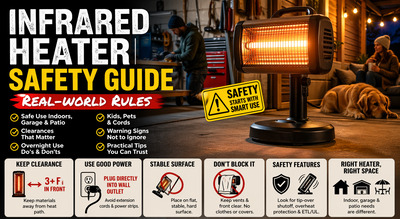
First, keep clear space around the heater. For many portable electric models, the usual rule is at least 3 feet in front, with breathing room around the sides and top. Some wall and ceiling units have different rules, so the manual always wins. The general idea is simple: nothing soft, flammable, or heat-sensitive should sit in the radiant path.
Second, plug portable heaters directly into a wall outlet. Don’t use a cheap extension cord. Don’t use a crowded power strip. High-wattage heaters pull a lot of power, and weak cords are where sketchy setups start.
Third, put portable units on a stable, hard surface. Not on bedding. Not half-on a rug edge. Not balanced on a box in the garage. If it can wobble, slide, or get bumped over, fix that before you turn it on.
Fourth, don’t block the heater. That includes laundry draped nearby, towels, covers, plastic bins, and random garage clutter. Infrared heaters look simple, so people get casual around them. That’s usually the mistake.
Finally, buy models with safety basics built in — tip-over shutoff for portable units, overheat protection, and proper certification marks for your market.
Core safety rules
| Rule | Why it matters |
|---|---|
| Keep clear space around the heater | Radiant heat can overheat nearby fabrics, paper, plastic, and furniture |
| Plug portable units directly into the wall | Extension cords and power strips are common weak points |
| Put portable heaters on a stable, hard surface | Prevents tipping, wobbling, and accidental contact |
| Don’t block the heater or radiant path | Blocked heat can create hot spots or overheating |
| Buy certified models with safety features | Tip-over shutoff and overheat protection reduce risk |
| Follow the manual for clearances and mounting | Different heater types have different safe distances |
Why infrared heaters get people into trouble
Most heater problems come from normal-looking mistakes.
People see a quiet heater with no flame and assume it’s automatically low-risk. That’s where the false confidence starts. Infrared heat feels clean and simple, but it still hits surfaces directly. That matters more than people realize.
Another issue is using the heater for the wrong job. A small personal infrared heater might be fine near a desk or chair, but not for trying to warm a whole cold garage. When it underperforms, people start dragging it closer to themselves, closer to shelves, or closer to random stuff in the room. That shrinking distance is where safety margins disappear.
Then there’s the “temporary” habit problem. Temporary extension cord. Temporary spot in front of a curtain. Temporary use beside laundry. Temporary overnight run. A lot of heater accidents start with “just for now.”
Common mistake chart
Higher bar = higher risk
Plugged into wall outlet only           █
On stable hard floor                    █
Proper wall/ceiling mount               █
Near furniture or curtains              ████
Used in cluttered garage corner         █████
Running overnight beside bedding        ██████
Used with extension cord/power strip    ███████
Covered, blocked, or partly enclosed    ████████
That chart is blunt, but it matches reality pretty well. The biggest danger usually isn’t infrared heat itself. It’s bad habits around a heater.
Infrared heater safety in bedrooms, garages, and patios
This is where people often make bad assumptions. A heater that’s fine in one setting may be a bad fit in another.
Best practices by location
| Location | Usually okay? | Main risk | Safer move |
|---|---|---|---|
| Bedroom | Yes, with care | Bedding, curtains, overnight use | Fixed unit or well-cleared portable with thermostat |
| Living room | Yes | Furniture, rugs, kids, pets | Keep a clear zone and don’t aim at upholstery up close |
| Home office | Yes | Tight desk setups, paper clutter | Keep cords neat and heater out of leg traffic |
| Garage | Depends | Cardboard, chemicals, rags, clutter | Heat a work zone, not storage shelves |
| Covered patio | Yes, if outdoor-rated | Wrong IP/weather rating, bad mounting | Use a heater rated for outdoor or damp conditions |
| Bathroom | Only if rated for it | Water and incorrect placement | Use only units approved for bathroom or wet-area use |
Indoor use
Electric infrared heaters are often simplest indoors. Bedrooms, offices, workshops, and living spaces can all work well. The main thing is keeping the heater away from soft furnishings, curtains, and clutter.
Garage use
Garages are more complicated. The problem usually isn’t just the heater — it’s what’s around it. Boxes, fuel, solvents, hanging coats, cleaning rags, plastic bins, and random junk all make the space less forgiving. If you use infrared heat in a garage, keep the heated zone cleaner than you think you need to.
Patio use
Outdoor and covered patio use needs the right heater type. A unit that isn’t rated for damp or outdoor conditions does not become safe just because it’s under a roof. Covered patio still counts as an outdoor-style environment in practical terms.
Can you leave an infrared heater on overnight?
This is the question people care about most, and the honest answer is: sometimes, but don’t get casual about it.
A heater being able to run for hours is not the same as saying it’s smart to leave it going all night in a crowded room. Overnight use raises the stakes because nobody is actively watching the setup.
Portable units are the biggest concern here. They can be bumped, covered, placed too close to bedding, or used on bad power connections. Fixed wall or ceiling-mounted infrared heaters with thermostatic control are usually a better overnight option than a portable unit parked near the bed.
If you do use one overnight, stack the odds in your favor. Use a model with overheat protection, tip-over protection if it’s portable, a thermostat or timer, and lots of clearance. Keep the floor area around it empty. Never run it through an extension cord. Never dry clothes on it or near it. And don’t aim it directly at bedding.
Overnight use checklist
| Question | If yes | If no |
|---|---|---|
| Does it have overheat protection? | Better | Don’t use overnight |
| Is it portable with tip-over shutoff? | Better | Higher risk |
| Is it plugged directly into the wall? | Good | Fix that first |
| Is it well away from bedding and curtains? | Good | Don’t run it overnight |
| Is there open space around it? | Good | Clear the area |
| Is it controlled by thermostat or timer? | Better | Less ideal |
| Is it acting perfectly normal with no odor or hot plug? | Better | Stop using it |
The safe version of overnight use is boring. Stable. Clear. Uncrowded. Controlled. If your setup doesn’t look boring, it’s probably not the setup you want to trust while sleeping.
Kids, pets, and bathroom safety
A heater can be perfectly fine in an adult-only room and a bad idea in a busy family space.
Kids may touch the front grill, brush against it, or drag things near it. Pets may treat it like the best sleeping spot in the house. That matters because even without open flame, surfaces and nearby materials can get hot enough to burn skin or cause trouble over time.
Bathrooms are another place where people guess instead of checking. Some infrared heaters are suitable for bathroom use, but only if they have the right IP rating and are installed in the correct zone. A normal indoor heater should not just be dragged into a damp bathroom because the room feels cold.
Family-home safety table
| Situation | What goes wrong | Better option |
|---|---|---|
| Dog sleeps in front of heater | Too much close heat, accidental contact | Use a higher-mounted unit or barrier |
| Child plays near portable unit | Touch burns or tip-over risk | Keep heater out of reach or use wall-mounted style |
| Heater in walkway | Someone brushes into it or trips on cord | Move it out of traffic |
| Blanket or pet bed nearby | Fabric warms too much | Keep the surrounding area empty |
| Heater under desk with clutter | Paper, cables, or fabric get too warm | Clear the area and reduce crowding |
If you’ve got kids or pets, the safest heater is usually not the one sitting low and open on the floor.
The biggest mistakes people make
Here’s the fast version of what not to do.
Do this / Don’t do this
| Do | Don’t |
|---|---|
| Keep a generous clearance zone | Cram it beside furniture |
| Plug directly into the wall | Use extension cords or power strips |
| Use the right heater for the room | Force a small heater to do a whole-room job |
| Follow the manual for mounting | Guess at safe distances |
| Clean dust off regularly | Ignore strange smells and keep using it |
| Use outdoor-rated models outside | Bring an indoor unit onto a patio |
| Keep garages tidy around the heated zone | Aim heat at cardboard, plastic, or stored chemicals |
Most of this comes down to one question: are you asking the heater to do its job, or are you asking it to compensate for a messy setup?
If it’s the second one, that’s where risk starts climbing.
Warning signs you shouldn’t ignore
A heater usually gives you clues before it becomes a serious problem.
A mild smell during first use can be normal. Dust and manufacturing residue can burn off. That should go away quickly. But a strong plastic smell, ongoing burning odor, unusually hot plug, hot wall outlet, repeated breaker trips, flickering, or odd cycling behavior are not things to shrug off.
Warning signs table
| Warning sign | What it may mean | What to do |
|---|---|---|
| Burning plastic smell | Overheating part or wiring issue | Unplug immediately |
| Very hot plug or outlet | Poor connection or overload | Stop using it and check the circuit |
| Repeated breaker trips | Circuit overload or internal fault | Don’t keep resetting and retrying |
| Visible scorching or discoloration | Overheating | Retire the heater |
| Strange new noise | Internal wear, dust, fan issue | Inspect before reuse |
| Heater shuts off constantly | Overheat protection activating | Check airflow, dust, and placement |
A heater that still powers on is not automatically a heater you should trust.
A simple way to think about infrared heater safety
A good setup usually looks like this:
- the heater has room around it
- it’s on the right outlet or correctly mounted
- it’s being used in the right type of space
- there’s nothing soft, flammable, or messy in its path
- it’s behaving normally every time you use it
That’s really it.
People often make heater safety sound more technical than it needs to be. In real life, the smartest setups are the ones that remove variables. Less clutter. Less improvising. Less “this should probably be fine.”
Bottom line
This infrared heater safety guide really comes down to one idea: the setup matters more than the marketing. Infrared heaters are not automatically dangerous, and they are not automatically foolproof either. They are usually safest when the setup is simple — enough clearance, the right heater for the room, no weak cords, no clutter in the radiant path, and no weird behavior from the unit itself.
So don’t judge safety by how quiet the heater is or by the fact that there’s no visible flame. Judge it by the setup. If the setup is clean, stable, and boring, you’re usually in good shape. If it involves crowded furniture, garage clutter, extension cords, bedding, or “just for tonight” shortcuts, that’s where risk starts climbing.