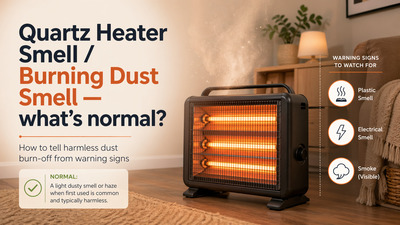
You switch on your quartz heater, the elements start glowing, the room begins to warm up — and then you notice that smell.
That’s when a simple heating fix suddenly feels a lot less simple. Is it just dust burning off after months in storage? Is something overheating? Or is the heater trying to tell you it’s done?
In many cases, the answer is harmless. A light dusty smell on first use is common, especially after the heater has been sitting in a closet, garage, or spare room for months. Still, not every burning smell is a “wait it out” situation. Plastic, rubber, or electrical odors are a different story.
This guide breaks it down in plain English. You’ll learn what a normal first-use odor is like, how long it should last, which warning signs matter, and what you can safely check at home before deciding whether to keep using the heater or replace it.
Quartz heater smell: quick answer
If the odor is mild, dusty, and fades as the heater runs, that’s usually normal. In most cases, it’s just dust burning off the heating area or reflector after storage.
However, if the smell is sharp, plastic-like, electrical, or smoky — or if it hangs around for much longer than expected — stop using the heater and inspect it. A normal first-use smell should improve fairly quickly, not get worse.
Why a quartz heater smell is common on first use
Quartz heaters heat up fast. That quick response is exactly why people like them. You turn one on, the tubes or elements get hot almost immediately, and you feel warmth right away.
Because of that, dust and lint get noticed fast too.
If the heater has been sitting unused since last winter, fine dust can settle inside the grille, on the reflector, and around the heating area. Once the unit heats up again, that dust burns off and creates the smell people usually describe as “burning,” even though it’s often just dry dust burn-off.
This happens more often if the heater was stored in places like:
- a garage
- a closet with dust buildup
- a basement
- near pet hair, rugs, or fabric lint
- a room where it sat untouched for months
A new unit can also give off a mild first-use odor. In that case, it may be leftover manufacturing residue or a protective coating burning away during the first few runs.
So yes, it’s very possible for a heater to smell a bit at startup without anything being wrong.
What a normal burning dust smell is like
A normal first-use smell is usually pretty easy to recognize once you know what to expect. It tends to smell like warm dust, dry air, or slightly hot metal. It may seem a little harsh at first, but it should not smell like melting plastic, burnt rubber, or overheated wiring.
More importantly, it should fade.
That’s the part that matters most. A harmless dust burn-off smell usually starts soon after you switch the heater on, then gradually gets lighter as the unit keeps running. In a typical room, it may be mostly gone within 10 to 30 minutes. In a dustier setup — or with a brand-new heater — it can take a bit longer.
Here’s a simple comparison:
| Sign | Usually normal | More concerning |
|---|---|---|
| Starts on first use after storage | Yes | Sometimes |
| Smells dusty or slightly metallic | Yes | Not usually serious alone |
| Fades as the heater runs | Yes | No |
| Comes back every time for days | No | Yes |
| Smells like plastic or wiring | No | Yes |
| Plug or outlet gets hot | No | Yes |
| Visible smoke continues | No | Yes |
| Buzzing, flickering, or odd shutdowns | No | Yes |
If the smell gets weaker, that’s a good sign. If it gets sharper, heavier, or more chemical, treat it differently.
How long should the burning dust smell last?
This is where people often start to worry too early — or wait too long.
A mild dusty smell does not have to disappear in two minutes. If the heater sat unused for months, some odor at startup is expected. On the other hand, it should not still smell strong hours later.
A practical timeline looks like this:
0–5 min      strongest for many heaters
5–15 min     should already be fading
15–30 min    often light by now
30–60 min    possible with a dusty or brand-new unit
60+ min      no longer typical if still strong
As a rule of thumb:
- 10 to 30 minutes — usually normal
- up to 1 hour — still possible if the unit was dusty or brand-new
- longer than that — start treating it as a problem
Also, if the same smell shows up every single day, it is no longer just “first-use dust.”
Common causes behind the smell
Not every odor comes from the same source. Here are the most common ones.
Dust burning off
This is the classic cause. Dust settles on the hot parts during the off-season, then burns away once the heater is running again.
What it smells like: dry, dusty, a bit harsh
What usually happens: strongest at startup, then fades
What to do: ventilate the room and monitor it for a short run
New-heater odor
A brand-new quartz heater can smell slightly odd during the first few uses. That does not automatically mean it is defective.
What it smells like: mild appliance or coating smell
What usually happens: fades after a few runs
What to do: run it briefly in a ventilated room while staying nearby
Lint, pet hair, or debris buildup
Because many portable heaters sit low to the floor, they collect lint, fuzz, pet hair, and all the small debris that builds up around baseboards and rugs.
What it smells like: stronger dust smell, sometimes a bit nasty
What usually happens: may keep returning until cleaned
What to do: unplug, cool down, and vacuum the grille carefully
Foreign object near the hot area
Sometimes the issue is not the heater itself. A tag, thread, bit of packaging, or lightweight fabric can get too close and start heating up.
What it smells like: plastic, fabric, or something sharper than dust
What usually happens: stronger smell, sometimes a bit of visible haze
What to do: unplug immediately and inspect the area
Hot plug, outlet, or wiring
This is where things move out of normal territory.
What it smells like: acrid, electrical, or plastic-like
What usually happens: plug may feel hot, heater may buzz, outlet may look discolored
What to do: stop using the heater immediately
Here’s the quick version:
| Cause | Smell profile | Usually safe? | Best next step |
|---|---|---|---|
| Dust on heater | Dry, dusty, mild burnt smell | Usually yes | Brief monitored run |
| New unit residue | Mild appliance smell | Usually yes | Ventilate and retest |
| Pet hair / lint | Stronger dusty odor | Usually yes if cleaned | Vacuum and clean |
| Damp storage | Musty, stale smell | Usually | Clean and air out |
| Foreign object | Odd burning smell | No | Unplug and inspect |
| Plug / wiring issue | Sharp electrical or plastic smell | No | Stop using immediately |
Quartz heater smell warning signs to watch for
A few signs should move you from “monitor it” to “unplug it now.”
Stop using the heater right away if:
- it smells like melting plastic or rubber
- the plug or outlet gets unusually hot
- you see ongoing smoke, not just a quick dusty puff
- the smell gets stronger instead of fading
- the heater buzzes, crackles, or flickers
- it trips a breaker
- the odor returns every time, even after cleaning
- the unit has been dropped, damaged, or stored badly
This is where people sometimes convince themselves everything is fine because “heaters smell sometimes.” They do — but only up to a point. A dusty startup smell is one thing. A heater that smells like hot wiring every time it runs is another.
Safe checks you can do at home
You do not need to take the heater apart to do the most useful checks.
| Check | Safe to do yourself? | What to look for |
|---|---|---|
| Unplug and cool down | Yes | Always first step |
| Inspect plug and cord | Yes | Cracks, scorching, discoloration, hot spots |
| Check outlet | Yes | Heat, looseness, burn marks |
| Vacuum the grille | Yes | Dust, lint, pet hair |
| Look around the heater | Yes | Curtains, paper, tags, fabric, debris |
| Test briefly with ventilation | Yes | Does the smell improve or get worse? |
| Open the housing | Usually no | Better avoided unless the manual allows it |
A simple step-by-step approach works best:
1. Unplug the heater and let it cool fully
Do not inspect anything while it is still hot.
2. Check the plug and cord
If the plug smells burnt, looks brown, or feels damaged, stop there.
3. Vacuum the front grille and exterior vents
A brush attachment helps loosen dust without pushing it farther inside.
4. Make sure the unit is on a hard, clear surface
Keep it away from rugs, curtains, bedding, and paper.
5. Plug it directly into the wall
Avoid extension cords and power strips while troubleshooting.
6. Test it for 10 to 15 minutes in a ventilated room
If the smell fades, dust was probably the cause. If it turns sharper or more chemical, unplug it.
How to prevent the smell next season
A little upkeep makes a big difference here.
| What to do | Why it helps |
|---|---|
| Clean the heater before storage | Less dust burns off next season |
| Store it in a dry place | Reduces musty odor and moisture issues |
| Vacuum the grille before first use | Cuts down on lint and pet hair buildup |
| Run it briefly in a ventilated room at season start | Burns off light dust before regular use |
| Keep the area around it clean | Less debris gets pulled into the heater |
| Plug directly into the wall | Reduces overheating risk at the plug |
A good habit is to clean the unit before putting it away and again before the first startup of the season. That alone solves a surprising number of odor complaints.
Bottom line on quartz heater smell
A heater that smells dusty on first use is not automatically a problem. In many cases, it is just short-lived dust burn-off after storage, and the smell clears on its own. If the odor fades within 10 to 30 minutes — or at least keeps improving — that is usually a reassuring sign.
What is not reassuring is a sharp plastic, electrical, or persistent smell. If the plug gets hot, the outlet smells burnt, or the odor sticks around long after startup, stop using the unit. Clean it, test it once carefully, and if it still smells wrong, replace it. That is usually the safer move — and the smarter one.