Infrared vs radiant vs quartz heaters can look like three completely different categories when you’re shopping online. One product page says infrared, another says radiant, and another says quartz — and before long it feels like you need a glossary just to buy a heater for a bedroom, garage, patio, or office.
That’s where the confusion starts. Sometimes those labels do point to real differences. Other times they’re describing the same heater from different angles. That’s why two models can look almost identical, yet one is marketed as a quartz heater, another as an infrared heater, and a third as a radiant heater.
This guide clears that up in plain English. We’ll look at what each label actually refers to, where they overlap, and what they tell you in real life about heat feel, warm-up speed, room coverage, and best use cases. No marketing fluff — just the part that helps you figure out what you’re actually buying.
Quick answer
Before getting into the details, here’s the simplest version:
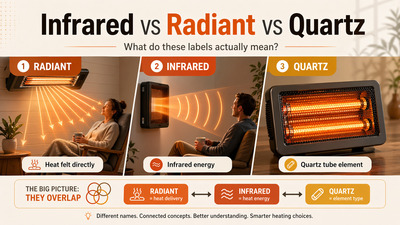
- Radiant describes how heat is delivered
- Infrared describes the type of heat energy being used
- Quartz usually describes the element design
That means one heater can be radiant, infrared, and quartz at the same time.
Infrared vs radiant vs quartz heaters at a glance
| Label | What it really describes | What it tells you | What it does not tell you |
|---|---|---|---|
| Radiant | Heat transfer method | The heater warms people and objects directly | What element is inside |
| Infrared | Type of heat energy | The heater uses infrared heat | Whether it has quartz tubes or a fan |
| Quartz | Element construction | The heater likely uses quartz tubes or lamps | Whether it’s best for whole-room heating |
Why these labels get confusing
The reason this gets messy is that the labels describe different layers of the same product.
A heater might be called:
- radiant because it sends heat outward directly
- infrared because that direct heat is infrared energy
- quartz because the element sits inside a quartz tube
So when you see something described as an “infrared quartz radiant heater,” that’s not automatically wrong. It’s just stacking multiple descriptions into one product title.
The real problem is that product pages often make these terms sound bigger and more separate than they really are. For shoppers, the result is a lot of unnecessary confusion.
What does radiant mean?
Start with the broadest term: radiant.
A radiant heater warms people and objects directly instead of relying mostly on warming the surrounding air first. The easiest comparison is sunlight on a cold day. The air may still feel chilly, but your skin feels warm because the heat is hitting you directly.
That’s the core idea behind radiant heat. It feels fast, directional, and best suited for zones where you want warmth in a particular area rather than evenly heating every corner of the room.
This is why radiant heaters tend to work well in places like:
- garages
- workshops
- patios
- covered decks
- desk areas
- reading chairs
The catch is that radiant heat can feel great right away, then underwhelming if you expect it to behave like central heating. Once you move out of the heat path, the room may still feel cool.
So the important takeaway is simple: radiant tells you how the heat reaches you. It does not tell you what kind of element is inside the heater.
What does infrared mean?
Now let’s move to infrared.
Infrared refers to the type of heat energy being emitted. It’s still radiant heat — just more specifically, radiant heat in the infrared range.
In everyday shopping, this is why infrared and radiant often point to a very similar user experience. Both usually mean you’ll feel warmth more directly on your body or on nearby objects, rather than waiting for the whole room’s air to warm up first.
In plain English:
- Radiant tells you the method of heat transfer
- Infrared tells you the kind of energy doing the heating
For most buyers, that technical distinction matters less than marketers make it sound.
Infrared heaters are popular because they often:
- feel warm quickly
- work well for spot heating
- perform better outdoors than fan-only room heaters
- create that “heat on your skin” feeling right away
That said, not every infrared heater feels the same. Some are strongly directional, like patio or bar heaters. Others combine infrared elements with a fan, so they also move warmed air around the room. That’s where product labels start to blur together.
What does quartz mean?
Quartz is the label that confuses people the most, because it usually refers to the heater’s construction, not the overall heating experience.
In many quartz heaters, the heating coil sits inside a quartz tube. That tube handles high heat well and helps the heater warm up quickly. So when a product says quartz heater, it usually means quartz tubes or quartz lamps are part of the design.
That’s the key point: quartz is often a type of infrared heater, not a separate universe of heater technology.
So a single heater can be:
- radiant because it sends heat directly outward
- infrared because it emits infrared energy
- quartz because the element is inside a quartz tube
A classic example is a ceiling-mounted patio heater with glowing tubes. That unit is usually quartz, infrared, and radiant all at once.
Another example is an indoor cabinet-style heater with quartz tubes plus a fan. It may still be sold as an infrared quartz heater, but the fan changes the experience. Some of the warmth comes from circulated air, not just direct radiant heat.
That’s why quartz doesn’t automatically mean better, more powerful, safer, or more efficient. It mainly tells you something about the element design.
Visual comparison chart
Here’s a practical shopper view of how these labels usually behave.
| Feature | Radiant | Infrared | Quartz |
|---|---|---|---|
| Direct warmth feel | High | High | High |
| Warm-up feel | Fast | Fast | Fast |
| Whole-room heating | Low to Medium | Low to Medium | Low to Medium |
| Outdoor usefulness | Good | Good | Often Good |
| Directional heat | High | High | High |
| Visible glow | Sometimes | Sometimes | Often |
| May use a fan | Sometimes | Sometimes | Sometimes |
| Best known for | Spot warmth | Fast direct heat | Quartz-tube element design |
Heat feel and coverage chart
This isn’t lab testing — just a practical way to compare what these labels usually imply in real use.
| Category | Direct warmth | Room-filling comfort | Line-of-sight dependence |
|---|---|---|---|
| Radiant | 5/5 | 2/5 | 5/5 |
| Infrared | 5/5 | 2/5 to 3/5 | 4/5 to 5/5 |
| Quartz | 4/5 to 5/5 | 2/5 to 3/5 | 4/5 to 5/5 |
Quick read:
- Direct warmth: strongest point for all three
- Room-filling comfort: usually weaker unless a fan is involved
- Line-of-sight dependence: if you’re not in the heat path, results drop
The overlap matters more than the differences
This is the main thing to understand in the infrared vs radiant vs quartz heaters discussion: these terms are not clean, separate categories.
They overlap like this:
- Radiant = how heat is delivered
- Infrared = the type of heat energy
- Quartz = one common way the element is built
That means a quartz heater is often also infrared, and an infrared heater is often radiant.
A ceiling-mounted patio heater with glowing tubes may be described with all three labels, and technically that can be accurate. So the goal isn’t to find the “one true term.” It’s to understand what each term is actually telling you.
What these labels mean in real rooms
This is where the practical buying advice starts.
If a heater is sold as radiant
Expect:
- direct, targeted warmth
- better personal comfort than whole-room balance
- stronger results when aimed correctly
Best for:
- desk areas
- reading chairs
- workshops
- garages
- partially open spaces
If a heater is sold as infrared
Expect:
- quick warmth on people and objects
- good performance in line of sight
- a similar feel to radiant heating
Best for:
- spot heating
- small rooms
- covered patios
- garage work zones
- under-desk comfort
If a heater is sold as quartz
Expect:
- a heating element built around quartz tubes or lamps
- fast warm-up
- often a visible glow
- a radiant or infrared-style feel
Best for:
- patio heaters
- garage heaters
- short-use bathroom heating where rated
- quick directional warmth
Real-world use cases
| Space / situation | Best label to look for | Why |
|---|---|---|
| Patio or covered outdoor seating | Infrared / Radiant / Quartz | Direct heat works better outdoors than trying to warm air |
| Garage or workshop | Infrared / Quartz | Good for zoning heat where you stand or work |
| Desk or personal office use | Radiant / Infrared | Fast warmth without heating the whole room |
| Bedroom | Infrared with fan or mixed-use heater | Pure spot heat can feel too localized |
| Small bathroom | Radiant or quartz models rated for bathroom use | Fast warmth works well in short-use spaces |
| Large living room | Labels matter less than design and wattage | Many so-called infrared heaters still won’t heat a large room evenly |
The part listings don’t explain well
A lot of indoor “infrared quartz heaters” are not pure spot heaters.
Many are hybrid-style models that combine:
- quartz infrared elements
- a fan
- thermostat control
- cabinet or tower housing
That changes the feel quite a bit.
Instead of behaving like a classic glowing radiant heater, these can act more like small room heaters with some infrared characteristics. That’s why two heaters can both be called infrared quartz heaters, but one feels like direct body warmth while the other feels closer to a regular portable room heater.
So the label alone never tells the full story.
What matters more than the label
If you’re choosing between heaters, these details usually matter more than whether the box says radiant, infrared, or quartz.
1. Heater shape and format
A bar heater, dish heater, or patio heater is usually more directional.
A cabinet or tower model is usually trying to spread heat more broadly.
2. Whether it has a fan
| Has a fan? | What that usually means |
|---|---|
| No fan | More direct spot warmth |
| With fan | More mixed heating, less purely directional |
3. Wattage
Most standard plug-in electric heaters top out around 1500W. That means many heaters have similar maximum output even if they’re marketed very differently. In many cases, the real difference is how the warmth feels, not some dramatic jump in raw heating power.
4. Indoor or outdoor rating
This matters a lot. A heater being infrared or quartz does not automatically make it suitable for outdoor use.
5. Thermostat and controls
For bedrooms and daily indoor use, thermostat control, timer settings, and safety shutoff often matter more than the element label.
6. Safety features
Look for:
- tip-over shutoff
- overheat protection
- cool-touch housing
- stable base or safe mounting
- proper clearance guidance
Buyer cheat sheet
Choose a radiant, infrared, or quartz-style heater if you want:
- warmth that feels fast
- spot heating
- better performance in garages or semi-open spaces
- direct warmth on people, not just warm air
Choose something else — or a hybrid unit — if you want:
- even whole-room heating
- less directional warmth
- more balanced bedroom comfort
- a heater that behaves more like a traditional room heater
Pros and limitations by label
| Label | Main advantage | Main limitation |
|---|---|---|
| Radiant | Fast direct warmth | Can feel too localized |
| Infrared | Great personal heat feel | Not automatically better for whole-room use |
| Quartz | Quick warm-up and common in direct-heat designs | The label alone says little about coverage |
Common myths
Myth 1: Quartz means better
Not necessarily. Quartz mainly describes the element style. A quartz heater can be great, but it can also be too directional for your needs.
Myth 2: Infrared heaters always heat a whole room better
Not always. Some do okay in small enclosed rooms, especially with a fan, but many are strongest at direct warmth rather than even room heating.
Myth 3: Radiant, infrared, and quartz are completely different
Not really. They often overlap heavily.
Myth 4: If it glows orange, it must be more powerful
Not necessarily. It may feel more intense because the heat is more direct, but many heaters still operate under the same plug-in power limits.
So which one should you buy?
Here’s the practical answer: choose based on use case, not the buzzword.
Pick a radiant or infrared style if:
- you want fast personal warmth
- you want to heat a chair, couch, desk, garage bay, or patio seating area
- you care more about direct comfort than evenly heating the whole room
Pick a quartz model if:
- you like fast warm-up
- you want a classic glowing direct-heat feel
- you’re shopping for garage, patio, or zone heating
- the rest of the design also fits your space
Be careful if:
- you expect a large room to heat evenly
- the heater will be used while sleeping
- you’re buying for outdoor use without checking the rating
- you’re relying on labels alone instead of looking at the actual design
Bottom line
The easiest way to understand infrared vs radiant vs quartz heaters is this:
- Radiant tells you how the heater warms you
- Infrared tells you what kind of heat it emits
- Quartz tells you how the element is built
That’s why one heater can be all three at once.
So if product labels are making your head spin, don’t worry — you’re not missing some secret category system. Most of the time, these labels overlap more than they compete.
The smart move is to ignore the buzzword race and focus on what actually matters: do you want fast spot warmth, broader room comfort, or better outdoor performance? Once you answer that, the right heater gets much easier to spot.