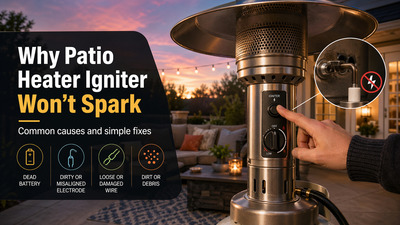
A patio heater igniter won’t spark problem usually feels worse than it really is, especially when the propane patio heater won’t ignite at all. You press the button, wait for the click, and get nothing — no spark, no flame, no sign the heater is even trying to start. That’s frustrating enough on an older unit, but it’s even worse when the heater worked last season or is brand new and suddenly seems dead.
The tricky part is that a few different faults can look almost identical at first. A dead battery, a dirty electrode, a loose wire, or a worn-out igniter button can all leave you standing there doing the same thing over and over with no result. Add a faint propane smell to the mix, and it starts to feel like a much bigger issue than it may actually be.
The good news is that most no-spark problems follow a pretty simple pattern. Once you know what to check first, it gets much easier to figure out whether you’re dealing with a quick fix, a bad part, or a problem that needs more caution.
Quick answer: what usually causes no spark?
In most cases, the issue comes down to one of these:
| Symptom | Most likely cause | First thing to check |
|---|---|---|
| No click, no spark | Dead battery or bad igniter button | Replace the battery |
| Click, but no visible spark | Dirty or misaligned electrode | Inspect the electrode tip |
| Weak spark once in a while | Corrosion, moisture, or low battery power | Clean contacts and retry |
| Spark is present, but no flame | Gas-flow or pilot issue | Check the pilot area |
| Gas smell, but no ignition | Fuel is present but startup is failing | Stop and ventilate |
That’s worth sorting out first, because a heater that truly has no spark needs a different fix than one that sparks but still won’t light.
First make sure it’s really an igniter problem
Before taking anything apart, confirm what the heater is actually doing.
A true no-spark issue means you press the igniter and don’t see a spark at the pilot area. Sometimes there’s no click either — the patio heater isn’t clicking at all.
Sometimes the button feels soft or dead. That usually points to the igniter system itself — the battery, switch, wire, or electrode.
A different problem is when the heater does spark, but the flame never catches. In that case, the igniter may be fine, and the real issue could be a clogged pilot tube, blocked orifice, low gas flow, or air in the line.
Here’s the quick difference:
| What you notice | What it usually points to |
|---|---|
| No click and no spark | Battery, button, or wire issue |
| Click but no spark at the tip | Electrode, wire, or gap issue |
| Spark is visible but heater won’t light | Gas-flow problem |
| Flame appears briefly, then dies | Thermocouple or fuel issue |
If the heater lights briefly but the flame won’t stay on, that’s usually a different issue — see why your patio heater pilot light keeps going out.
That one distinction matters a lot. It keeps you from replacing the igniter when the spark was never the real problem.
For a full breakdown of ignition, pilot, gas flow, and thermocouple issues together, see our complete propane patio heater troubleshooting guide.
Start with the easiest checks
This is the part people sometimes skip, but it solves a lot of cases.
Check the battery
Many patio heaters use a battery-powered igniter. If the battery is weak, dead, installed backward, or sitting against corroded contacts, the heater may give you no spark at all.
Take it out and check:
- polarity
- contact corrosion
- battery age
- whether the cap is seated properly
A fresh battery is the fastest, cheapest thing to rule out.
Check the startup sequence
A lot of heaters need the same basic routine:
- Open the tank valve
- Turn the control knob to pilot
- Press and hold the knob in
- Press the igniter button
If the knob isn’t fully depressed, the heater can seem unresponsive even when the main parts are fine.
Check for a loose connection
If the heater is new, recently assembled, or recently moved, a wire may have come loose around the control area. This happens more often than people think. A connection can look “almost on” and still fail to carry the spark.
Why a patio heater igniter won’t spark
For the igniter system to work, a few simple things have to happen in order:
- the button or piezo unit has to create the spark
- the wire has to carry that spark
- the electrode has to be intact
- the spark gap has to be close enough to jump
- the area around the pilot has to be clean enough for the spark to form properly
If one of those breaks down, the whole startup process can feel dead.
You can think of it like a chain:
igniter button → battery or piezo unit → wire → electrode tip → spark jumps near pilot
If the spark disappears anywhere along that path, the heater won’t light.
Check the igniter wire and electrode next
Once the easy stuff is ruled out, move to the ignition area itself.
Turn the heater off. Shut off the propane tank. If you’ve already tried lighting it several times, give it a little time to air out before inspecting anything.
Then look closely at the ignition assembly.
| Part | What to look for | What it usually means |
|---|---|---|
| Electrode tip | Dirt, soot, rust | Clean it |
| Ceramic insulator | Cracks or chips | Replace the electrode |
| Ignition wire | Loose fit or damage | Reconnect or replace |
| Spark gap | Tip too far away or bent | Reposition carefully |
| Mounting point | Corrosion or wobble | Clean and secure |
A healthy setup usually gives you a clean spark in the right place. If the spark is weak, missing, or jumping somewhere odd, the issue is often at the electrode end rather than the button end.
That’s also why a heater can click but still never produce a visible spark where it actually matters.
Dirt, rust, and spider webs can stop ignition
Outdoor heaters collect all the usual outdoor junk — dust, moisture, rust, carbon, and insect debris.
That matters because the spark is small. It doesn’t take much buildup to interfere with it.
| Problem area | What happens | Result |
|---|---|---|
| Electrode tip | Carbon blocks the spark path | Weak or no spark |
| Burner area | Dust or webs interrupt ignition | Spark doesn’t catch fuel well |
| Metal target near pilot | Rust affects grounding | Spark becomes inconsistent |
| Battery contacts | Corrosion reduces power | Weak igniter response |
| Pilot opening | Debris blocks the flame path | Spark exists, but heater won’t light |
This is where a careful cleaning can help more than expected. Use a soft brush, dry cloth, or compressed air. Don’t jab at delicate parts or scrape the ceramic insulator aggressively. You’re trying to clear buildup, not reshape the assembly.
Spider webs are especially common in gas appliances that sit outdoors for long stretches. Small blockages around the pilot area can cause surprisingly annoying startup problems.
When the switch or igniter unit has failed
Sometimes the problem really is the igniter itself.
That becomes more likely when:
- there’s no click at all
- the button feels loose or dead
- the battery is fresh
- the wire is connected
- the electrode looks decent
- the heater can be lit another way, but not from the built-in button
In that situation, the button or piezo unit may simply be worn out.
| Situation | Most likely next step |
|---|---|
| Fresh battery, still no response | Replace igniter switch |
| Clicks, but no spark after cleaning | Replace electrode or igniter |
| Button feels broken | Replace switch |
| Works only once in a while | Replace igniter assembly |
| Brand-new heater with a loose connection | Recheck assembly or use warranty |
If the heater is new, it’s smart to check the manual or warranty before buying parts. A loose factory connection or faulty switch on a new unit is not rare.
If you smell gas, stop and slow down
This is the point where caution matters more than persistence.
If you smell propane while trying to start the heater, gas is reaching at least part of the system. That doesn’t automatically mean the igniter is the only problem, and it definitely doesn’t mean you should keep pressing the button over and over.
Turn the heater off. Close the tank valve. Let the area ventilate fully before doing anything else.
A brief odor right at startup can happen. A stronger smell that lingers is different. That can point to loose fittings, hose damage, regulator trouble, or unburned fuel collecting because ignition never happened.
| Situation | What to do next |
|---|---|
| No gas smell, no spark | Continue checking the igniter system |
| Brief startup odor only | Inspect carefully, then retry |
| Strong gas smell | Shut down and ventilate |
| Suspected leak | Stop troubleshooting with live gas |
| Damaged hose or fitting | Replace the part or call a pro |
Review essential patio heater safety guidelines before continuing.
A no-spark issue is annoying. A gas-leak issue is a safety problem. Treat those as two different things.
Best fixes by symptom
Here’s the fast version:
| Symptom | Best first fix | Next move |
|---|---|---|
| No click, no spark | Replace battery | Replace igniter switch |
| Click but no visible spark | Check wire and electrode | Replace electrode |
| Weak or random spark | Clean contacts and tip | Replace igniter assembly |
| Spark is there, but no flame | Clean pilot area | Check gas flow (see patio heater gas not flowing guide) |
| New heater stopped after assembly | Recheck wire fit | Warranty claim |
| Gas smell, no ignition | Shut off and ventilate | Inspect for leaks |
That usually gets you to the right answer faster than randomly swapping parts.
When replacement makes more sense
If the igniter assembly has failed repeatedly, the electrode is corroded, and the heater is older or heavily rusted, replacing the unit may be more practical than replacing individual ignition parts.
You can compare current options in our guide to the best propane patio heaters.
Bottom line
Most cases come back to the same handful of causes — battery, button, wire, electrode, or dirt around the ignition area. That’s actually good news, because those are all things you can check without turning the job into a major repair.
Start with the simple stuff, confirm whether it’s truly a no-spark issue, and work toward the ignition assembly only after the obvious checks are done. If fuel smell enters the picture, slow down and treat it seriously.
The goal isn’t to force the heater to light. It’s to figure out why it isn’t sparking in the first place — and fix the right thing once.