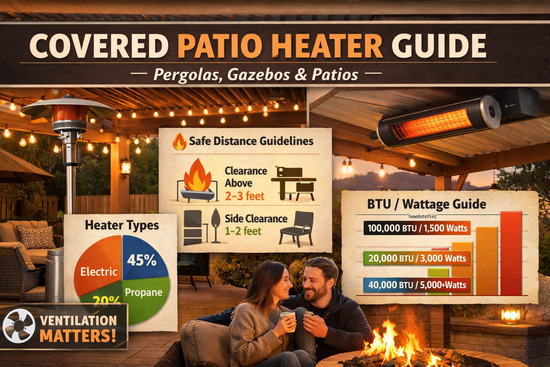
Picking a heater for a covered outdoor space sounds simple — until you realize that “covered” changes the rules.
A heater that works fine on an open patio can become a bad fit under a pergola, gazebo, or roofed seating area. Suddenly you’re dealing with clearance, ventilation, power, mounting height, and whether that nice-looking flame heater is actually a smart idea under wood beams. That’s exactly why this covered patio heater guide matters. The wrong pick can waste money, clutter the space, or make the setup feel riskier than it should.
The good news is it’s not that hard once you strip away the marketing fluff. You don’t need to memorize codes or compare fifty heaters line by line. You just need to match the heater to the structure, the seating layout, and the way the space is actually used. This guide breaks that down in plain English so you can figure out what works, what doesn’t, and where people usually get it wrong.
What’s covered:
- Which heater types make the most sense for covered spaces
- Pergola vs gazebo vs covered patio differences
- Electric vs propane vs natural gas in real life
- Sizing and placement basics
- Clearance and ventilation habits that matter
- Common mistakes that make covered patios feel colder, not warmer
Covered patio heater guide — what matters before you buy
The biggest mistake people make is shopping by raw output first.
They see high BTU numbers, big wattage, or broad “heats up to X square feet” claims and assume that’s enough. It usually isn’t. Covered outdoor spaces don’t behave like indoor rooms. A roof helps a little, but it doesn’t trap heat the way a real ceiling and four walls do. Heat still escapes fast, especially if the sides are open or wind moves through the space.
That’s why direct, targeted warmth usually works better than trying to “heat the air.” In real terms, that means infrared-style heaters often feel better under a pergola or gazebo than heaters that mostly depend on warming the surrounding air.
Here’s the short version:
| What matters most | Why it matters |
|---|---|
| Structure type | A pergola, gazebo, and roofed patio don’t behave the same |
| Roof height | Lower covers limit heater choices and placement |
| Materials overhead | Wood, fabric, and curtains change safety margins |
| Side openness | More airflow helps safety but also lets heat escape |
| Seating layout | Heating people directly works better than heating empty space |
So before you worry about “best heater,” figure out what you’re heating, how open it is, and where people actually sit.
Why covered spaces change the heater decision
A covered patio feels more protected, but that doesn’t always mean it’s easier to heat.
The roof can reduce some upward heat loss, but it also creates new restrictions. Now you have beams, rafters, ceiling finishes, canopies, screens, drapes, fans, and furniture layouts to work around. A freestanding propane heater that feels fine in the middle of an open slab patio can become awkward or risky under a smaller covered structure.
There’s also a comfort issue. Covered spaces can fool people into expecting indoor-style warmth. That usually leads to oversizing, poor placement, or disappointment. Outdoor heating works best when you focus on comfort zones — the table, the sofa area, the chairs — not the entire footprint.
How covered spaces usually behave
Open patio warmth retention        : ██
Pergola warmth retention           : ███
Gazebo warmth retention            : ████
Covered patio with partial screens : █████
Indoor room                        : ██████████
That’s not a scientific scale — just a useful way to think about expectations. A covered space helps, but it’s still outdoor heating, not indoor climate control.
Electric vs propane vs natural gas — which is better under a cover?
If you want the practical answer, electric infrared is often the easiest place to start for a covered space.
Electric heaters
Electric infrared heaters are usually the cleanest fit for pergolas, gazebos, and roofed patios. They don’t create combustion fumes, they can often be mounted overhead or on posts, and they warm people and surfaces directly. They’re especially good for dining tables, sofas, and conversation areas. The downside is that larger spaces may need multiple units, and some stronger heaters need 240V power.
Propane heaters
Propane is popular because it’s portable and throws strong heat for the money. But under a cover, portability isn’t always an advantage. These heaters take up floor space, can interfere with walkways, and need more attention to ceiling clearance and ventilation. They can work in open-sided covered spaces, but they’re less forgiving than electric.
Natural gas heaters
Natural gas works well for permanent setups and higher-use outdoor living spaces. No tank swaps, no dragging units around, and operating cost is often attractive long term. But install is more involved, and gas under a cover is not where you want shortcuts. This is the category where professional planning matters most.
Quick comparison table
| Heater type | Best for | Pros | Main drawback |
|---|---|---|---|
| Electric infrared | Pergolas, gazebos, covered patios | Clean, targeted, easy to zone | May need more than one unit |
| Propane | Open-sided covered spaces | Portable, strong heat, simple setup | Needs more clearance and floor space |
| Natural gas | Permanent covered patio setups | No refills, strong output, tidy long term | Professional install required |
Pergola vs gazebo vs covered patio — same category, different reality
People often lump these together, but they don’t behave exactly the same.
Pergolas
Pergolas are often more open on top or around the sides, which helps ventilation but lets warmth drift away faster. They tend to work especially well with mounted electric infrared heaters that aim heat where people sit. Freestanding gas heaters can work in some pergolas, but lower beams and wooden construction often make them less convenient than they first seem.
Gazebos
Gazebos usually feel more enclosed and cozy, which can help comfort but also raises the stakes for clearance and airflow. Many are wood-framed, which means open flame and high-heat overhead placement deserve extra caution. Electric heaters usually make more sense here, especially if you want a cleaner look and less floor clutter.
Covered patios
This is the broadest category. Some covered patios are basically roof extensions. Others are full-blown outdoor rooms with screens, curtains, fans, lighting, and built-in seating. These spaces often benefit from mounted heaters along the perimeter or above the main seating zones rather than one big center-mounted solution.
Best match by structure
| Structure | Usually best heater style | Why |
|---|---|---|
| Small pergola | 1 mounted electric infrared | Good zone heat, minimal clutter |
| Dining pergola | 2 smaller electric heaters | Better coverage than 1 big unit |
| Wood gazebo | Mounted electric infrared | Safer and easier to manage |
| Open covered patio | Electric or gas, depending on layout | More flexibility if clearance allows |
| Outdoor room with partial screens | Electric infrared | Better fit for semi-enclosed use |
How much heat do you really need?
This is where people either overbuy or under-plan.
A 10×10 space doesn’t automatically need the same setup as another 10×10 space. A simple loveseat and two chairs in one corner is easier to heat than a full dining setup where people sit around the edges. Layout matters as much as size.
A simple way to think about it
Step 1: Measure the footprint
Length × width gives you the basic size.
Step 2: Look at the seating zone
Where do people actually spend time?
Step 3: Check openness
A breezy pergola needs more strategic heat than a sheltered covered patio.
Step 4: Think in zones
Two smaller heaters often work better than one oversized unit.
Real-world sizing table
| Space | Typical layout | Smarter heating approach |
|---|---|---|
| 8×8 pergola | Simple seating | 1 heater can be enough |
| 10×10 pergola | Table plus perimeter chairs | Often better with 2 heaters |
| 12×14 covered patio | Sofa and chairs | 1-2 mounted heaters aimed at seating |
| Large gazebo | Lounge + dining | Multiple zones usually win |
What usually feels more comfortable
1 oversized heater in the middle   : ███
2 smaller heaters over seating      : ████████
1 heater aimed into open air        : ██
Heater matched to table/lounge zone : █████████
Again, not lab data — just the real-world comfort pattern most people run into.
Placement is everything
A strong heater in a bad spot is still a bad setup.
That’s especially true in covered spaces where bad placement can make the area feel colder, more awkward, and less safe at the same time. The goal is usually not “heat the whole patio evenly.” The goal is “make the occupied zone feel warmer fast.”
Better placement habits
| Do this | Not this |
|---|---|
| Aim heat at the seating area | Aim heat into open air or dead corners |
| Keep walkways clear | Put a freestanding heater where people brush past it |
| Leave proper space overhead | Squeeze a tall heater under a low beam |
| Mount along edges when possible | Assume center placement is always best |
| Follow the manual for clearances | Guess based on photos online |
If you’re using a mounted electric heater, think about line of sight. If you’re using gas, think about airflow and overhead distance. Either way, a heater that points at people usually beats a heater that just exists nearby.
Safety, clearance, and ventilation — the non-boring version
This part gets skipped because it sounds dull. It’s also where a lot of bad patio heater setups start.
Every heater has its own clearance requirements. Those rules come from the manufacturer and they matter more than general blog advice. Wood ceilings, pergola beams, curtains, canopies, screens, and even outdoor decor can turn a “probably fine” setup into a bad one.
For gas heaters, ventilation is non-negotiable. A covered area is not the same as a fully open area, and once a space starts adding screens, curtains, or partial walls, electric usually becomes the safer and simpler answer.
Quick safety checklist
Do:
- Read the manual before buying
- Check the ceiling height and nearby materials
- Keep combustibles away from the heater
- Use a pro for gas lines or hardwired installs
- Put heat where people sit, not where it looks balanced on paper
Don’t:
- Use open-flame style heating casually under wood
- Ignore side airflow for gas units
- Buy a giant freestanding heater for a tight gazebo
- Treat a semi-enclosed patio like a fully open one
- Leave heaters running unattended overnight
The mistakes that make a covered patio heater setup disappointing
Most bad setups fail in predictable ways.
One mistake is buying by power alone. Bigger numbers don’t fix poor placement. Another is choosing portability when the space wants permanence. A freestanding unit sounds flexible until it’s always in the way. Another is ignoring materials. A heater that works under an aluminum patio cover may be a bad fit under a wood pergola with curtains.
And maybe the biggest mistake of all is expecting indoor results outdoors. That expectation pushes people toward oversized or awkward setups that still don’t feel right.
The better goal is simpler: make the main seating zone feel warmer, more comfortable, and more usable during cool nights. That’s usually enough to turn a rarely used covered patio into a space people actually enjoy.
Quick decision table
| If your space is… | Start here |
|---|---|
| Wood pergola with seating below | Mounted electric infrared |
| Gazebo with partial enclosure feel | Electric infrared first |
| Open covered patio with lots of airflow | Electric or gas depending on clearance |
| Larger permanent outdoor room | Natural gas or multiple electric zones |
| Small covered dining nook | 1-2 smaller mounted electric heaters |
Bottom line
The best covered patio heater setup usually comes down to three things — the structure, the heater type, and the seating layout. If your space is wood-framed, semi-enclosed, or tight on overhead clearance, electric infrared is usually the easiest answer. If the space is more open and permanently built out, gas can still make sense, but it needs more planning.
Start with where people actually sit, not the total square footage. Match the heater to the cover above it, the airflow around it, and the way you use the space. Get those parts right, and a covered patio, pergola, or gazebo becomes a place people actually want to stay in once the temperature drops.
If you want, I can also turn this into an even more “publish-ready” version with internal link ideas, image placements, and a featured snippet section.