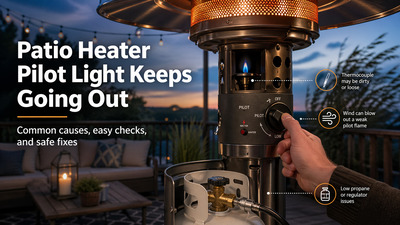
When a patio heater pilot keeps going out, note when it fails: while the control is held, immediately after release, later during operation, or only in wind. Those observations are more useful than replacing a thermocouple on suspicion. Follow the lighting sequence and hold time for the exact model; holding the knob longer is not a universal fix.
Gas odor or hissing changes the task: stop ignition attempts, leave the area and keep ignition sources away. From a safe location, contact your propane supplier, 911 or the fire department. Do not return or restart until a qualified responder says it is safe. PERC’s gas-leak guidance explains the response, including when not to approach the tank shutoff.
Which failure are you seeing?
| Observed failure | Useful distinction | What to do |
|---|---|---|
| No flame ever appears | The pilot has not been established | Separate no spark from spark-without-flame first. |
| Pilot dies while the control is held | Releasing the knob is not the trigger | Stop repeated attempts and report this detail to support. |
| Pilot dies immediately after release | The prescribed lighting sequence or flame-safety system needs checking | Confirm the model’s hold time; persistent failure needs service. |
| Pilot lasts, then goes out | Timing alone does not identify a failed part | Record the delay, weather and whether the main burner had started. |
| Outage coincides with gusts | The location or operating conditions may be unsuitable | Check wind limits and placement before considering another start. |
Check the instructions before the components
Find the model label and the manual that came with that heater. Read the lighting, relighting and shutdown sections together. Do not substitute a generic 30–60 second hold time, extend gas release indefinitely, or assume that a knob position means the same thing on every model.
Make a short record for support: when the pilot fails, whether it ever stays lit after release, whether the main burner starts, and whether the problem began after storage or a cylinder change. Report an already observed weak or unusual flame; do not deliberately repeat a failed start to obtain a photo.
Why a thermocouple is only one possibility
A pilot-operated flame-safety system depends on an established flame. An outage can involve the flame, fuel delivery, connections or safety components. The Hiland HLDS01-CGTHG/CGTSS/CGTCB and AZPH-GS manual lists several possibilities, including pilot-area dirt, a loose connection, a thermocouple fault and an anti-tilt switch issue. That is a reason to diagnose the system, not a shopping list of parts to replace.
Do not bypass the flame-safety or tilt switch, wedge the knob down, bend the sensor toward the flame, or use an improvised heat source to make it stay on. A heater that only runs with a safeguard defeated is not repaired.
Useful checks while the heater is off and cool
- Model and installation: confirm the unit is assembled and positioned as its instructions require, with guards present.
- Visible condition: look for damage, hose wear or an obviously trapped hose without disconnecting or repositioning gas components.
- Fuel history: record the last refill or cylinder change. Do not heat a propane cylinder to improve output.
- Environment: compare the operating conditions with the manual. A calm forecast does not rule out gusts at the heater.
Cleaning a pilot passage, tightening a gas fitting or replacing a regulator can change the gas system. Keep those jobs with qualified service rather than treating them as routine exterior cleaning. If there is suspected leakage, use the emergency guidance above instead of continuing inspection.
Choose the next step from the pattern
If the exact lighting sequence was not followed, consult the matching instructions before deciding whether another attempt is appropriate. If the documented sequence was followed and the pilot still dies, leave the heater off and arrange service. If the failures track wind, solve the operating-location problem first; a replacement sensor cannot make an unsuitable location suitable.