COSTWAY Oil Filled Radiator Heater Review: Quiet, Steady Heat for the Rooms You Actually Use
At a Glance
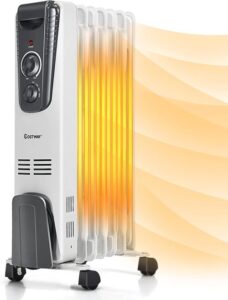
KEY FEATURES
- Power / Coverage: 1500W max output with 600W, 900W, and 1500W modes; realistic coverage is best in small to medium enclosed rooms*
- Heat levels: 3 settings: low, medium, and high
- Aim/Mounting: floor-standing design with caster wheels; no wall or ceiling mounting
- Controls: manual power switches and adjustable thermostat dial
- Work light: no work light; indicator light only
- Safety: overheat protection and tip-over protection
- Size / Weight: 13.5" D × 13" W × 25" H, 18 lb, black
PROS
- Quiet oil-filled heat is great for bedrooms, offices, and overnight use.
- Steady warmth works well in closed, insulated rooms.
- Manual controls are simple and smart-plug friendly.
- Caster wheels make it easy to move on smooth floors.
- Tip-over and overheat protection add peace of mind.
- Good value for room-by-room supplemental heating.
CONS
- It warms slowly, so it is not the right pick for instant heat.
- Drafty garages, open layouts, and leaky rooms can limit performance.
- The thermostat dial does not show an exact temperature.
- The single handle and front cord placement can make moving it awkward.
- The radiator surface can still get very hot during use.
- Quality control and customer-service complaints are worth knowing about.
Editor's Choice
Based on rigorous testing & Amazon customer feedback
🔥 Will This Heater Work For Your Room?
Answer a few quick questions about your space to see if this heater is a good match.
This COSTWAY 22611-CYPE review looks at whether this 1500W oil-filled radiator is a smart fix for cold bedrooms, offices, bathrooms, and upstairs rooms that never quite warm up.
In many homes, that’s exactly the kind of problem the COSTWAY 22611-CYPE oil-filled radiator heater is meant to solve. It’s not flashy, and it doesn’t blast hot air across the room. Instead of packing in smart features, this 1500W radiator focuses on quiet, steady, room-by-room warmth.
On the other hand, the big thing to understand for this COSTWAY 22611-CYPE review is expectations. Customers who treat it like a slow, silent radiator usually like it. People expecting instant heat from a small fan heater often feel disappointed at first.
COSTWAY 22611-CYPE review: Quick verdict
If you want quiet heat for a bedroom, home office, bathroom, pantry, or chilly upstairs room, the COSTWAY 22611-CYPE is a solid pick when the space is enclosed and fairly well sealed. It gives off soft, steady warmth, runs without fan noise, and has simple manual controls that many owners actually prefer. The catch is that it takes time to warm up, struggles more in drafty spaces, and quality control is not perfect.
Fast scorecard
| Category | Rating | What it means in real life |
|---|---|---|
| Room heating | 4.0 / 5 | Good in closed small-to-medium rooms, mixed in drafty spaces |
| Direct warmth | 3.7 / 5 | Warm near the unit, but not a quick blast heater |
| Consistent comfort | 4.4 / 5 | Once warm, it holds heat nicely and feels even |
| Quietness | 4.6 / 5 | No fan noise, only occasional clicks or pops |
| Ease of use | 4.1 / 5 | Simple controls, but no exact temperature setting |
| Build confidence | 3.2 / 5 | Many happy owners, but some serious quality complaints |
What kind of heater is this?
The COSTWAY 22611-CYPE is a portable oil-filled radiator. That means the heating element warms sealed oil inside the radiator fins, and those fins then radiate heat into the room.
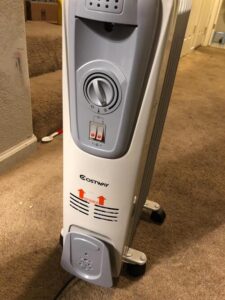
There’s no fan, no forced air, no glowing ceramic element, and no flame — just a black, floor-standing radiator with caster wheels and simple manual controls.
| Spec | COSTWAY 22611-CYPE |
|---|---|
| Heater type | Portable oil-filled radiator |
| Max power | 1500W |
| Heat settings | 600W / 900W / 1500W |
| Controls | Manual switches + thermostat dial |
| Fan | No |
| Remote | Not listed for this version |
| Safety | Tip-over protection, overheat protection |
| Size | 13.5″ D × 13″ W × 25″ H |
| Weight | 18 lb |
| Best use | Quiet supplemental room heat |
In fact, the manual controls are a bigger deal than they look. A lot of buyers specifically choose this style because it avoids digital panels, beeps, and unreliable auto modes. It’s the kind of heater you set, leave alone, and let it quietly do its thing.
Heat feel: slow, soft, and steady
The warmth from this heater feels different from a ceramic space heater. A ceramic heater gives you hot air right away. This COSTWAY radiator builds heat slowly, then keeps the room feeling warm in a calmer way.
Think of it less like a hair dryer and more like an old-school radiator. The heat spreads gradually. The air doesn’t feel as dry. There’s no fan pushing dust around. Owners who use it in bedrooms often like that the room feels warmer without that harsh “heated air blowing at your face” feeling.
Here’s the basic warm-up experience most people should expect:
| Time running | What you’ll likely notice |
|---|---|
| 0-5 minutes | Fins start warming, but the room may not feel different yet |
| 10-20 minutes | Heat becomes noticeable close to the radiator |
| 30-45 minutes | A closed room starts feeling more comfortable |
| 1+ hour | The room feels steadier, especially if doors are closed |
That first half hour is where expectations matter. Some customers thought the heater was weak because it didn’t throw heat instantly. Others gave it time and found that it quietly took the chill out of the room.
The best part is the residual heat. Once the oil is hot, the radiator keeps releasing warmth even after the thermostat cycles off. That’s why it can feel more stable than small fan heaters that turn the room into a hot-cold-hot-cold loop.
The realistic coverage story
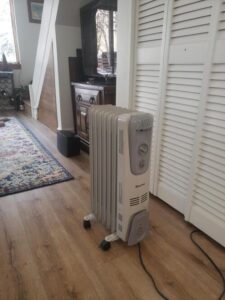
At first glance, COSTWAY says this heater can warm medium to large rooms. That can be true, but only with some context.
A well-insulated bedroom? Good fit.
A closed home office? Very good fit.
A bathroom before a shower? Good fit.
A drafty garage with gaps around the door? Much tougher.
Room fit guide
| Room / use case | Fit | Why |
|---|---|---|
| 10′ × 10′ office | Excellent | Small, closed spaces warm well |
| Bedroom | Very good | Quiet heat works nicely overnight |
| Bathroom | Good | Works well if used before the room gets cold |
| Upstairs bonus room | Good | Best with doors closed and decent insulation |
| Pantry / laundry room | Good | Nice for frost protection or taking off chill |
| RV bedroom | Good | Useful when you want electric heat instead of propane |
| Converted garage | Mixed | Can work if insulated and sealed |
| Drafty garage | Weak to mixed | Heat escapes too quickly |
| Large open living area | Mixed | May help, but usually not enough by itself |
In practice, the sweet spot is a closed room where the warmth can stay trapped. Customers using it in bedrooms, home offices, and small chilly rooms tend to sound the happiest. Buyers using it in rougher spaces get very different results depending on insulation.
One owner described a leaky room where the heater helped but couldn’t overcome poor sealing. Another used it in a converted garage after improving insulation and saw much better results. That’s the real lesson: the heater matters, but the room matters just as much.
Coverage expectation chart
| Heating role | Realistic area |
|---|---|
| Primary heat in a closed room | About 150-180 sq ft |
|
Extra heat with central heat helping |
About 250-270 sq ft |
| Drafty garage or poorly sealed room | Much less |
| Large open layout | Better with multiple heaters or main heat support |
Conversely, if you want one heater to keep a normal bedroom comfortable, this can work. However, if you want one plug-in radiator to heat a big open downstairs, you’ll probably be disappointed.
Warmth comparison: what it does better and worse
| Compared with… | COSTWAY oil radiator does better | COSTWAY oil radiator does worse |
|---|---|---|
| Ceramic fan heater | Quieter, steadier, less drying | Slower to feel warm |
| Forced-air central heat | Warms only the room you use | Won’t heat the whole house |
| Electric fireplace | More portable and practical | Less decorative |
| Baseboard heater | Easier to move room to room | Less permanent and less precise |
| Propane heater | No open flame or fuel tank | Needs electricity and a good circuit |
This is why people who value quiet comfort tend to like it. If your main complaint is noise, dry air, or heating unused rooms, the COSTWAY makes sense. If your main complaint is “I’m freezing right now and need heat in 30 seconds,” it’s not the best tool.
Controls and daily use
The controls are simple: heat switches and a thermostat dial. You choose the wattage level — 600W, 900W, or 1500W — then adjust the dial to control cycling.
A good way to use it is:
- Turn it on high.
- Let the room warm up.
- Turn the thermostat dial down slowly until you hear the click.
- Let it cycle from there.
- Drop to 600W or 900W if the room stays comfortable.
That’s the “set it and forget it” rhythm customers seem to like. Start strong, then maintain.
At the same time, the downside is that there’s no exact temperature readout. You can’t set it to 70°F. You set it by feel. Some owners don’t mind that at all. Others wish it had a real temperature display because the room can swing too warm or too cool until you learn the dial.
Control comfort meter
| Feature | How it feels |
|---|---|
| Manual switches | Simple and reliable |
| Thermostat dial | Useful, but not precise |
| Exact temperature setting | Not available |
| Smart plug compatibility | Better than many digital heaters, with the right rated plug |
| Remote convenience | Not included on this version |
| Learning curve | Mild, mostly figuring out the dial |
Manual controls also help if you want to use a properly rated smart plug or outlet timer. Many digital heaters won’t turn back on after power is cut unless you press a button. Manual radiators can often return to the same setting, which is useful for preheating a room before you enter.
Noise: almost silent, with a few radiator sounds
One of the biggest wins, however, is noise. There’s no fan, so there’s no constant hum. No whoosh. No rattly blower. No airflow noise while you’re sleeping or working.
People use it in bedrooms, home offices, nurseries, study rooms, and TV rooms because it stays out of the way acoustically. If you’re tired of fan heaters making Zoom calls, podcasts, or sleep harder, this kind of radiator feels like a relief.
Moreover, it’s not always completely silent. Owners mention occasional clicks, pops, gurgles, and metal expansion sounds. Most of those happen when the heater is warming up, cooling down, or cycling.
| Sound | How common it feels | Dealbreaker? |
|---|---|---|
| Fan noise | None | No fan |
| Soft clicks | Normal | Usually no |
| Metal pops | Occasional | Maybe for light sleepers |
| Gurgling/dripping sounds | Sometimes during warm-up | Usually fades |
| Screeching | Reported by some long-term users | Worth watching |
For most bedrooms, it’s quiet enough. For very light sleepers, random popping could be annoying, especially in a silent room.
Portability and setup
Setup is basic. Attach the caster wheels, set the heater upright, plug it directly into the wall, and turn it on. Most customers find the wheel assembly quick.
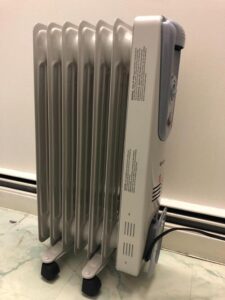
The radiator weighs 18 lb, so it’s not featherlight, but it’s manageable. The wheels help on smooth floors, and the front carry handle gives you a place to guide it.
The design could be better, though. A few owners complain that the single handle makes it awkward to move with two hands. Others dislike the cord placement because it can get in the way or make the indicator lights face the wall depending on where the outlet is.
There are also complaints about caster hardware. Some buyers report missing U-bolts or confusing wheel attachment parts. That doesn’t seem to happen to everyone, but it’s worth checking the parts bag before you start.
Setup checklist
| Step | Why it matters |
|---|---|
| Check for oil leaks before plugging in | A leaking oil radiator should not be used |
| Confirm wheel hardware is complete | Missing U-bolts can stop assembly |
| Place it on a flat floor | Helps avoid tipping and rolling issues |
| Plug directly into wall outlet | Full power draws about 12.5 amps |
| Keep clearance on all sides | Fins can get hot |
| Test it while you’re home | Catch smells, sparks, or overheating early |
Safety: good features, but still a hot radiator
COSTWAY includes tip-over protection and overheat protection. Those are good to have, especially for a portable heater that may be used in bedrooms, offices, and utility rooms.
Owners like the peace of mind, but the surface temperature deserves respect. Some users describe the fins as warm rather than scary hot at lower settings. Others say the heater gets hot enough that you would not want to leave your hand on it.
So treat it like a real radiator. Keep it away from bedding, curtains, furniture, paper, towels, and anything that can trap heat. Don’t tuck it into a corner with no airflow. Don’t run the cord under rugs. Don’t use it with a cheap extension cord.
For homes with small kids or curious pets, this is not a “place it anywhere and forget it” product. Older kids who understand not to touch it are one thing. Toddlers and roaming pets are different. A barrier or a safer placement may be needed.
The more serious complaints involve melted plastic, sparks, strong smells, oil leakage, and questionable behavior from the switches. Those are not normal. If you notice any of that, unplug the heater and stop using it.
Proper heater placement matters more than most people realize — see our heater placement guide for safety tips that apply to any portable unit.
Power use and running cost
On the practical side, power use is straightforward.
At full power, this heater uses 1500W. That’s normal for a plug-in space heater. The energy savings come from heating one room instead of the whole house, not from the radiator using some special low-cost heat source.
Power use snapshot
| Setting | Watts | Energy used in 1 hour |
|---|---|---|
| Low | 600W | 0.6 kWh |
| Medium | 900W | 0.9 kWh |
| High | 1500W | 1.5 kWh |
In real life, this COSTWAY 22611-CYPE review shows it behaves like most 1500W oil-filled radiators — great in small rooms, limited in big open ones.
If you run it on high for long stretches, you’ll use real electricity. No way around that. But if you warm a bedroom on low or medium instead of raising the whole-house thermostat, the math can make sense.
This is especially true for people with expensive fuel oil, gas, or heat-pump backup heat. A lot of owners use the COSTWAY as zone heat: bedroom at night, office during the day, bathroom in the morning.
The best use is to preheat on high, then back down to 600W or 900W once the room feels comfortable.
Build quality and reliability
However, that’s where things get more mixed.
Many owners are happy. Some have used this heater for years in bedrooms, garages, workshops, pump houses, and cold utility rooms. They like the simple manual design and say it keeps working without drama.
The no-fan setup helps. There’s no blower motor to fail. No filter to clean. No digital display to glitch. For buyers who have had digital heaters die early, that simplicity feels like a real advantage.
That said, the complaints are not all minor. While many owners are satisfied, not every experience is positive. Some units never seem to get hot enough, and others fail early or leak oil.
In rarer cases, buyers mention more serious issues like melted control plastic, sparking sounds, or a strong burning smell. Those experiences are enough to take seriously.
Reliability reality check
| What customers like | What to watch for |
|---|---|
| Some units last for years | Some fail within months |
| Simple manual controls | Dial is not precise |
| No fan motor | Occasional pops and creaks |
| Good heat in enclosed rooms | Weak results in drafty spaces |
| Easy to use daily | Customer service gets mixed comments |
| Good value when it works well | Quality control feels inconsistent |
Furthermore, the best advice is to test it early. Run it while you’re nearby and check the plug, outlet, cord, control panel, and smell. If anything feels wrong, don’t keep using it and hoping it settles down.
Overall, this COSTWAY 22611-CYPE review suggests satisfaction depends heavily on getting a properly assembled unit without defects.
First-use smell and maintenance
As with most oil-filled heaters, some buyers mention a smell when the heater is new.
A new heater often emits a smell, especially when coatings, dust, or manufacturing residue burn off. When the heater is brand new, a light smell is common as dust or factory coatings burn off. Because of that, it’s smart to run it in a ventilated space for a few hours before using it overnight in a bedroom. After the first run, maintenance is simple — just keep dust off the fins and allow space around the unit.
A light first-use smell is one thing. A strong burning odor, smoke, sparks, melting plastic, or air-quality issues that keep happening are different. Stop using it if those show up.
Who should buy it?
| You’ll probably like it if… | You may want to skip it if… |
|---|---|
| You want quiet heat for sleeping or working | You need instant heat right away |
| You’re heating one closed room | You need to heat a large open area |
| You prefer manual controls | You want a digital thermostat |
| You use smart plugs or outlet timers | You need built-in scheduling |
| You dislike fan noise and dry air | You want moving air or fast spot heat |
| You want extra heat | You expect whole-house heating |
| You can test and inspect it carefully | You want stronger quality confidence |
Pros & Cons Analysis
Based on extensive testing and Amazon customer feedback
Pros
- Quiet, fan-free heat — Owners consistently like that there's no fan noise, no blowing air, and no need to turn up the TV or computer volume while it runs.
- Comfortable steady warmth — Buyers often describe the heat as soft, even, and cozy, with the oil holding warmth after the thermostat cycles off.
- Good for bedrooms and home offices — Many people use it to warm one occupied room instead of running central heat for the whole house.
- Manual controls are simple — Owners who dislike digital panels appreciate the basic switches and thermostat dial, especially with smart plugs or plug-in timers.
- Works well as zone heat — Customers use it in bedrooms, bathrooms, RV bedrooms, laundry rooms, pump houses, pantries, workshops, and converted garage spaces.
- Easy wheel assembly — Most owners say attaching the caster wheels is quick, simple, and can be done without much effort.
- Portable on smooth floors — The wheels and front handle make it easy to roll from room to room once it's assembled.
- Useful safety features — Tip-over shutoff and overheat protection are reassuring for people using it around pets, older kids, or unattended utility spaces.
- Can reduce central heating use — Buyers with expensive gas, oil, or heat-pump backup heat like using it to warm only the rooms they occupy.
- Some long-term owners are happy — Several owners describe years of reliable use in garages, bedrooms, and utility spaces.
Cons
- Occasional popping and clicking — Several users mention metal expansion sounds, gurgles, or a loud pop when the heater cycles, especially during heat-up or cooldown.
- Slow heat-up compared with fan heaters — This is not an instant-blast heater; customers say it can take 20 to 45 minutes before the room really starts feeling better.
- Mixed results in drafty or open rooms — Some buyers say it struggles in poorly insulated bedrooms, basements, garages, or rooms with leaky doors.
- No exact temperature setting — The dial is not marked in degrees, so users often have to experiment until they find the right comfort level.
- Not a true whole-house heater — Even happy buyers usually frame it as room-by-room heat, not a replacement for central heat in a large home.
- Hardware confusion and missing parts — A recurring frustration is the U-bolt/caster hardware, with some buyers reporting missing or poorly fitting parts.
- Awkward to move while hot — Users mention that one handle is not ideal, the cord can get in the way, and the unit can feel top-heavy when rolling.
- Surface can still get very hot — Some owners warn that the fins can become hot enough to burn skin, so it still needs clearance and supervision around small children or roaming pets.
- Power draw can still matter — At 1500W, it can pull about 12.5 amps, and some users with older wiring or crowded circuits report breaker trips or outlet concerns.
- Quality control feels inconsistent — Complaints include weak heat output, early failure, oil leakage on arrival, melted plastic near controls, and poor customer-service experiences.
Our Verdict
The COSTWAY 22611-CYPE is at its best when you use it like a classic oil-filled radiator: turn it on before the room gets freezing, give it time, close the door, and let the warmth build. In that role, it can be a very comfortable heater for bedrooms, offices, bathrooms, RV bedrooms, laundry rooms, and other chilly spots.
It’s not the heater to buy if you want instant heat or exact temperature control. It’s also not the safest bet for a drafty garage, large open room, or any situation where you can’t monitor a new unit during the first few runs.
For the right room, though, it has a lot going for it. Quiet operation. Soft heat. Simple controls. Useful wheels. Lower heat settings for overnight use. Just inspect it carefully, plug it directly into a proper outlet, and take any odd smells, leaks, sparks, or melting seriously.
Frequently Asked Questions
How much space can the COSTWAY 22611-CYPE oil-filled radiator heater realistically heat?
It works best in small to medium enclosed rooms, especially bedrooms, home offices, bathrooms, and chilly bonus rooms. Some owners use it in larger or rougher spaces, but insulation, drafts, and ceiling height make a big difference. For primary heat, think closer to one normal bedroom or office rather than a large open floor plan.
Does this heater warm a room quickly?
Not instantly. Oil-filled radiators are slow-and-steady heaters. Many users say the room starts feeling noticeably better after about 20 to 45 minutes, with the best results coming when you let it run and then dial it back once the room is comfortable.
Is the COSTWAY 22611-CYPE quiet enough for sleeping?
Yes, for most people. There is no fan, so it does not blow air or make a constant hum. The main sounds owners mention are occasional clicks, pops, gurgles, or metal expansion noises during heat-up and cooldown.
What is the best way to use the thermostat dial?
A common approach is to start with both power switches on and the dial turned high. Once the room feels warm, slowly turn the dial down until you hear a click. That usually marks the point where the heater will cycle to maintain the room temperature.
Does this model have a remote control or timer?
This version is mainly a manual-control heater with switches and a thermostat dial. The supplied specs do not list a remote or built-in timer. Some owners like that because manual controls can work better with smart plugs or plug-in timers, but anyone wanting app control or exact temperature settings may want a digital model.
Can I use this heater with a smart plug?
Many owners prefer manual-control oil radiators because they can return to the same setting after power is restored, which makes them more compatible with smart plugs or outlet timers. Use a properly rated smart plug that can handle a 1500W heater, and avoid lightweight adapters or overloaded outlets.
Does the heater smell when first used?
Some users mention a first-use smell or warm-oil odor that fades after running it for a while in a ventilated area. A persistent burning smell, smoke, sparks, or worsening air quality readings should not be ignored.
Is the surface cool to the touch?
No, not always. Some owners say it feels only warm at lower settings, while others measured very hot surface temperatures on high. Treat it like a hot radiator: keep clearance around it and be careful around small children, pets, curtains, bedding, and furniture.
Will it trip a breaker?
At full power, the heater uses 1500W, which is about 12.5 amps on a 120V circuit. That is normal for a space heater, but older wiring, weak outlets, extension cords, or other high-draw devices on the same circuit can cause trouble. Plug it directly into a wall outlet whenever possible.
Is assembly difficult?
Most buyers find the wheel assembly simple and quick, but some report confusion around the caster hardware or missing U-bolts. Check all parts before you start, and make sure the wheel bases are secure before rolling the heater.
Is this a good heater for garages or workshops?
It can help in insulated or partly converted garage spaces, especially as zone heat. In drafty garages with visible gaps, bare walls, or leaky doors, one unit may only take the edge off rather than make the whole space warm.
How reliable is the COSTWAY 22611-CYPE?
The picture is mixed. Plenty of owners report years of steady use, but there are also complaints about weak heat, early failure, oil leakage on arrival, melted plastic, and customer-service frustration. Inspect it carefully when it arrives and stop using it if anything smells, sparks, leaks, or overheats abnormally.
Technical Specifications
| Brand | COSTWAY |
|---|---|
| Model / SKU | 22611-CYPE (ASIN: B0859C7DSJ) |
| Heater type | Portable indoor electric oil-filled radiator heater |
| Form factor | Free standing radiator |
| Heating method | Oil-filled radiant and natural convection heat |
| Heating element | Sealed oil reservoir with 7 thermal slots |
| Max heat output | 1500 W |
| Voltage | 120 V |
| Amperage | 12.5 A (calculated) |
| Coverage (manufacturer claim) | Medium to large rooms (no sq ft rating specified) |
| Temperature range | Not specified |
| Speeds / levels | 3 heat settings: 600W / 900W / 1500W |
| Noise level | Not specified (customers describe it as quiet, with occasional clicks, pops, or gurgles) |
| Oscillation | No |
| Controls | Manual power switches + adjustable thermostat dial |
| Timer | No built-in timer specified |
| Power source | Corded electric |
| Mounting / placement | Free standing floor placement with 4 caster wheels and front carry handle |
| Dimensions (D × W × H) | 13.5" × 13" × 25" |
| Weight | 18 lb |
| Color | Black |
| Special features | Adjustable thermostat, 3 heat settings, Caster wheels, Front carry handle, Cord wrap, Overheat protection, Tip-over protection |
| Safety certification | Not specified |
| Included in the box | Oil-filled radiator heater |
| Warranty | Not specified |
| Recommended room types / uses | Bedroom, home office, study room, bathroom, laundry room, pantry, pump house, RV bedroom, converted garage, workshop, supplemental zone heating |
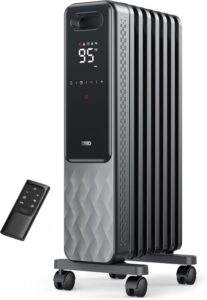
Dreo DR-HSH010 Review — Quiet Oil-Filled Heat for Rooms
This Dreo DR-HSH010 review looks at how this 1500W oil-filled radiator performs in real bedrooms, offices, RVs, and cold enclosed…
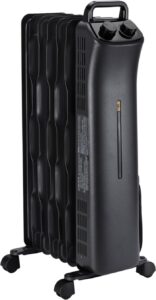
Amazon Basics Oil Space Heater – 7-Fin Portable Radiator with Thermostat, 1500W
Product Overview The Amazon Basics Oil Space Heater delivers steady radiant warmth for small to medium-sized rooms. With 7 oil-filled…
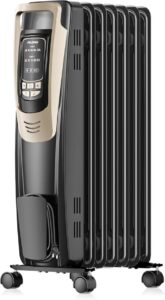
PELONIS PH-14A Review — Quiet Heat for Small Drafty Bedrooms
This PELONIS PH-14A review looks at how this 1500W oil-filled radiator performs in real-world use — from slow, steady bedroom…
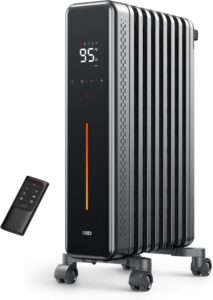
DREO DR-HSH011 Radiator Heater Review: Quiet, Steady Heat for Cold Bedrooms and Offices
This DREO DR-HSH011 review explores whether this portable 1500W oil-filled radiator is the perfect solution for cold rooms in your…


