PELONIS PH-14A Review — Quiet Heat for Small Drafty Bedrooms
At a Glance
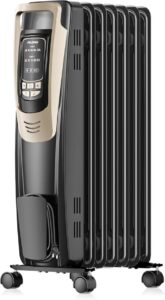
KEY FEATURES
- Power / Coverage: 1500W max output, rated up to ~164 sq ft*
- Heat levels: High, Low, and ECO mode; customer feedback indicates High is 1500W and Low is 900W
- Aim/Mounting: floor-standing radiator with caster wheels and carrying handle
- Controls: digital control panel, LED display, remote control, electronic thermostat, and timer
- Work light: not included; this is a quiet room heater, not a garage/shop light heater
- Safety: overheat protection, tip-over shutoff, flame-retardant materials, ETL certification noted in product copy
- Size / Weight: 15.16" D × 6.38" W × 26.06" H, 16.09 lb, champagne finish
PROS
- Quiet oil-filled heat works well for bedrooms, offices, and closed rooms.
- Strong warmth helps many buyers reduce central heating in specific rooms.
- The remote is handy from bed, the couch, or a desk.
- ECO mode and the timer make daily use easier.
- Wheels and a handle make it easy to move from room to room.
- No fan means no constant hum and less dry-feeling blown air.
CONS
- It takes longer to heat up than a fan-forced ceramic heater.
- Running 1500W regularly can still raise your electric bill.
- The remote needs direct line of sight and may not work from every angle.
- The thermostat can overshoot, and the lowest 65°F setting may feel too hot.
- Some owners report missing hardware, uneven wheels, or caster assembly trouble.
- The control beep is loud enough to annoy light sleepers.
Editor's Choice
Based on rigorous testing & Amazon customer feedback
🔥 Will This Heater Work For Your Room?
Answer a few quick questions about your space to see if this heater is a good match.
This PELONIS PH-14A review looks at how this 1500W oil-filled radiator performs in real-world use — from slow, steady bedroom heating to everyday comfort in offices, RVs, and drafty spaces.
Some rooms just refuse to stay warm.
Maybe your bedroom sits at the far end of the house. Maybe your home office is over the garage. Maybe your RV, breezeway, she shed, or drafty old bedroom gets cold long before the rest of the house does. Turning up the central heat works, sure — but then you’re paying to heat rooms nobody is using.
That’s the exact problem the PELONIS PH-14A is built for. It’s a portable 1500W oil-filled radiator with a remote, ECO mode, timer, wheels, and digital thermostat. It doesn’t blast hot air like a ceramic heater. It doesn’t glow like a quartz heater. It just sits there, warms up, and slowly fills the room with steady radiator heat.
And for the right room, that’s exactly what people seem to like about it.
Quick verdict
In this PELONIS PH-14A review, the short answer is this: if you want quiet, steady heat for a bedroom, office, RV, bathroom, enclosed porch, or small apartment, the PELONIS PH-14A is a solid pick. It’s especially good for people who hate fan noise and want something they can leave running on low or ECO mode for comfortable background warmth. The catch is that it’s not instant, the thermostat can run warm, the beep is loud, and the lowest 65°F setting may still feel too hot in small bedrooms.
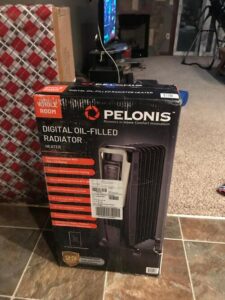
Visual scorecard
| Category | Rating | What it means in real life |
|---|---|---|
| Room heating | 4.4 / 5 | Strong in closed rooms; less predictable in open layouts |
| Quietness | 4.6 / 5 | Nearly silent while heating, but the button beep is loud |
| Ease of use | 4.1 / 5 | Remote, timer, and wheels help a lot |
| Thermostat accuracy | 3.0 / 5 | Comfortable, but not precise |
| Build quality | 3.6 / 5 | Many good units, but quality control is uneven |
| Value | 4.2 / 5 | Strong if you use it as zone heat instead of whole-home heat |
Best use case snapshot
| Use case | Fit | Why |
|---|---|---|
| Small bedroom | Good, but can run hot | Quiet and cozy, though 65°F may still feel warm |
| Medium bedroom | Excellent | Enough heat for steady overnight comfort |
| Home office | Excellent | Quiet enough for calls and computer work |
| Bathroom | Good | Works well in closed spaces, but needs safe placement away from water |
| RV / 5th wheel | Very good | Helps reduce propane use and keeps a compact space warm |
| Breezeway / enclosed porch | Good | Useful for cold transition spaces if drafts are controlled |
| Large open living room | Mixed | Can help, but don’t expect furnace-level coverage |
| Garage | Limited | Better for insulated, enclosed spaces than big drafty garages |
| Greenhouse / coop | Good with caution | Owners use it successfully, but placement and safety matter |
What the heat feels like
The PELONIS PH-14A gives you the classic oil radiator feel: slow to start, then steady and comfortable.
In everyday use, this PH-14A oil-filled radiator feels calmer than most fan heaters.
You won’t feel a blast of heat the second you turn it on. Instead, the oil inside has to warm up first. The oil inside has to warm up first. After that, the metal fins begin radiating heat into the room, and the space gradually feels softer, warmer, and more stable.
That’s the big difference between this and a fan heater. If you want a deeper breakdown of how this style works long term, see our oil-filled radiator heater guide. A ceramic heater gives you fast hot air, but it can feel dry, noisy, and uneven. The PELONIS feels calmer. Customers often describe it as a better bedroom heater because there’s no fan blowing across the room and no constant hum while you’re trying to sleep.
The warmth is not sharp or directional. It spreads slowly. That makes it better for maintaining comfort than for rescuing a freezing room in five minutes.
Here’s the easiest way to think about it:
| If you want… | This heater feels… |
|---|---|
| Instant hot air | Too slow |
| Quiet background warmth | Very good |
| Heat while sleeping | Strong, but maybe too warm for cool sleepers |
| Dry-air-free comfort | Much better than fan heaters |
| One-room heating | Exactly the right use case |
| Whole-home heating | Not the right tool by itself |
Heat-up speed: don’t judge it too early
Oil-filled heaters need patience. A few buyers expect fast heat because the listing says “rapid heating,” but this style simply doesn’t work like a forced-air heater.
Give it time.
In a closed bedroom, the heater can make a noticeable difference once the fins are hot.
Larger rooms may need longer to build up warmth.
Meanwhile, drafty areas will force it to work harder because warm air keeps escaping.
The nice part is what happens after it’s warm. The oil holds heat, so the room doesn’t feel as choppy as it can with some fan heaters. Even after cycling down, the radiator stays warm for a while.
That “slow rise, long hold” pattern is why people like it for bedrooms, offices, RVs, and older homes.
Coverage — the realistic story
PELONIS lists coverage at about 164 square feet. That’s a fair number for primary heating in a closed, reasonably insulated room.
In practice, insulation and airflow matter more than square footage alone. A 12 × 11 bedroom with the door closed is very different from a vaulted downstairs space, an old farmhouse room, or an open-plan apartment.
The PH-14A punches above its weight in small and medium closed rooms. Buyers mention bedrooms, offices, bathrooms, breezeways, RVs, she sheds, greenhouses, and even chicken coops. That tells you a lot about the heater’s real strength: it’s best as a local comfort heater.
For big open rooms, expectations need to be lower. It may help a lot, especially if the house already has some central heat running. But if you’re trying to make a large drafty open area feel like a fully heated living room, one 1500W radiator will have limits.
Realistic coverage guide
| Room condition | Best-fit coverage |
|---|---|
| Closed, insulated room as main heat | ~125 sq ft |
| Closed room as supplemental heat | ~190 sq ft |
| Drafty older room | ~90–125 sq ft |
| Open layout | Best used as supplemental heat only |
| RV / small enclosed space | Often very effective |
| High ceilings or leaky windows | Expect slower warming |
Controls: useful, but not perfect
The controls are one of the reasons people choose this model over a basic dial radiator.
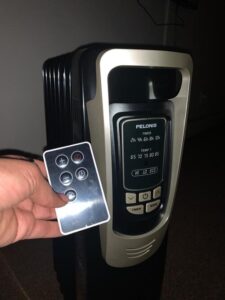
You get an LED display, on-unit buttons, a remote, a timer, and ECO mode. That sounds simple, but in daily use it makes a difference. Being able to adjust the heat from bed or a couch is genuinely useful.
The remote is the feature many people end up liking more than expected. If you wake up warm, you can turn the heater down without getting up. If you’re working at a desk, you can adjust it from your chair.
The catch is line of sight. The remote needs to be aimed at the front control panel. If the heater is beside the bed but facing the wrong direction, the remote can feel weaker than it should.
There’s also no true smart-plug behavior. If power is cut and restored, the heater won’t automatically resume heating. You need to turn it back on from the unit or remote. That matters if you wanted to pair it with a Wi-Fi outlet.
The thermostat issue
This is probably the biggest day-to-day complaint.
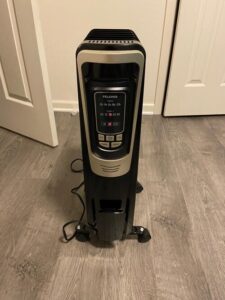
The heater lets you choose 65°F, 70°F, 75°F, 80°F, or 85°F. Simple enough. But many owners find that the room gets warmer than the selected number.
For example, people who set it to 65°F sometimes say the room lands somewhere in the 70s. In a small bedroom, that can be too warm for sleeping. In a cold office or drafty room, it may feel just right.
So don’t treat the thermostat like a precision climate-control tool. Treat it more like five comfort levels:
| Display setting | Real-world feel |
|---|---|
| 65°F | Low, but still warm in small rooms |
| 70°F | Comfortable for many bedrooms/offices |
| 75°F | Warm |
| 80°F | Very warm |
| 85°F | Hot-room territory |
If you like sleeping cool, this may be the wrong heater for your bedroom. If you’re always cold, you may love it.
However, many owners find the room gets warmer than the selected number.
ECO mode and timer
ECO mode is one of the best practical features here. It helps the heater cycle between power levels to maintain warmth instead of just blasting away at high all the time.
People often use ECO once the room is already comfortable. That’s the smart move. Let the room warm up, then use ECO or low mode to maintain it.
The timer is another useful feature. A lot of buyers don’t want a space heater running endlessly, so setting it for a few hours in the evening or morning helps. It’s especially handy if you use the heater before bed, while working, or to pre-warm a room.
The timer is not perfect. Some users find the instructions confusing, and the increments may not be as flexible as everyone wants. Still, for basic “run for a while, then shut off” use, it does the job.
Noise: almost silent — except for one thing
During normal operation, this heater is very quiet.
No fan. No rushing air. No buzzing motor. That makes it great for bedrooms, offices, Zoom calls, reading, studying, and sleeping.
The only real noise problem is the beep.
Every setting change comes with a loud, sharp beep. Owners compare it to the kind of sound that can wake someone up at night. And there’s no simple mute setting.
You may also hear light clicking when the thermostat cycles. Most people don’t mind that. The beep is the real gripe.
That said, the heater itself remains nearly silent while running.
Noise breakdown
| Sound source | How noticeable is it? |
|---|---|
| Fan noise | None |
| Normal heating | Very quiet |
| Thermostat clicking | Light to moderate |
| Button beep | Loud and annoying |
| Nighttime adjustments | Not ideal if someone is sleeping |
Portability and setup
The PH-14A weighs about 16 lb and comes with caster wheels. Once the wheels are installed, it’s easy to roll from room to room.
That matters because this heater makes the most sense as a zone heater. Use it in the office during the day. Roll it to the bedroom at night. Move it to a breezeway or enclosed porch when needed.
Assembly is usually simple, but not always smooth. Customers mention attaching the wheels and brackets, and many say it’s easy. Others report missing wingnuts, damaged screws, uneven wheels, or confusing caster placement.
So check the hardware before you need the heater on a freezing night. It’s a small thing, but it saves frustration.
The cord also comes up as a minor complaint. Some buyers wish it were longer. Since this is a high-wattage heater, avoid using random extension cords unless the manual allows it and the cord is properly rated.
Safety: better design than exposed coils, but still needs respect
Oil-filled radiators often feel safer than exposed-element heaters because there’s no glowing coil and no fan blowing heat onto nearby objects. Customers with pets, birds, kids, plants, and older homes often like that.
This model includes overheat protection and tip-over shutoff. The product description also mentions ETL certification and flame-retardant materials.
That said, don’t treat any 1500W heater casually.
A few owners report serious problems like oil leaks, overheated plugs, sparks, smoke, or melted plastic near the plug. These do not describe the typical experience, but they are important enough to mention clearly.
Use it the boring, safe way:
| Safety habit | Why it matters |
|---|---|
| Plug into a wall outlet | High-wattage heaters can overload weak strips or cords |
| Keep clearance around it | Radiators get hot during use |
| Inspect for oil leaks | A sealed oil heater should not leak |
| Check the plug temperature | A hot plug can signal a problem |
| Don’t ignore burning smells | Stop using it and investigate |
| Keep it upright | Oil-filled heaters are designed to run upright |
If it leaks, sparks, smokes, or makes a new electrical smell, stop using it. That’s not normal break-in behavior.
Energy use: can save money, but not by magic
Customers often buy this heater to reduce central heating use. That can work if you use it smartly.
For example, heating one bedroom instead of the whole house can make sense. Running it in an RV to reduce propane use can make sense. Using it in a home office while the rest of the house stays cooler can make sense.
But the heater itself is still electric resistance heat. As this PELONIS PH-14A review shows, it doesn’t use less electricity — it just distributes heat differently. If you’re comparing operating costs more closely, see our guide on how much space heaters cost to run.
On high, it uses up to 1500W. If you run it all day on high, your bill can go up.
The savings come from behavior, not magic efficiency. You save when this heater lets you lower the furnace, heat pump, baseboard heat, or propane system elsewhere.
Best settings strategy
| Situation | Suggested approach |
|---|---|
| Cold room, first start | Use High briefly to warm the room |
| Room is comfortable | Switch to Low or ECO |
| Sleeping | Try 65°F first, but watch for overheating |
| Working at desk | ECO mode usually makes sense |
| Leaving room soon | Use timer |
| Small bedroom | Avoid high unless it’s very cold |
| Drafty room | Close doors, block drafts, then use ECO |
Build quality and reliability
This is the mixed part.
Many buyers are happy with the build. They like the compact footprint, wheels, handle, digital display, and steady heat. Some people buy multiple units because the first one worked well.
That’s a good sign.
But there are enough quality-control complaints to be careful. Some units arrive with damaged screws, missing hardware, broken plastic, uneven wheels, or signs that they may have been returned before. Others work well for a season and then fail after sitting unused.
Reported failure signs include flashing lights, no heat, whining, buzzing, a failing remote, or reduced heating after storage.
The fairest read: when you get a good unit, the PH-14A can be excellent. When you get a bad one, the warranty window may feel too short.
Inspect it right away. Run it while you’re home. Watch for leaks during the first heat cycle. Keep the box until you’re sure it’s working properly.
On the other hand, quality control can be uneven.
PELONIS PH-14A vs common alternatives
| Compared with… | PELONIS PH-14A advantage | Where the other option may win |
|---|---|---|
| Ceramic space heater | Quieter, steadier, less drying | Faster heat, more compact |
| Basic oil radiator with knobs | Remote, timer, digital controls | Simpler, often better for smart plugs |
| Infrared heater | Better whole-room background warmth | Faster direct body heat |
| Central heat | Warms only the room you use | Better for whole-home comfort |
| Propane heater | No fuel tanks, no combustion indoors | Propane may be cheaper in some setups |
Who Should Buy It? — PELONIS PH-14A Review Summary
You’ll probably be happy with the PELONIS PH-14A if you want:
- Quiet heat for a bedroom or office
- A heater without fan noise
- Steady warmth instead of hot-air blasts
- A remote control you’ll actually use
- Supplemental heat for an older or drafty home
- A portable radiator you can roll between rooms
- A heater for an RV, enclosed porch, she shed, or small apartment
- Something that helps reduce use of central heat in one occupied room
Who should skip it?
You may want a different heater if you need:
- Instant heat within seconds
- Exact thermostat control
- A setting below 65°F
- Silent button presses
- Smart plug compatibility
- A heater for a large open layout
- The cheapest possible oil-filled radiator
- A unit with fewer electronic parts
Pros & Cons Analysis
Based on extensive testing and Amazon customer feedback
Pros
- Strong steady heat — Customers consistently say this heater makes bedrooms, offices, RVs, breezeways, and small apartments feel warm and comfortable once it gets going.
- Very quiet during normal heating — Many owners love that there is no fan noise, making it a good fit for bedrooms, offices, phone calls, and nighttime use.
- Remote control is genuinely useful — Buyers like adjusting the heat from bed, the couch, or across the room without getting up.
- Good for closed-room zone heating — Owners often use it to avoid heating the whole house, especially in bedrooms, offices, bathrooms, breezeways, and older drafty rooms.
- ECO mode helps with everyday use — Many buyers like using ECO or low mode for steady warmth without constantly adjusting the heater.
- Easy to move around — The caster wheels and handle make it practical to roll between rooms, offices, bedrooms, and small living spaces.
- Comfortable heat without blowing air — Owners with dry skin, pets, birds, or bedrooms often prefer the gentle radiator warmth over fan-forced heaters.
- Simple digital controls — Users like the clear buttons, display, timer, and heat modes compared with older dial-only oil heaters.
- Can reduce central heating use — Many buyers describe using it to take pressure off a furnace, heat pump, propane system, or whole-home electric heat.
- Generally feels safer than exposed-element heaters — Customers like the oil-filled design, tip-over protection, overheat protection, and lack of glowing coils.
Cons
- Not instant heat — Oil-filled radiators take time to warm up, and a few buyers expected faster results than this style of heater can realistically provide.
- Loud control beeps — A recurring complaint is the sharp beep when changing settings, turning it on, or turning it off, especially at night.
- Remote needs line of sight — Users mention that the remote has to be aimed directly at the front panel, and some report the remote failing after use.
- Open layouts are less predictable — It can help larger areas, but performance drops when the space is open, drafty, poorly insulated, or has high ceilings.
- Thermostat accuracy is hit-or-miss — Several users say the room gets much warmer than the selected setting, especially when set to the 65°F minimum.
- Assembly and hardware issues show up — Some buyers had missing wingnuts, damaged screws, uneven wheels, or confusing caster installation.
- Can overheat small bedrooms — People who sleep cool may find the lowest 65°F setting too warm, especially in smaller rooms with the door closed.
- Limited temperature steps — The five temperature settings jump in 5-degree increments from 65°F to 85°F, so fine-tuning to 68°F or 72°F is not possible.
- Electric bill can still rise — This is a 1500W electric heater, so running it often on high can show up on the utility bill.
- Some serious safety complaints exist — A small but important group of owners report oil leaks, overheated plugs, sparks, smoke, or units that failed after storage.
Our Verdict
The PELONIS PH-14A is at its best when you use it as a quiet room heater, not a miracle whole-house fix. Put it in a closed bedroom, office, RV, breezeway, or small living area, and it can make the space feel warm, calm, and comfortable without fan noise.
Its best qualities are easy to understand: steady heat, quiet operation, useful controls, a handy remote, and good portability. For people who want to heat the room they’re actually using, that combination makes a lot of sense.
The weak spots are just as clear. The thermostat can run warm. The beep is too loud. The remote needs line of sight. Temperature choices are limited. And quality control is not perfect, so the first few days of use matter.
If you want gentle, quiet, set-it-and-forget-it warmth for one room, this is a strong value. If you want instant heat, exact temperature control, or smart-plug automation, you’ll probably be happier with a different style of heater.
Frequently Asked Questions
How much space can the PELONIS PH-14A really heat?
PELONIS rates it for about 164 square feet, and that feels realistic for primary heating in a closed, reasonably insulated room. Customers also use it in larger bedrooms, offices, breezeways, RVs, and apartments as supplemental heat, but open layouts and drafts reduce performance.
Is the PELONIS PH-14A good for a bedroom?
Yes, especially if you want quiet, steady warmth without fan noise. The catch is that the lowest 65°F setting can still make smaller bedrooms warmer than some sleepers like, and the control beep is loud at night.
Does this heater warm up instantly?
No. Like most oil-filled radiators, it needs time to heat the oil and fins before the room feels warmer. Buyers often like the steady warmth once it is running, but this is not the best choice for instant blast heat.
Is the PELONIS PH-14A quiet?
During normal heating, customers describe it as very quiet because there is no fan. You may still hear loud beeps when changing settings and occasional clicking as the thermostat cycles.
Does the remote control work well?
The remote is useful, but it needs to be aimed directly at the front control panel. Some owners love it for bedtime adjustments, while others mention weak line-of-sight performance or remote failure over time.
Does the thermostat keep an accurate room temperature?
Feedback is mixed. Some users say it maintains a comfortable room, while others report that a 65°F setting can warm the room into the 70s or higher. Think of the temperature settings as rough comfort levels rather than lab-accurate readings.
Can I use the PELONIS PH-14A with a smart plug?
This is not ideal for smart plug control because the heater does not automatically resume heating when power is restored. You usually need to press the power button on the unit or remote after power is supplied.
Should I plug this heater into a surge protector or extension cord?
Use a proper wall outlet and follow the manual. One customer reported shutdowns when using a surge protector, and high-wattage space heaters are generally safest when plugged directly into a suitable wall outlet.
Does the PELONIS PH-14A smell when first used?
Some buyers notice a faint first-use odor as coatings burn off, while others report no smell. Running it in a ventilated area for the first heat cycle and wiping dust from the fins can help.
Are there reliability concerns?
Most owners report good heating performance, but reliability is the main caution. Complaints include failed units after a season, oil leaks on first use, flashing lights, buzzing, damaged parts, and rare plug overheating or sparking reports.
Technical Specifications
| Brand | PELONIS |
|---|---|
| Model / SKU | PH-14A (ASIN: B07XRP9M3F) |
| Heater type | Portable indoor electric space heater |
| Form factor | Tower / oil-filled radiator |
| Heating method | Oil-filled radiant and convection heat |
| Heating element | Sealed oil-filled radiator fins |
| Max heat output | 1500 W |
| Voltage | 110 V (listed) |
| Amperage | 13.64 A |
| Coverage (manufacturer claim) | Up to 164 sq ft |
| Temperature range | 65°F to 85°F (5°F increments) |
| Speeds / levels | 3 modes: High, Low, ECO (manufacturer lists 1500W / 900W / 600W; customer feedback suggests ECO cycles between power levels) |
| Noise level | Not specified (customers describe normal operation as very quiet; control beeps are loud) |
| Oscillation | No |
| Controls | On-unit digital controls + remote control |
| Timer | 10-hour timer |
| Power source | Corded electric |
| Mounting / placement | Free standing with caster wheels and carrying handle |
| Dimensions (D × W × H) | 15.16" × 6.38" × 26.06" |
| Weight | 16.09 lb |
| Color | Champagne |
| Special features | Adjustable thermostat, Electronic thermostat, ECO mode, Remote control, Digital display, 10-hour timer, Caster wheels, Carrying handle, Tip-over protection, Overheat protection, Flame-retardant materials |
| Safety certification | ETL certified (listed in product description) |
| Included in the box | Oil-filled radiator heater, Remote control, User manual, Caster wheel accessories |
| Warranty | 1-year manufacturer warranty |
| Recommended room types / uses | Bedroom, home office, bathroom, RV, breezeway, enclosed porch, small apartment, living room, she shed, greenhouse, chicken coop, drafty older rooms |
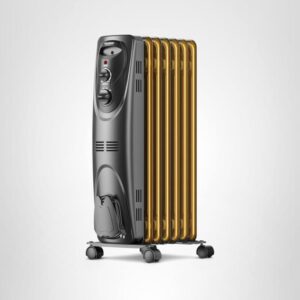
PELONIS Oil Filled Radiator Heater Review — Quiet, Steady Heat That Feels Like “Central Heating Lite”
If you’re shopping for a space heater you can run while you work, read, or sleep — the PELONIS oil…
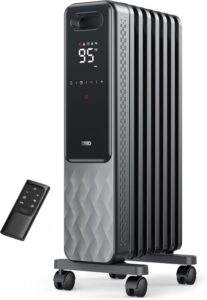
Dreo DR-HSH010 Review — Quiet Oil-Filled Heat for Rooms
This Dreo DR-HSH010 review looks at how this 1500W oil-filled radiator performs in real bedrooms, offices, RVs, and cold enclosed…
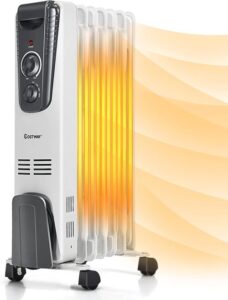
COSTWAY Oil Filled Radiator Heater Review: Quiet, Steady Heat for the Rooms You Actually Use
This COSTWAY 22611-CYPE review looks at whether this 1500W oil-filled radiator is a smart fix for cold bedrooms, offices, bathrooms,…
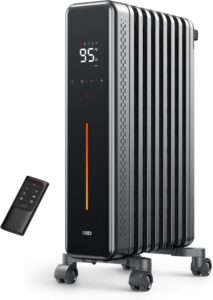
DREO DR-HSH011 Radiator Heater Review: Quiet, Steady Heat for Cold Bedrooms and Offices
This DREO DR-HSH011 review explores whether this portable 1500W oil-filled radiator is the perfect solution for cold rooms in your…


