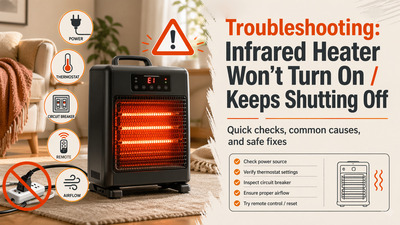
Infrared heater troubleshooting usually sounds easier than it turns out to be. You switch the heater on, expect that quick warm glow, and either nothing happens at all — or it starts heating, then shuts off a minute later for no obvious reason.
That’s what makes this so frustrating. Infrared heaters seem simple, so when they stop working, people naturally assume there must be one clear answer. In reality, the cause can be anything from a dead outlet or low thermostat setting to blocked airflow, a weak smart plug, or a safety sensor doing its job.
This guide keeps it practical. We’ll go through the most common reasons an infrared heater won’t turn on or keeps shutting off, the checks you can safely do yourself, and the signs that mean it’s time to stop troubleshooting and get help.
Infrared heater troubleshooting: quick answer first
Before getting into the full guide, here’s the short version.
| Symptom | Most likely cause | What to check first |
|---|---|---|
| Heater won’t turn on at all | Dead outlet, tripped breaker, thermostat setting, remote issue | Test the outlet, reset breaker, raise thermostat |
| Heater turns on, then shuts off fast | Overheat protection, blocked airflow, poor clearance | Let it cool, clear space around it |
| Heater works in one outlet but not another | Weak circuit, GFCI trip, overloaded outlet | Try a different wall outlet directly |
| Heater shuts off when moved | Tip-over switch or unstable surface | Put it on a flat, stable surface |
| Heater warms a little but not enough | Wrong size for the room, poor placement | Check coverage, drafts, and positioning |
| Remote works badly or not at all | Dead batteries, pairing issue | Replace batteries and re-pair if needed |
If your problem matches one of those patterns, you’re already narrowing it down.
Start with the simple checks first
A lot of heater problems turn out to be basic. That’s actually good news, because the easiest fixes are often the most common ones.
Start with power. Make sure the heater is plugged directly into a working wall outlet. Don’t assume the outlet is fine just because something nearby still works. Test that exact socket with another appliance. If the heater uses a fused spur, outdoor socket, or wall isolator, check that too.
Then move to the obvious controls. Make sure the heater is actually switched on, not just plugged in. If it has a thermostat, raise the setting above the current room temperature. If it uses a remote, try fresh batteries. A heater can look completely dead when it’s really just not being told to heat.
This is also the point where smart plugs, timers, extension cords, and power strips should come under suspicion. Infrared heaters can draw a lot of power, and weak accessories don’t always handle that well. A heater that seems faulty may actually be reacting to a poor connection or voltage drop.
The short version — before you blame the heater itself, rule out the outlet, the controls, and anything extra sitting between the heater and the wall.
Why an infrared heater won’t turn on
If your infrared heater won’t turn on at all, the most likely causes are power, settings, or a safety lockout.
1. Power isn’t reaching the heater
This is the first thing to check. It could be:
- a tripped breaker
- a dead outlet
- a GFCI trip
- a loose plug
- a faulty smart plug
- a damaged power cord
If another appliance works fine in the same outlet and the heater still does nothing, then it makes sense to move on to the control side.
2. The thermostat or timer is preventing startup
Sometimes the heater isn’t broken at all. The set temperature may be lower than the room temperature, so the heater has no reason to kick on. The same goes for timers, eco modes, or control panels that require a specific startup sequence.
This is especially common on newer heaters with remotes, Wi-Fi controls, or built-in timers. They can look unresponsive when the real issue is just settings.
3. A safety switch is blocking operation
Freestanding infrared heaters often have a tip-over switch. If the unit isn’t upright, level, and stable, it may refuse to run. Some heaters also need a full cool-down period after overheating before they’ll start again.
4. There may be an internal fault
If power is confirmed and the settings are correct, the problem may be internal — a faulty switch, failed thermostat, control board problem, bad wiring, or a blown thermal fuse.
This is where safe troubleshooting stops being casual. Visible inspection is one thing. Opening the casing, bypassing safeties, or jumpering parts to “test it” is another. If the heater only works when a safety feature is defeated, that’s not a fix. That’s a warning sign.
Why an infrared heater keeps shutting off
This is the other big side of infrared heater troubleshooting. The heater comes on, runs for a short time, then shuts off. Or it cycles on and off more often than it should.
In most cases, that means a safety device is being triggered.
Overheating is the most common cause
Infrared heaters often shut themselves down when internal heat builds too much. That can happen because of:
- blocked vents
- dust buildup
- covered surfaces
- poor airflow
- tight placement near walls or ceilings
- use in a cramped area the heater wasn’t designed for
That doesn’t always mean the heater is defective. Sometimes it simply means heat is getting trapped and the unit is protecting itself.
Sensor placement can fool the heater
Some heaters use a temperature sensor or thermostat bulb that can accidentally read the heater’s own heat instead of the room temperature. When that happens, the heater may shut off early because it thinks the room has already reached the target temperature.
That can look like a bad thermostat, but sometimes it’s really a sensor placement issue.
Power accessories can cause cycling
Cheap smart plugs, worn outlets, and overloaded extension cords can all cause intermittent shutoff. The heater may work for a bit, then cut out once the connection heats up or the voltage dips.
That’s why one of the best infrared heater troubleshooting tests is also one of the simplest: plug the heater directly into a known-good wall outlet with nothing else in the chain.
Infrared heater troubleshooting table by symptom
Here’s a practical lookup table for the most common patterns.
| What you notice | Likely cause | Try this |
|---|---|---|
| No lights, no heat, no response | No power | Test outlet, breaker, GFCI, power switch |
| Lights work, but no heat | Thermostat too low, timer expired, control issue | Raise temp, reset timer, check remote |
| Heats for 1–3 minutes, then shuts off | Overheat cutoff | Let it cool, clear vents, check spacing |
| Works better on low than high | Heat buildup or sensor issue | Clean it, improve airflow, check clearance |
| Shuts off when touched or moved | Tip-over switch | Stabilize it on a flat surface |
| Cuts in and out outdoors | Weak outdoor outlet, GFCI, smart plug issue | Use direct wall power, check outlet |
| Turns off before the room feels warm | Sensor misreading or undersized heater | Reposition heater, review room size |
| Repeated breaker trips | Circuit overload or internal fault | Stop using it and get it checked |
Step-by-step checklist to troubleshoot an infrared heater
If you want to work through the problem in a clean order, use this list.
1. Test the outlet
Plug in another device and make sure the outlet is actually live.
2. Check the breaker or GFCI
Garage, patio, and outdoor circuits trip more often than people expect.
3. Plug the heater directly into the wall
Remove:
- smart plugs
- extension cords
- timers
- power strips
- outlet splitters
4. Check the thermostat and controls
Raise the thermostat. Replace remote batteries. Make sure the heater isn’t in timer mode or waiting for pairing.
5. Let it cool fully
If it shut off while hot, wait before trying again. Some heaters need time to reset.
6. Check placement and airflow
Look for:
- curtains too close
- furniture blocking the front or sides
- dust on vents
- poor wall or ceiling clearance
- unstable placement on portable models
7. Clean visible dust
Only when the heater is unplugged and fully cool. Wipe the exterior and clear accessible vents. Don’t open the casing unless the manual clearly allows it.
8. Test again under simple conditions
One heater. One good outlet. No add-ons. No clutter around it.
If it still fails the same way, the problem is probably internal.
Electric infrared heaters vs gas patio heaters
Not all heater problems follow the same logic.
Portable electric infrared heaters usually fail because of outlet issues, thermostat problems, blocked airflow, bad cords, tip-over switches, or internal overheat protection.
Wall-mounted and ceiling-mounted electric models add extra variables like clearance, remote pairing, control boxes, and sensor placement. A mounted heater that sits too close to a ceiling or beam may run hot and shut down early even if the heater itself is still fine.
Gas or propane infrared patio heaters are a different category. If they won’t stay lit, the issue may involve fuel supply, ignition, flame sensing, burner cleanliness, or ventilation. Gas smell, soot, or weak ignition are not “keep testing it” situations. Those are stop signs.
Infrared heater safety: what you can check and what you should leave alone
Some problems are reasonable to check yourself. Some are not.
| Safe for most people to check | Leave to a pro |
|---|---|
| Outlet power | Internal wiring |
| Breaker / GFCI | Thermal fuse replacement |
| Thermostat setting | Control board diagnosis |
| Remote batteries | Gas ignition parts |
| Visible cord condition | Burnt internal components |
| Dust on exterior vents | Sensor rewiring or bypassing |
| Clearance around heater | Anything involving opened live circuits |
A good rule is this: if the fix involves placement, settings, cleaning, or the power source, it’s usually fair DIY territory. If it involves internal electrical parts, fuel systems, or defeating a safety feature, stop there.
When to repair it and when to replace it
Some heaters are worth fixing. Some aren’t.
Replacement often makes more sense when:
- it’s a cheap portable heater with repeated shutdown issues
- the power cord is damaged
- it smells like melting plastic or burnt wiring
- the unit shows scorch marks
- parts are hard to find
- the problem appears internal and the heater is already old
For a more expensive wall-mounted heater, repair may still be worth it. For a low-cost portable unit, once the issue goes beyond simple external checks, replacing it is often the smarter move.
Bottom line
Most infrared heater problems come back to the same handful of causes — power issues, wrong settings, blocked airflow, overheating cutoffs, unstable placement, or weak accessories like smart plugs and extension cords.
That’s why the best approach is simple infrared heater troubleshooting, in order. Test the outlet. Check the breaker. Remove the extras. Raise the thermostat. Let the unit cool. Make sure it has room to breathe. If it still won’t turn on or keeps shutting off after that, the problem is probably internal.
At that point, don’t force it, don’t bypass safety parts, and don’t keep resetting it over and over. Getting the heat back on matters, but doing it safely matters more.