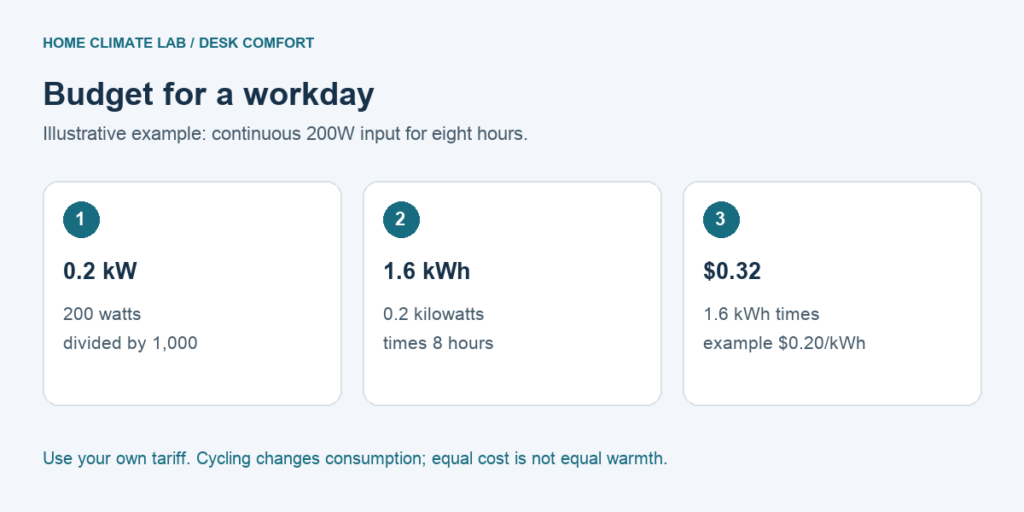
A 200W under-desk heater running continuously for eight hours uses 1.6 kWh. At an example electricity rate of $0.20 per kWh, that costs $0.32 per workday, or $6.40 for 20 identical days. Your actual bill depends on your unit’s input, how long it heats and your tariff.
Use this worksheet to budget for a desk routine. It is not a current electricity-price survey or a promise of savings against central heating. Every dollar figure below uses an illustrative rate, not a national average.
Write down these three inputs
- Electrical input in watts: read the exact unit’s label or documentation. Do not substitute a heat-output marketing claim, a similar model, or a different generation.
- Hours at that input: start with a continuous-use scenario. An eight-hour workday is not necessarily eight heating hours if the unit cycles or you turn it off during breaks.
- Your applicable price per kWh: use the usage-based rate on your tariff. If rates change by time of day, calculate those periods separately. Fixed account charges are not caused by switching on this heater.
The U.S. Energy Information Administration explains watts and kilowatt-hours: watts describe power, while watt-hours account for time. For this worksheet, divide watts by 1,000 to get kilowatts, then multiply by hours and your price per kWh.
Cost = watts ÷ 1,000 × heating hours × price per kWh.
Eight-hour workday examples
Each row assumes the stated input for all eight hours, $0.20/kWh and 20 workdays. The wattages are calculation examples, not claims about a particular product or equivalent warmth.
| Input | kWh / day | Cost / day | 20 days |
|---|---|---|---|
| 50 W | 0.4 | $0.08 | $1.60 |
| 100 W | 0.8 | $0.16 | $3.20 |
| 150 W | 1.2 | $0.24 | $4.80 |
| 200 W | 1.6 | $0.32 | $6.40 |
| 300 W | 2.4 | $0.48 | $9.60 |
| 500 W | 4 | $0.80 | $16.00 |
| 1500 W | 12 | $2.40 | $48.00 |
To adjust the table, multiply its costs by your tariff divided by $0.20. At $0.30/kWh, multiply by 1.5; the 200W example becomes $0.48 per eight-hour day. For a four-hour session at the same input, halve the eight-hour figure.
Separate heat settings, timers and thermostat cycling
A selectable heat level may change input power, cycle the heater, or use another control scheme. A label such as low does not reliably mean half the rated watts. Use a documented setting value or treat the result as an estimate based on full input.
A timer limits a session’s length. Restarting a four-hour timer for a second four-hour session gives eight scheduled hours, not four. Time spent off for lunch should be excluded. Standby consumption, if any, is separate and is not included in this table.
For a purely illustrative cycling example, a heater drawing 200W for a total of four hours during an eight-hour day uses 0.8 kWh for heating, costing $0.16 at the example rate. That is arithmetic, not a measured duty cycle for a reviewed product. Do not assign a 50% duty cycle just because a heater has a thermostat.
Check the model before using a product example
The original Cozy Legs CL-2 was advertised at 200W, so the 200W row is a useful continuous-input scenario for that rating. It is not a measurement of every unit or a substitute for checking your label. The current CL-RETAIL product has a different rating.
For the original WhisperHeat DSK1300, exact-model input remains unverified in our evidence. Its advertised session timer does not supply the missing wattage. We therefore cannot give it a defensible model-specific running-cost figure.
Decide what spending actually replaces
If you add a desk warmer while leaving the rest of your heating unchanged, the warmer adds electricity use. Savings require some other consumption to decrease; the size of that change is not established by this table.
For example, 200W and 1,500W devices running for the same eight hours differ by 10.4 kWh, or $2.08 at $0.20/kWh. That comparison does not mean the smaller device can perform the larger one’s room-heating job. It only compares electrical inputs over equal time.
The existing infrared running-cost guide discusses the broader heating-method question. For a desk purchase, first decide whether you need warmth beneath your feet or near your legs; then budget for the exact product and work routine.
Keep your calculation with the model number, input rating, tariff and assumed hours. Those four details make it easy to update the estimate when your schedule or rate changes, and prevent a low headline running cost from hiding a different heating task.