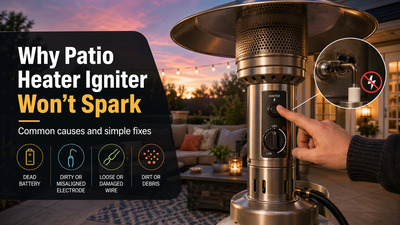
If your patio heater igniter will not spark, first identify whether it uses a mechanical piezo striker or a battery-powered igniter. A battery replacement only helps the second type. A click, by itself, does not prove that a spark reaches the ignition point—and a visible spark with no flame is a different problem.
Gas odor or hissing changes the task: stop ignition attempts, leave the area and keep ignition sources away. From a safe location, contact your propane supplier, 911 or the fire department. Do not return or restart until a qualified responder says it is safe. PERC’s gas-leak guidance explains the response, including when not to approach the tank shutoff.
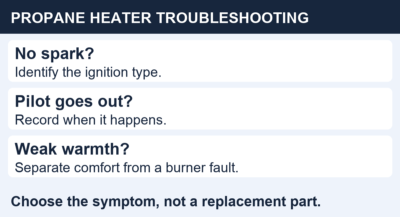
Start with the symptom you already observed
Use what happened during the last normal lighting attempt. Do not keep releasing gas to recreate the fault, remove guards to watch a spark, or put your face near the burner.
| What happened | What it tells you | Next step |
|---|---|---|
| No click and no spark | Ignition type matters before diagnosis | Find the model number and ignition instructions. |
| Click, but no visible spark | The sound alone cannot locate the fault | Use the manual’s inspection procedure; report a damaged button, wire or ceramic insulator to service. |
| Spark visible, but no flame | This is not simply a no-spark symptom | Stop repeated attempts and ask support about the specified lighting sequence and fuel supply. |
| Flame appears, then goes out | Ignition occurred; keeping the flame established is the separate problem | Use the pilot-out symptom guide. |
Piezo and battery ignition need different checks
A manual piezo striker generates the ignition spark mechanically; it does not need an ignition battery. AZ Patio Heaters identifies its BURN-PZ part as a manual piezo striker for specific commercial heater models. This is an example of the distinction, not a universal replacement recommendation.
For battery ignition, turn the appliance and fuel supply off as directed and let it cool before touching the battery compartment. Check the specified battery size, polarity marks and cap seating. Replace only the user-accessible battery described by your manual. Severe corrosion, a broken holder or wiring damage belongs with service.
Do not choose a battery size from a generic article or the appearance of the button. The mirrored Hiland commercial flame-heater manual contains conflicting AA/AAA wording between its parts list and assembly text. For that family, confirm the compartment marking and ask Hiland if the supplied instructions disagree.
What you can inspect without adjusting ignition parts
- Record the exact model and symptom. Include whether the heater is newly assembled, recently moved or returning from storage.
- Compare the exterior assembly with the model’s instructions. A missing guard, damaged cable or visibly cracked insulator is a reason to stop, not to try another lighting method.
- Limit cleaning to the owner maintenance instructions. Do not push wire into an orifice, bend an electrode to an estimated gap or spray cleaner into the controls.
- Ask for the correct part diagnosis. Give support the model, serial number and observations before ordering an igniter assembly.
The Hiland manual assigns repairs to a qualified service person. Its troubleshooting table is not permission to dismantle another heater’s ignition assembly.
When to stop trying to light it
Use the retry and waiting instructions supplied with your exact heater. There is no universal sequence for all patio heaters, and instructions for purging an initial installation are not interchangeable with a failed-ignition retry. If the documented sequence still fails, leave the heater off and contact the manufacturer.
Do not use a match as a general diagnostic shortcut. Some models describe manual lighting; that does not establish that it is appropriate for your appliance or this fault. The useful result here is a clear distinction: battery check, mechanical ignition fault, spark-without-flame, or a pilot that lights but goes out. That distinction helps support diagnose the right system.