DREO DR-HSH011 Radiator Heater Review: Quiet, Steady Heat for Cold Bedrooms and Offices
At a Glance
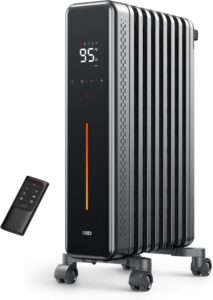
KEY FEATURES
- Power / Coverage: 1500W max output with 600W, 900W, and 1500W modes, rated up to ~250 sq ft*
- Heat levels: 4 modes including H1, H2, H3, and ECO mode
- Aim/Mounting: floor-standing design with caster wheels and portable room-to-room placement
- Controls: remote control, on-unit touch controls, digital thermostat, temperature display, and 24-hour timer
- Work light: no work light; includes front digital display and ambient temperature indicator
- Safety: tip-over protection, triple overheat protection, V0 flame-retardant material, safety plug, and ETL certification
- Size / Weight: 19.37" D × 10.12" W × 26.06" H, 20.59 lb, Space Gray
PROS
- Steady oil-filled warmth works well in enclosed bedrooms, offices, and basement rooms.
- Quiet operation makes it easy to use while sleeping, working, or watching TV.
- ECO mode and 600W/900W/1500W settings help manage comfort and power use.
- The remote, digital display, and timer make daily use more convenient.
- Casters and a side handle make it easier to roll between rooms.
- Tip-over protection, overheat protection, and ETL certification add peace of mind.
CONS
- It takes time to warm the space, so it is not the best choice for instant heat.
- Some users still hear relay clicks, metal creaks, hums, or loud button beeps.
- The thermostat can read several degrees off, so you may need to experiment.
- The front controls can be hard to see, and losing the remote makes operation less pleasant.
- A few buyers report dents, wobbly wheels, missing remotes, or shipping damage.
- Some owners report warm plugs, breaker trips, oil leaks, or outlet safety concerns.
Editor's Choice
Based on rigorous testing & Amazon customer feedback
🔥 Will This Heater Work For Your Room?
Answer a few quick questions about your space to see if this heater is a good match.
This DREO DR-HSH011 review explores whether this portable 1500W oil-filled radiator is the perfect solution for cold rooms in your home. We’ll look at its heat performance, noise level, safety features, and customer experiences.
It might be the bedroom at the far end of the house. In other cases, it’s the home office above the garage. Sometimes, it’s the basement room that never catches up with the rest of the house. Turning up the central heat works, but then you’re paying to warm rooms nobody’s using.
That’s where the DREO DR-HSH011 oil-filled radiator heater makes sense. It’s a 1500W portable radiator with 8 fins, a digital thermostat, remote control, ECO mode, caster wheels, and a 24-hour timer. It’s not a fan heater that blasts hot air at your ankles. It’s the quiet, slow-and-steady type that warms a room and keeps it comfortable.
The short version? It’s best for enclosed rooms where you want steady warmth without fan noise.
DREO DR-HSH011 Review Verdict
Overall, this DREO DR-HSH011 review shows that the heater performs best in small enclosed rooms where steady, quiet warmth matters more than raw power.
If you want a quiet heater for a bedroom, office, basement room, sunroom, guest suite, or cold corner of the house, the DREO DR-HSH011 is a strong pick. It’s easy to move, nearly silent, and much more comfortable for long use than a loud fan heater.
For a quick comparison of various heater types, check out our ceramic vs oil-filled radiator comparison. The thermostat can also be off by a few degrees. That said, some buyers report first-use smell, outlet warmth, or quality-control issues.
Treat it like a portable radiator — not a magic box for a huge open floor plan — and it makes a lot more sense.
DREO DR-HSH011 at a glance
| Feature | What you get |
|---|---|
| Heater type | Portable oil-filled radiator |
| Max power | 1500W |
| Heat settings | 600W, 900W, 1500W, ECO mode |
| Coverage claim | Up to 250 sq ft |
| Best real-world fit | Bedrooms, offices, basements, enclosed rooms |
| Controls | Remote + on-unit touch panel |
| Timer | 24-hour countdown timer |
| Thermostat range | 41°F to 95°F |
| Noise | No fan; mostly silent |
| Weight | 20.59 lb |
| Safety features | Tip-over protection, overheat protection, safety plug, ETL certification |
DREO DR-HSH011 Review Performance Scorecard
| Category | Rating | What that means |
|---|---|---|
| Room Heating | 4.1 / 5 | Very good in closed rooms, mixed in open spaces |
| Direct Heat | 3.6 / 5 | Warm near the unit, but not a hot-air blast |
| Consistent Warmth | 4.4 / 5 | One of its biggest strengths once the room is warm |
| Quietness | 4.7 / 5 | Nearly silent, aside from clicks, creaks, or beeps |
| Controls | 4.0 / 5 | Remote is handy, front panel is less loved |
| Thermostat Accuracy | 3.3 / 5 | Useful, but many owners adjust around it |
| Value | 4.0 / 5 | Good if you want quiet comfort, less impressive if you expect instant heat |
Heat profile: what kind of warmth should you expect?
| Heat trait | Rating | Visual |
|---|---|---|
| Slow warm-up | High | █████ |
| Quiet comfort | Excellent | █████ |
| Direct blast | Low | ██░░░ |
| Room stability | Strong | ████░ |
| Open-room power | Mixed | ███░░ |
| Bedroom friendliness | Strong | ████░ |
This chart tells the real story. The Dreo DR-HSH011 is not about “walk in cold, feel heat in ten seconds.” It’s about turning a chilly room into a comfortable room and keeping it there without noise.
That makes it a very different experience from a ceramic space heater. A fan heater gives you a quick hot stream. This gives you a slower, softer, more even warmth.
What the heat feels like in real life
Oil-filled radiators have their own personality. They don’t scream for attention. They sit there quietly, warm up, and slowly change how the room feels.
With the Dreo DR-HSH011, customers often describe the heat as steady and comfortable. The strongest warmth rises from the top, while the sides give off gentler heat. Once the radiator gets going, the room starts to feel more settled — less like a quick burst of hot air, more like the cold has been pushed out.
You’ll feel some warmth if you stand near it, but this is not a direct personal heater in the same way a quartz or ceramic heater is. It’s better at warming the room around you than blasting your hands or feet.
That’s why it works well in bedrooms and offices. As a result, it provides steady warmth without the annoying noise of other heaters. You can let it run in the background while you sleep, work, read, or watch TV. No fan roar. No dry-air blast. Just quiet heat building in the room.
Heat-up speed: fast enough, but not instant
Here’s where expectations matter.
Some buyers say it starts feeling warm within a few minutes. That’s true if you mean the heater itself. The fins begin warming, and you can feel heat rising from the unit.
But warming the whole room takes longer.
| Situation | What to expect |
|---|---|
| Standing near the heater | Warmth starts within several minutes |
| Small bedroom | Noticeable comfort after 15-30 minutes |
| Medium office or basement room | Better after 30-60 minutes |
| Cold open living area | May need hours or may feel underpowered |
| Very cold basement/shop | Works best when left running steadily |
This is normal for an oil-filled radiator. The heater has to warm the oil first. Then the oil warms the metal fins. Then the fins warm the air and surrounding surfaces.
The upside is that once the room is warm, the comfort feels more stable. Several owners mention that forced-air heaters warm quickly but cool off quickly too. This Dreo is slower, but the heat feels less jumpy.
Coverage — the realistic story
Dreo lists the coverage at 250 sq ft. That’s believable in a closed, insulated room. It’s optimistic for open layouts, drafty homes, unfinished basements, greenhouses, or rooms with high ceilings.
For more details on how to choose the right heater for different room sizes, check out our oil-filled radiator heater guide.
Think of the coverage like this:
| Space type | Realistic fit |
|---|---|
| Small bedroom | Excellent |
| Medium bedroom | Very good |
| Home office | Very good |
| Bathroom before showers | Good |
| Finished basement room | Good |
| Sunroom | Good if enclosed |
| Large living room | Mixed |
| Open living room + kitchen | Not ideal as the only heater |
| Garage | Only if insulated and enclosed |
| Greenhouse | Risky unless conditions are mild and protected |
A pattern shows up in customer feedback: people are happiest when they use it in a room that can hold heat. Close the door, limit drafts, and the heater has a fair chance.
Open spaces are different. If the living room spills into the kitchen, hallway, and staircase, the heater has to fight a much larger air volume. That’s when people start saying they need to set it very high or leave it running for a long time.
For primary heat, I’d think of this as a heater for roughly 175-200 sq ft in a typical home. As supplemental heat, it can help a larger zone feel more comfortable.
Best use cases
| Use case | Fit | Why |
|---|---|---|
| Cold bedroom | Excellent | Quiet, steady, remote-friendly |
| Home office | Excellent | No fan noise during calls or work |
| Nursery or guest room | Good | Consistent warmth, but keep it safely placed |
| Basement room | Good | Works well if enclosed and not too drafty |
| Room above garage | Good | Helps with stubborn cold spots |
| Bathroom warm-up | Good | Nice before showers, but keep away from water |
| Large open living area | Fair | Can help, but may not fully heat the space |
| Freeze protection | Mixed | May not restart automatically after power loss |
| Garage or shed | Mixed | Only in dry, enclosed, properly powered spaces |
The best match is someone who says, “My house is mostly fine, but this one room is always cold.”
That’s exactly where the Dreo DR-HSH011 fits.
ECO mode: useful, but you may need to outsmart it
ECO mode is one of the best features here. You set a temperature, and the heater cycles itself instead of running full power all the time. For long sessions, that’s helpful.
It’s especially nice in bedrooms. Warm the room first, switch to ECO, and let the heater maintain comfort while you sleep.
The catch is the thermostat. Some owners say it tracks well enough. Others say the display is several degrees off. A common workaround is simple: set the heater higher than your actual target.
| Desired room feel | Possible Dreo setting to try |
|---|---|
| Mild warmth | 68-72°F |
| Cozy bedroom | 74-78°F |
| Cold basement room | 78-85°F |
| Very cold space | H3 first, then ECO |
That doesn’t mean every unit is inaccurate. It means you shouldn’t trust the display blindly on day one. Use a separate room thermometer if you care about exact temperature.
Once you learn your unit’s behavior, ECO mode becomes much easier to live with.
Heat settings explained
The Dreo gives you three manual heat levels plus ECO mode:
| Mode | Power | Best use |
|---|---|---|
| H1 | 600W | Mild days, smaller rooms, lower power draw |
| H2 | 900W | Everyday steady heat |
| H3 | 1500W | Cold starts, larger rooms, faster warm-up |
| ECO | Automatic | Maintaining comfort once the room is warm |
For most people, the best routine is:
- Start on H3 to warm the room.
- Wait until the room feels comfortable.
- Switch to ECO to maintain the warmth.
- Adjust the target temperature if the thermostat reads off.
That setup avoids the “why isn’t it warming fast enough?” feeling that can happen if you start in ECO mode in a cold room.
Controls and remote: mostly convenient, slightly quirky
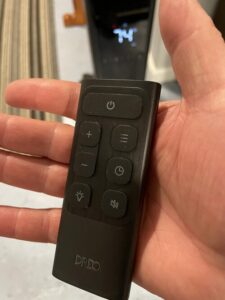
The remote is a big part of the appeal. If you’re using this heater in a bedroom, you’ll probably love being able to adjust the temperature without getting out from under the blankets.
Same for a home office. You can bump the setting up or down without breaking your flow.
The front panel is less charming. Some users find the touch controls hard to see, especially in dim light. A few mention that the icons take a little learning. H1 can look like “HI” at first glance, which is not ideal when H1 actually means the lowest heat level.
There’s also some inconsistency around the display behavior. Some owners like that the display dims or turns off in a dark room. Others wish it stayed on. A few say their unit doesn’t behave exactly like the listing suggests.
So yes, the controls are modern and useful. But they’re not perfect.
Timer: handy, but not a true schedule
The 24-hour timer is useful for simple routines. You can set it to shut off after you fall asleep, or turn on before you start work in a cold office.
Where it falls short is scheduling. This is not a “run every night from 10 p.m. to 6 a.m.” type of timer. It’s more of a countdown timer.
| Timer need | Does it work? |
|---|---|
| Shut off after bedtime | Yes |
| Turn on a few hours from now | Yes |
| Preheat an office before work | Yes, with manual setup |
| Repeat the same schedule daily | No |
| Smart app control | No |
That’s not a dealbreaker for everyone. But if you’re used to smart thermostats, app schedules, or full weekly programming, this will feel basic.
Noise: one of its biggest strengths
This heater is quiet enough for sleep, work, and TV rooms.
There’s no fan, so there’s no constant whoosh. Most of the time, it just sits there silently. If you’re comparing this with other heater types, see our space heater comparison guide for a breakdown of how different heaters handle noise and heat delivery. That’s a huge plus if you’re replacing a ceramic heater that makes your bedroom sound like a small server room.
You may hear faint clicks when the heater cycles. You may also hear small creaks or ticks as the metal expands and cools. That’s normal for this type of heater.
The one sound complaint that stands out is the beep. Button presses can be loud enough to annoy light sleepers, especially if the timer turns the heater on early in the morning.
| Sound source | How noticeable is it? |
|---|---|
| Fan noise | None |
| Relay click | Very faint for most users |
| Metal expansion creaks | Occasional |
| Electrical hum | Rare, but mentioned |
| Button beep | More noticeable |
| Sleep compatibility | Strong overall |
If silence is your top priority, this heater is still a much better fit than most fan-forced models.
First-use smell: real, but usually temporary
Some people get almost no smell. Others get a strong odor during the first burn-in.
That’s normal enough with heaters that get hot, but it’s still annoying if you expected to plug it in beside your bed right away.
The smartest move is to run it on high in a ventilated area before regular use.
| First-use step | Why it helps |
|---|---|
| Run on H3 for a few hours | Burns off manufacturing residue |
| Ventilate the room | Keeps odor from building up indoors |
| Avoid first use at bedtime | Gives the smell time to fade |
| Check for leaks | Makes sure the unit is safe before daily use |
A few owners say the smell lasted longer than expected. If the odor stays strong after multiple long burn-in sessions, or smells like melting plastic or electrical burning, don’t ignore it.
Power use and outlet safety
This heater pulls 12.5 amps at 1500W. That’s normal for a full-size electric space heater, but it’s still a heavy load for a household circuit.
Do not treat it like a lamp.
| Setup choice | Recommendation |
|---|---|
| Wall outlet | Best option |
| Power strip | Avoid |
| Light-duty extension cord | Avoid |
| Shared outlet with TV/computer/etc. | Not ideal |
| Old loose outlet | Avoid |
| Dedicated circuit | Best if available |
Some owners report warm cords or plugs. A few report breaker trips, melted plugs, or more serious outlet issues. Those are not “normal little quirks.” They’re warning signs.
Use a good wall outlet. Don’t run another high-draw appliance on the same circuit. Check the plug during the first few uses. If it gets hot, smells wrong, buzzes, or trips the breaker, stop using the heater.
This advice applies to pretty much every 1500W space heater, but it matters here because people often leave oil-filled radiators running for long stretches.
Build quality and design
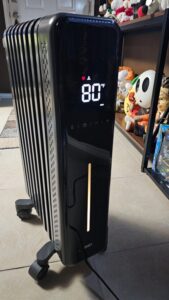
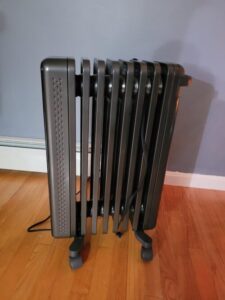
The Dreo DR-HSH011 looks nicer than many old-school oil heaters. The Space Gray finish, rounded fin design, front display, and smooth casing give it a more modern feel.
The casters are a real win. Customers like that it rolls across carpet and hard floors without much drama. At 20.59 pounds, it has enough weight to feel stable, but it’s still manageable to move.
The handles and front panel are plastic, which keeps the weight down but may not satisfy anyone expecting a thick, classic all-metal radiator. Some buyers describe it as sturdy. Others say it feels a little lighter or less heavy-duty than older oil radiators.
Quality control is the part that gives pause. Dents, shipping damage, wobbly wheels, missing remotes, oil leaks, and early failures all show up in customer feedback.
Most people seem to get a good unit. Still, inspect yours carefully before trusting it for daily use.
Reliability: the honest story
When this heater works, people really like it. Some owners use it through cold snaps, leave it running daily, or buy more than one because the heat is quiet and comfortable.
There are also buyers who had a rougher experience. A few units stopped working after weeks. Some leaked oil. Some arrived damaged. Others had odd behavior with the display, remote, or thermostat.
The most concerning complaints involve outlet heat or plug damage. Again, that’s not the typical experience, but it’s serious enough to mention clearly.
Here’s the practical checklist I’d use after buying one:
| What to check | Why it matters |
|---|---|
| Look for dents or leaks | Shipping damage can happen |
| Test all heat modes | Make sure H1, H2, H3, and ECO work |
| Test the remote | Coin batteries can be weak |
| Check the plug after 30-60 minutes | Warm is one thing; hot is a problem |
| Watch for strong burning smells | First-use odor should fade |
| Confirm tip-over shutoff | Especially important around pets or kids |
A good unit can be a great everyday heater. A bad unit should go back quickly.
Dreo DR-HSH011 vs fan heater
| Category | Dreo oil-filled radiator | Ceramic fan heater |
|---|---|---|
| Heat speed | Slower | |
| Noise | Much quieter | |
| Air dryness | Less noticeable | |
| Warmth feel | Softer and steadier | |
| Best use | Long room comfort | |
| Instant personal heat | Not as strong | |
| Cool-down | Gradual | |
| Dust blowing | No fan blowing dust |
A fan heater wins when you want fast heat right now. The Dreo wins when you want a room to stay comfortable without noise.
That’s why owners who use it overnight or during work tend to be happier than people expecting a fast blast in a large cold room.
Dreo DR-HSH011 vs older oil radiators
| Category | Dreo DR-HSH011 | Traditional oil radiator |
|---|---|---|
| Controls | Digital + remote | |
| Thermostat | Adjustable digital setting | |
| Timer | Yes | |
| Look | More modern | |
| Weight feel | Lighter, more plastic parts | |
| Simplicity | Less simple than dial controls | |
| Remote convenience | Big advantage | |
| Long-term rugged feel | Mixed |
The Dreo feels like a modernized oil radiator. That’s great if you want a remote, timer, display, and ECO mode. It’s less ideal if you prefer the simplicity of old dial controls and thick metal construction.
Best settings for common rooms
| Room | Suggested starting point | Notes |
|---|---|---|
| Small bedroom | H2, then ECO | Good balance of comfort and power |
| Cold bedroom | H3 for 20-30 minutes, then ECO | Preheat before bedtime |
| Home office | H3 to warm up, ECO while working | Quiet enough for calls |
| Basement room | H3 longer, then ECO | Concrete and drafts slow things down |
| Bathroom warm-up | H3 before shower | Keep safely away from water |
| Living room | H3, doorways limited if possible | Works better in enclosed spaces |
| Sunroom | H3, then ECO if insulated | Drafts matter a lot |
The big trick is not starting in ECO from a cold room and expecting miracles. Use H3 first. Let the heater build some heat. Then let ECO maintain it.
Who will probably love it?
You’ll probably be happy with the Dreo DR-HSH011 if you want:
- A quiet heater for sleeping or working
- Steady warmth instead of a hot fan blast
- A remote-controlled radiator for bedroom use
- Supplemental heat for one cold room
- A heater that doesn’t blow dust around
- A portable unit with smooth wheels
- ECO mode for long sessions
- A more modern-looking oil-filled radiator
This is a good fit for people who say, “I don’t need the whole house warmer. I just need this room to stop feeling cold.”
Who should skip it?
You might want something else if you need:
- Instant heat the moment you turn it on
- Strong airflow across a large room
- A heater for a big open floor plan
- App control or a true weekly schedule
- Automatic restart after a power outage
- A rugged old-school metal radiator feel
- A heater for damp outdoor or garage conditions
- A unit you can safely run from a power strip
This is not the best choice for someone who wants a loud but fast heater. It’s also not the heater I’d choose as unattended freeze protection if power interruptions are common, since some owners say it needs to be restarted manually.
Pros & Cons Analysis
Based on extensive testing and Amazon customer feedback
Pros
- Steady, comfortable room heat — Customers consistently describe the warmth as even and lasting, especially in bedrooms, offices, basement rooms, sunrooms, and drafty smaller living areas.
- Very quiet operation — Many buyers love that there is no fan noise, making it easy to use while sleeping, working, watching TV, or keeping a nursery warmer at night.
- Useful ECO mode — Owners like being able to set a target temperature and let the heater cycle on and off instead of blasting heat nonstop.
- Remote control is genuinely convenient — Buyers using it in bedrooms and offices appreciate changing heat levels, timer settings, and display brightness without getting up.
- Good for enclosed cold rooms — Customers report strong results in bedrooms, home offices, attic offices, basement shops, bathrooms before showers, and rooms above garages.
- Flexible wattage settings — The 600W, 900W, and 1500W levels let users manage warmth and power draw more carefully than a simple on/off heater.
- Easy to move around — The casters get frequent praise for rolling well across carpet and hard floors, and the unit feels manageable despite weighing over 20 pounds.
- No dry forced-air feeling — Customers switching from fan heaters like that this oil-filled radiator gives a softer warmth without blowing air around or drying out the room as much.
- Safety features add confidence — Owners mention tip-over protection, overheat protection, rounded fin design, and a surface that feels safer than many exposed-element heaters.
- Nice modern look — Buyers often mention the slim gray design, front display, temperature color indicator, and cleaner appearance compared with older oil radiators.
- Helpful timer for daily routines — People like using the timer to preheat an attic office, shut the heater off after bedtime, or avoid forgetting it on.
Cons
- Not instant heat — Several owners mention that it takes time to warm up, with some saying you may need 15-30 minutes before the room starts feeling noticeably better.
- Occasional clicks, creaks, or hums — A few users hear faint relay clicks or expansion noises, and some report electrical hums in older buildings or certain outlets.
- Thermostat can read high or low — A recurring complaint is that the display temperature may be several degrees off, so some users set it 6-10°F higher than the room temperature they actually want.
- Remote dependence can be annoying — Some customers say the front controls are harder to use, the power button is difficult to see, or the included coin battery may arrive weak or dead.
- Open layouts are a tougher ask — Feedback is more mixed in large living rooms, open kitchen/living areas, greenhouses, and spaces with lots of drafts or poor insulation.
- High power can stress outlets — Several owners warn not to use power strips or shared outlets, and a few report warm cords, breaker trips, melted plugs, or serious outlet concerns.
- Some units arrive damaged or uneven — A few buyers mention dents, shipping damage, missing remotes, wobbly wheels, or receiving a different color/model than expected.
- Less direct blast than fan heaters — Buyers expecting a hot-air stream may feel underwhelmed because the heat builds gradually instead of pushing warm air at you.
- Safety still depends on setup — Some reviews raise concerns about hot plugs, shared circuits, extension cords, and rare oil leaks, so outlet choice and inspection matter.
- Display and beep behavior can bother sleepers — Some users dislike the bright side glow, automatic display behavior, loud button beeps, or inconsistent display-off features between units.
- Timer is countdown-based — Buyers who want a true schedule, like 10 p.m. to 6 a.m. every night, may find the 24-hour timer useful but limited.
Our Verdict
The DREO DR-HSH011 is at its best when you use it as a quiet comfort heater for a room you actually spend time in. Bedrooms, offices, basement rooms, guest suites, and sunrooms are its natural habitat. Give it a closed door, a safe wall outlet, and enough time to warm up, and it can make a cold space feel much more livable.
Its strengths are real: quiet operation, steady heat, useful ECO mode, smooth wheels, remote control, and a nicer design than many basic oil radiators.
The weaknesses are also real. The thermostat may need adjusting. First-use smell can happen. The front controls are not everyone’s favorite. Quality control is not flawless. And because it’s a 1500W heater, outlet safety matters.
If you want instant heat, skip it. If you want quiet, steady, set-it-and-forget-it warmth in an enclosed room, the Dreo DR-HSH011 is a strong pick — just inspect it carefully, burn it in before bedroom use, and plug it directly into a proper wall outlet.
Overall, this DREO DR-HSH011 review shows that the heater performs best in small enclosed rooms where steady, quiet warmth matters more than raw power.
Frequently Asked Questions
Is the Dreo DR-HSH011 good for large rooms?
It can help in larger rooms, but it performs best in enclosed spaces where the doors are closed and drafts are limited. Customers get better results in bedrooms, offices, basements, and smaller living areas than in open floor plans.
How fast does the Dreo DR-HSH011 heat up?
Expect gradual heat, not instant warmth. Many users say it starts feeling warm within several minutes, but the room may need 15-30 minutes or longer to feel comfortable, especially from a cold start.
Is the Dreo DR-HSH011 quiet enough for a bedroom?
Yes, this is one of its strongest points. Customers often describe it as silent or nearly silent, though you may hear faint relay clicks, small metal creaks, or button beeps.
Does the ECO mode work well?
ECO mode is useful for set-it-and-forget-it comfort, but the thermostat may not match your separate room thermometer exactly. Some owners set the heater several degrees higher to reach the temperature they actually want.
Does this heater smell when first used?
Some units have little to no odor, while others give off a noticeable first-use smell. Many customers recommend running it on high in a ventilated area for a few hours before using it in a bedroom.
Can I use the Dreo DR-HSH011 with an extension cord or power strip?
The safer approach is to plug it directly into a wall outlet and avoid power strips. Several owners warn about warm cords, shared outlets, and breaker trips, especially on the 1500W setting.
Does the remote control work well?
Most buyers like the remote because it makes bedroom and office use easier. A few report weak batteries, missing remotes, or front controls that are annoying to use without the remote.
Is the thermostat accurate?
Feedback is mixed. Some customers find it close enough, while others say they need to set the display 6-10°F higher than their target room temperature.
Is the Dreo DR-HSH011 safe around pets or kids?
Customers like the rounded fin design, tip-over shutoff, and overheat protection, but the fins and control area can still get hot. Keep it clear of bedding, curtains, toys, pet beds, and anything that blocks airflow.
Will it restart after a power outage?
Some owners report that it does not restart automatically after a brief power interruption and must be turned on manually. That matters if you need unattended freeze protection.
What rooms is the Dreo DR-HSH011 best for?
It is best for bedrooms, home offices, attic offices, basement rooms, sunrooms, guest suites, bathrooms before showers, and enclosed rooms that need steady supplemental heat.
Technical Specifications
| Brand | Dreo |
|---|---|
| Model / SKU | DR-HSH011 Grey (ASIN: B0CQ2918KX) |
| Heater type | Portable indoor electric oil-filled radiator heater |
| Form factor | Free standing radiator |
| Heating method | Oil-filled radiant / convection heat |
| Heating element | Sealed oil-filled radiator with 8 fins |
| Max heat output | 1500 W |
| Voltage | 120 V |
| Amperage | 12.5 A |
| Coverage (manufacturer claim) | Up to 250 sq ft |
| Temperature range | 41°F to 95°F (1°F increments) |
| Speeds / levels | 4 modes; heat levels include H1/H2/H3 (600W/900W/1500W) plus ECO mode |
| Noise level | Not specified (customers describe it as quiet / nearly silent) |
| Oscillation | No |
| Controls | On-unit touch controls + remote control |
| Timer | 24-hour timer |
| Power source | Corded electric |
| Mounting / placement | Free standing with caster wheels |
| Dimensions (D × W × H) | 19.37" × 10.12" × 26.06" |
| Weight | 20.59 lb |
| Color | Space Gray |
| Special features | Digital display, Electronic thermostat, ECO mode, Remote control, 24-hour timer, Ambient temperature indicator, Tip-over protection, Triple overheat protection, Safety plug, Energy efficient mode |
| Safety certification | ETL certified |
| Included in the box | Radiator heater, Remote control with battery included |
| Warranty | Not specified |
| Recommended room types / uses | Bedroom, home office, living room, basement room, attic office, sunroom, guest suite, bathroom warm-up, craft shed, mobile home, RV / fifth wheel |
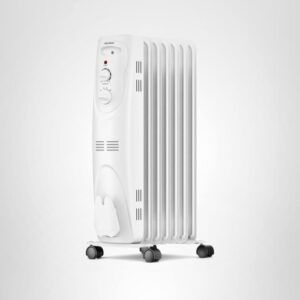
PELONIS Oil Filled Radiator Heater Review — Quiet, Steady Heat You Can Live With
If you’re searching for a PELONIS oil filled radiator heater review, you’re probably after the same thing most people want…
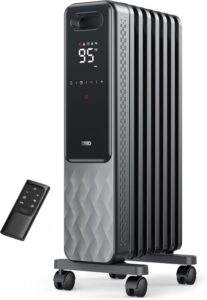
Dreo DR-HSH010 Review — Quiet Oil-Filled Heat for Rooms
This Dreo DR-HSH010 review looks at how this 1500W oil-filled radiator performs in real bedrooms, offices, RVs, and cold enclosed…
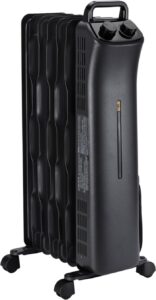
Amazon Basics Oil Space Heater – 7-Fin Portable Radiator with Thermostat, 1500W
Product Overview The Amazon Basics Oil Space Heater delivers steady radiant warmth for small to medium-sized rooms. With 7 oil-filled…
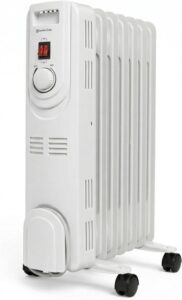
Comfort Zone CZ7007J Review: Quiet, Steady Warmth for Small Rooms
This Comfort Zone CZ7007J review looks at whether this compact 1200W oil-filled radiator heater is a smart choice for small…


