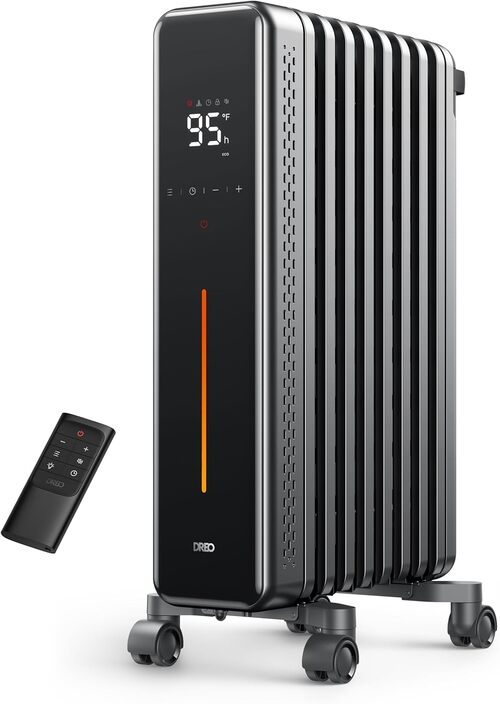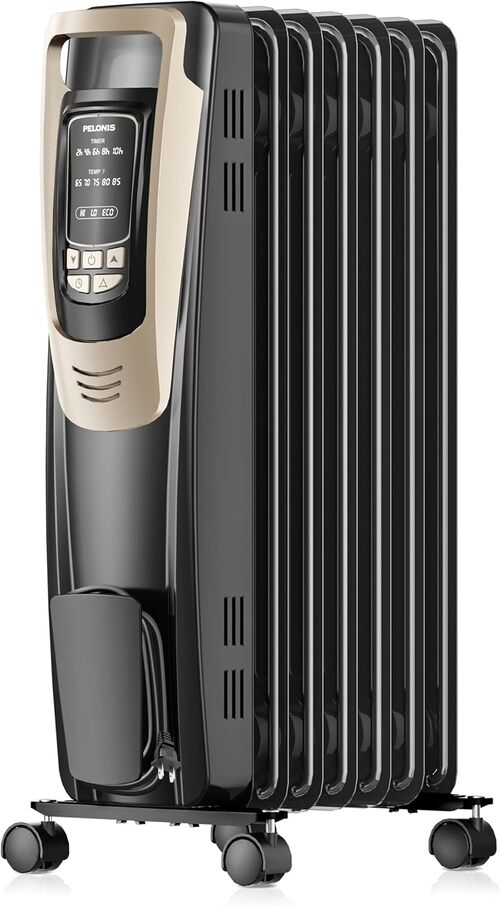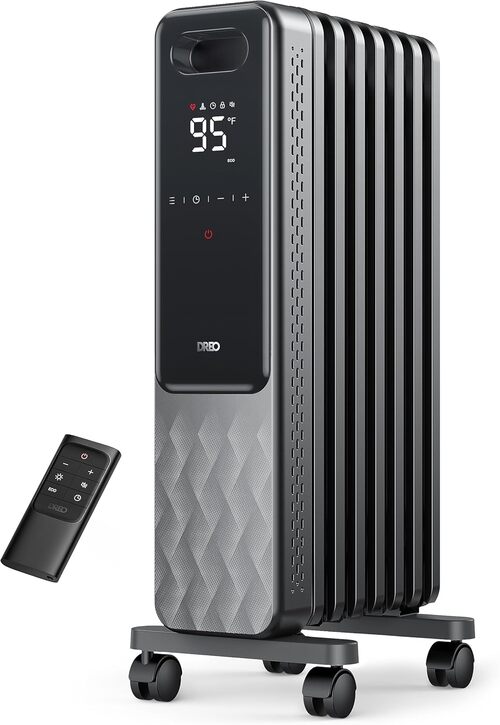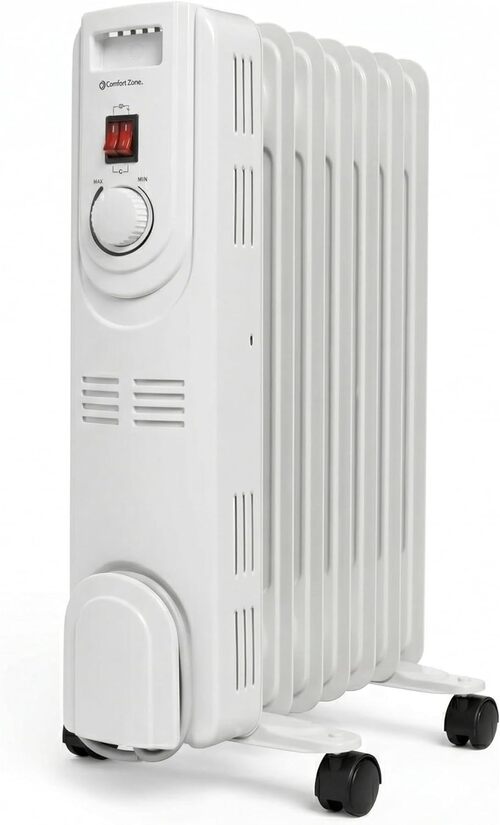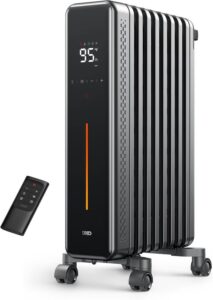
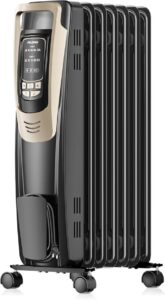
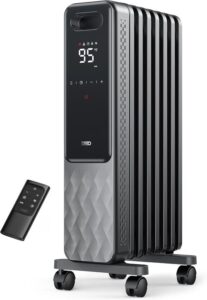
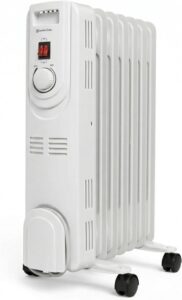
Choose an oil-filled radiator for gradual warmth in a room you are using, especially when you dislike fan noise. Start with controls and heating demand: Dreo HSH011 offers finer digital adjustment, Pelonis PH-14A uses coarse presets, HSH010 needs an ECO-behavior check, and Comfort Zone CZ7007J is the mechanical, lower-power option.
Which tradeoff fits your room?
| Attribute | Dreo DR-HSH011 (US, standard) | Pelonis PH-14A (US) | Dreo DR-HSH010 (US, standard) | Comfort Zone CZ7007J (US) |
|---|---|---|---|---|
| Maximum rated input | 1500 W | 1500 W | 1500 W | 1200 W |
| Thermostat adjustment | Digital; 41–95 °F, 1 °F steps | Digital; 65–85 °F, five presets | Digital; 41–95 °F, 1 °F steps | Mechanical adjustable dial; no numbered °F setpoint |
| Timer range | Up to 24 h | 2 / 4 / 6 / 8 / 10 h | Up to 24 h | No built-in timer shown in manual |
| Remote control | Included | Included | Included | No remote shown in manual |
This is a conditional shortlist of four US models whose documentation and owner evidence were reviewed for this revision. It is not a test-lab ranking or a claim to cover every radiator on sale. Generic Pelonis listings and other models are not interchangeable with these exact products.
How to choose before comparing prices
- For flexible temperature selection, start with Dreo HSH011. Its broader range does not guarantee a more accurate room temperature.
- For remote operation with a small set of presets, consider Pelonis PH-14A. Skip it if its 65 °F minimum is already above your target.
- Consider Dreo HSH010 only with its ECO and start-up caveats in view; do not assume it behaves identically to HSH011.
- For a mechanical dial and modest supplemental heat, consider Comfort Zone CZ7007J. Its 1200 W maximum cannot be treated as equivalent capacity to 1500 W.
Before budgeting for regular use, calculate your oil-filled radiator running cost from the unit’s documented input, your tariff and heating hours. The guide separates continuous-input estimates from thermostat cycling.
What owner reviews change about this shortlist
The positive evidence is about useful warmth, low fan-related disturbance, remote convenience and, for some models, mobility. The contrary evidence is equally relevant: temperature offsets, control frustrations, odor, weak room performance and isolated failures. We read original Top/Critical samples collected October 25, 2026, keeping variants separate. These are selected accounts, not failure-rate measurements or a controlled head-to-head test.
The PH-14A subset excludes a pooled silver ASIN; CZ7007J accounts lack child-variant labels. HSH010’s older start-up complaints are not carried over to HSH011. Individual reviews below explain those limits and link to the underlying owner accounts.
When this type of heater is the wrong choice
If you need an immediate stream of warm air, a radiator is a poor match for that sensation. If an open or poorly insulated room loses heat faster than a portable heater supplies it, extra digital features will not fix the problem. Avoid choosing a heater by a single advertised room size or an owner’s electricity-bill anecdote. No current-price winner or guaranteed energy saving is claimed here.
Use a direct wall outlet and keep combustibles at least three feet away. Turn the heater off before sleeping or leaving it unattended. CPSC guidance applies even when a heater has a timer or tip-over protection.