Dreo DR-HSH010 Review — Quiet Oil-Filled Heat for Rooms
At a Glance
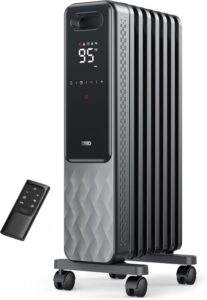
KEY FEATURES
- Power / Coverage: 1500W max output with 600W, 900W, and 1500W modes, rated up to ~250 sq ft*
- Heat levels: 3 manual heat settings plus ECO mode for thermostat-based temperature control
- Aim/Mounting: free-standing floor placement with caster wheels and carry handle; no oscillation or directional aiming
- Controls: touchscreen control panel, LED display, remote control, mute mode, screen-off mode, and 24-hour timer
- Safety: overheat protection, tip-over protection, child lock, burn-proof plug, fire-resistant material, and ETL listing
- Size / Weight: 12.83" D × 9.92" W × 26.14" H, 17.6 lb, Space Grey
PROS
- Quiet oil-filled heat works well for bedrooms, offices, RVs, and kids' rooms.
- Steady radiant warmth feels gentler than fan-forced ceramic heat.
- Works best in enclosed rooms where the heat can build and hold.
- Remote, timer, mute mode, and screen-off mode are useful daily features.
- 600W, 900W, and 1500W settings help manage power use manually.
- Tip-over protection, overheat protection, child lock, and enclosed heating add peace of mind.
CONS
- It can still click, pop, buzz, or whine enough to bother very sensitive sleepers.
- It takes longer to warm a room than a fan heater.
- Open living areas, drafty rooms, and oversized spaces can feel underheated.
- Touch controls are hard to see or feel in the dark without the remote.
- ECO temperature mode does not let you manually cap the wattage level.
- The radiator surface still gets hot and needs careful placement around kids and pets.
Editor's Choice
Based on rigorous testing & Amazon customer feedback
🔥 Will This Heater Work For Your Room?
Answer a few quick questions about your space to see if this heater is a good match.
This Dreo DR-HSH010 review looks at how this 1500W oil-filled radiator performs in real bedrooms, offices, RVs, and cold enclosed rooms — not just on a spec sheet.
There’s cold, and then there’s that one room cold. The bedroom that never matches the thermostat. The basement office where your hands get stiff by 10 a.m.
You know the room. The bedroom that never matches the thermostat. The basement office where your hands get stiff by 10 a.m. The RV corner that feels chilly even when the rest of the space is fine. Or the older apartment where central heat technically works, but somehow still leaves you reaching for an extra blanket.
That’s where the DREO DR-HSH010 oil-filled radiator makes the most sense. It’s not a flashy heater. It doesn’t blast hot air across the room or glow like a fireplace. Instead, it gives off a slow, steady, quiet warmth that builds over time.
Customers who like it tend to use it the right way: in bedrooms, offices, RVs, kids’ rooms, bathrooms, basement rooms, and other contained spaces. People who expect it to heat a huge open living room like a furnace are usually less impressed.
Dreo DR-HSH010 Review — Quick Verdict
If you’re reading this Dreo DR-HSH010 review looking for quiet, steady heat for a bedroom or office, here’s the short answer: it’s a strong pick in the right room. It’s comfortable, quiet, easy to live with, and more polished than basic dial-style oil radiators. The remote, timer, ECO mode, mute setting, and screen-off mode all feel useful in real life.
The catch is that it’s still an oil-filled radiator. It takes time to warm a room, the surface gets hot, and the ECO mode has a few quirks. It’s better as a room-by-room comfort heater than a whole-house rescue plan.
Quick scorecard
| Category | Rating | Real-world meaning |
|---|---|---|
| Room heating | 4.1 / 5 | Very good in enclosed rooms, weaker in open layouts |
| Warmth comfort | 4.4 / 5 | Gentle, steady heat without a fan blast |
| Speed | 3.4 / 5 | Warms gradually; not an instant-heat heater |
| Controls | 4.0 / 5 | Remote and timer are handy, but touch buttons are hard in the dark |
| Quietness | 4.4 / 5 | Mostly silent, though some users notice clicks, pops, buzzing, or whine |
| Safety confidence | 4.3 / 5 | Good safety features, but the radiator body still gets hot |
| Value | 4.0 / 5 | Worth it if you want digital features and quiet heat |
Best uses at a glance
| Best for | Why it works |
|---|---|
| Bedroom heating | Quiet operation, screen-off mode, remote control, and steady overnight warmth |
| Home office | No fan noise during work calls and no hot air blowing at your face |
| Kids’ room or nursery | Stable temperature control and no fan cycling loudly at night |
| Basement hobby room | Steady background warmth for chilly enclosed spaces |
| RV use | 600W and 900W modes help avoid pulling too much current |
| Bathroom or cold extension | Helpful for taking the chill off, as long as it’s placed safely |
| Older homes | Good for warming the room you actually use instead of cranking central heat everywhere |
| Not ideal for | Why you may be disappointed |
|---|---|
| Large open living room/kitchen areas | The heat spreads slowly and can get lost in open layouts |
| Very drafty rooms | Warmth leaks away before the radiator can build comfort |
| Instant heat seekers | A ceramic or fan-forced heater feels hot faster |
| Smart plug routines | It does not automatically resume heating after power is restored |
| People who need cool-touch surfaces | The fins and sides can get very hot |
| Strict low-watt thermostat use | You can set wattage manually or use ECO temperature mode, but not both together |
What the heat feels like
The DREO DR-HSH010 gives off the classic oil radiator kind of warmth: slow, even, and comfortable. If you’re comparing heating styles, see our oil-filled radiator heater guide for a deeper breakdown of how this type works.
You don’t feel a blast of hot air as soon as it turns on. Instead, the oil inside heats up, the metal fins get warm, and the room gradually starts to feel less sharp around the edges. After a while, the warmth feels more settled than what you get from a small fan heater.
That’s why people often describe it as better for sleeping, working, or keeping a room comfortable over several hours. There’s no fan pushing dry air around. There’s no constant whoosh. The heat just sits in the room and builds.
The flip side is speed. If you walk into a freezing room and want heat in two minutes, this isn’t the best tool. It can take several minutes before the radiator really starts giving off heat, and a cold room may need 30 to 60 minutes before it feels properly comfortable.
Heat feel comparison
| Heater type | How it feels | Where the DREO fits |
|---|---|---|
| Ceramic fan heater | Fast hot air, quick spot warmth, more noise | DREO is slower but quieter and gentler |
| Infrared heater | Direct “sun on skin” warmth | DREO is less direct but better for gradual room comfort |
| Oil-filled radiator | Slow, steady, fan-free warmth | This is exactly the DREO’s lane |
| Central heat | Whole-home heating through vents or radiators | DREO works better as room-by-room support |
Coverage — the realistic story
DREO lists the heater for up to 250 sq ft. That can be realistic in the right space, but the room matters more than the number.
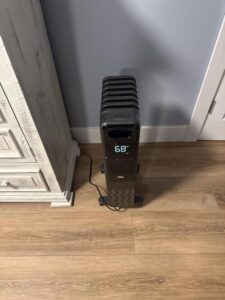
A closed bedroom, home office, RV, bathroom, or basement room gives this heater a fair chance. The warmth has time to build, and the radiator can hold the room at a comfortable level once it catches up.
Open layouts are harder. If your living room spills into a kitchen, hallway, and stairwell, one 1500W oil radiator can feel underwhelming. The heat spreads out, drafts pull it away, and you may only notice warmth near the heater.
In this Dreo DR-HSH010 review, coverage claims matter less than real-world room layout.
A better real-world expectation is this:
| Situation | Realistic expectation |
|---|---|
| Small enclosed room under 150 sq ft | Strong performance, usually comfortable |
| Bedroom or office around 150–185 sq ft | Good fit if insulation is decent |
| Room around 200–250 sq ft | Works as supplemental heat, not always as the only heat source |
| Open living area | Mixed results; may need multiple heaters or central heat support |
| Drafty older room | Helps, but drafts can overpower it |
| RV or small apartment zone | Often works well when used carefully with power limits |
The sweet spot is zone heating. Use it in the room you’re actually sitting, sleeping, or working in. That’s where it can genuinely improve comfort without asking your central system to warm the whole house.
Heat-up timeline
This heater rewards patience. Here’s a practical expectation based on how owners tend to describe it:
| Time after turning on | What to expect |
|---|---|
| 0–5 minutes | Heater starts warming, but the room may not feel different yet |
| 5–15 minutes | Fins get hot and warmth becomes noticeable nearby |
| 15–30 minutes | Small rooms start to feel more comfortable |
| 30–60 minutes | Enclosed bedrooms and offices can reach a steady comfort level |
| 1+ hour | Best results in cold or larger rooms, especially with the door closed |
That slow start isn’t really a flaw. It’s how oil-filled heaters work. Once the oil and metal body are hot, the heat feels smoother and less jumpy than a fan heater cycling on and off.
Controls and daily use
The DR-HSH010 is much more modern than a basic oil radiator with two knobs. You get a touchscreen-style control panel, LED display, remote, timer, mute mode, screen-off mode, child lock, and ECO mode.
The remote is one of those features people don’t always think they need until they use it. Adjusting the heater from bed is nice. So is turning it down from a desk without breaking focus.
The timer is useful too. You can set it to shut off after a certain number of hours or use delayed start so the room begins warming before you need it.
Here’s where it gets less perfect: the control panel looks sleek, but the buttons are hard to feel in the dark. Some owners say they end up hunting for the power button unless the remote is nearby. A backlit or tactile button layout would have made nighttime use easier.
Controls cheat sheet
| Feature | What it does well | Real-world gripe |
|---|---|---|
| Remote control | Easy adjustments from bed or desk | Works best when pointed toward the front |
| LED display | Big, clear temperature readout | Can be hard to see under bright light for some users |
| Screen-off mode | Great for bedrooms | You may need the remote if the room is dark |
| Mute mode | Turns off loud beeps | Some other clicks/pops can still happen |
| Touch panel | Looks clean and modern | No tactile feel |
| 24-hour timer | Handy for sleep and scheduled warmth | Not a full smart heater replacement |
ECO mode: good idea, slightly odd execution
ECO mode is meant to maintain your chosen temperature automatically. For a lot of people, that’s the mode they use most. Set a temperature, let the heater cycle, and stop fiddling with it.
When it works well, it feels like a set-it-and-forget-it feature. Owners using it in bedrooms and kids’ rooms often like that the room stays more stable than it did with fan heaters.
The limitation is control. Manual heat mode lets you choose:
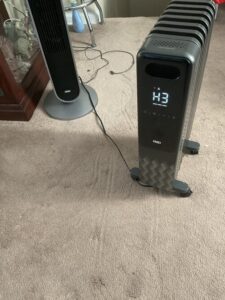
| Mode | Power draw | Best use |
|---|---|---|
| H1 | 600W | RVs, small rooms, lower circuit load |
| H2 | 900W | Moderate warmth without full draw |
| H3 | 1500W | Faster warm-up or colder rooms |
| ECO | Automatic | Maintaining a target temperature |
The problem is that ECO mode doesn’t let you say, “Keep the room at 70°F, but never go above 900W.” That bothers people in older homes, RVs, or rooms with other appliances on the same circuit.
Some owners also dislike the high-heat startup behavior. In a cold basement, that can be helpful. In a nursery or small bedroom, it can overshoot and make the room warmer than expected before settling down.
Noise: mostly quiet, not always silent
Most people buy oil-filled radiators because they want peace. On that front, the DREO mostly delivers.
There’s no fan motor. No air rush. No oscillation noise. For bedrooms, nurseries, and home offices, that’s a big plus.
Still, “quiet” doesn’t always mean “zero sound.” Some owners mention clicking when the thermostat cycles. Others hear popping or crackling when the metal heats up from cold. A few report a faint buzzing or high-pitched whine from the electronics or display area.
Sound profile chart
| Sound | How common it feels in customer feedback | What it means |
|---|---|---|
| Fan noise | None | There is no fan |
| Thermostat click | Occasional | Normal cycling sound |
| Popping during warm-up | Occasional | Usually expansion as the radiator heats |
| Beeps | Controllable | Mute mode helps |
| Buzzing or high-pitched whine | Less common, but reported | May bother sensitive sleepers |
| Display light | Manageable | Screen-off mode helps |
If you’re a light sleeper, use mute mode and screen-off mode right away. Also test the heater for a night before throwing away the packaging, just in case your unit has that electronic whine some people notice.
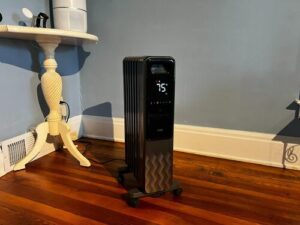
Safety: reassuring, but still needs respect
DREO includes a good safety package here: tip-over protection, overheat protection, child lock, fire-resistant material, a burn-proof plug, and ETL listing.
That’s a big reason people choose this over exposed-element heaters. There’s no glowing coil and no fan pulling in dust. Many owners feel better using it in bedrooms, kids’ rooms, and pet areas than they did with ceramic or infrared heaters.
But don’t confuse “safer design” with “safe to touch.” The radiator body can get hot. The fins, sides, and ends can be hot enough that you wouldn’t want a child grabbing them or a pet pressing against them for long.
Give it breathing room. Proper placement matters just as much as heater type — see our infrared heater placement guide for indoor safety and clearance tips. Keep it away from bedding, curtains, furniture, towels, papers, and anything that can block airflow. Plug it directly into a wall outlet, not a power strip.
Power use and electric bills
In this Dreo DR-HSH010 review, power use is one of the most important real-world considerations. That means warming the bedroom, office, or living space you’re actually using while keeping your central heat lower.
Plenty of owners like it for exactly that. They’re not trying to heat the entire home. They’re taking the chill off one room.
But electric heat is still electric heat. At 1500W, running it for long hours can add up fast. Some buyers saw savings because they used it strategically. Others saw their bill jump because they ran it constantly or asked it to heat too much space.
Practical power guide
| Setting | Power | Best for |
|---|---|---|
| H1 | 600W | Small rooms, RV use, lower draw |
| H2 | 900W | Everyday background warmth |
| H3 | 1500W | Cold starts and faster warm-up |
| ECO | Variable | Maintaining comfort once the room is warm |
The best strategy is simple: use high heat to warm the room, then switch to ECO or a lower setting once the space feels comfortable.
Build quality and setup
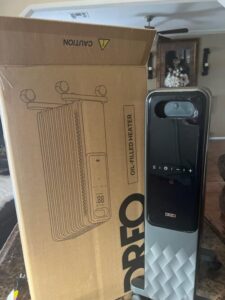
Setup is easy. The caster feet attach with wing nuts, so you don’t need much effort to get it ready.
The heater itself feels modern and fairly solid. The Space Grey finish looks nicer than the plain old oil radiators many people are used to, and the rounded design helps it blend into bedrooms and offices.
Rolling it around is fine on smooth floors. Hardwood and flat surfaces are the easiest. Carpet, thresholds, and stairs are less fun.
The biggest practical complaint is moving it while warm. The handle can get warm, and there isn’t a second handle on the opposite side. If you need to lift it over a step or carry it between floors, let it cool first.
Quality control looks a little mixed. Most buyers receive a working unit and use it happily. Some report missing screws, loose hardware, dented units, damaged packaging, dead remote batteries, or cheap-feeling casters. Check everything when it arrives, especially the wheels, cord, plug, and radiator body.
First-use smell and maintenance
Some units have a new-heater smell during the first few uses. A few owners say it fades quickly. Others say it took longer than expected.
The safest move is to run it on high in a ventilated area before putting it in a bedroom. If you can run it near an open window, in a garage, or under a covered outdoor area while supervised, that first burn-off period will be less annoying.
After that, maintenance is simple. Wipe dust off the fins before winter, keep the plug and cord in good shape, and don’t let lint or pet hair build up around the heater.
The biggest deal-breakers
The DREO DR-HSH010 is a good heater, but it has a few deal-breakers depending on how you plan to use it.
| Deal-breaker | Why it matters |
|---|---|
| No auto-restart after power loss | Bad fit for unattended freeze protection |
| ECO mode can’t be wattage-limited | Frustrating for RVs, old circuits, or shared outlets |
| Touch buttons are hard in the dark | Annoying for nighttime adjustments |
| Slow heat-up | Not ideal if you want instant warmth |
| Hot surface | Needs caution around kids and pets |
| Mixed quality-control reports | Inspect it carefully when it arrives |
The power-loss behavior is especially important. If the power goes out and comes back, the heater does not simply resume heating. That’s fine for normal bedroom use. It’s not great if you’re trying to keep pipes from freezing in a bathroom, workshop, or extension while you’re away.
Who should buy the DREO DR-HSH010?
You’ll probably be happy with it if you want:
- A quiet heater for a bedroom, office, RV, or nursery
- Gentle warmth without a fan blowing air around
- A heater that can run in the background while you sleep or work
- A remote control you’ll use from bed or your desk
- A timer for delayed start or auto shutoff
- A screen-off mode for dark bedrooms
- Supplemental heat so you can lower your main thermostat
- A more modern oil radiator than the old dial-style models
You may want to skip it if you need:
- Instant heat the second you turn it on
- One heater for a large open floor plan
- A heater that restarts automatically after outages
- A smart heater with app control
- A thermostat mode that also lets you cap wattage
- Physical buttons you can easily feel at night
- A cool-touch heater for very young kids or curious pets
Pros & Cons Analysis
Based on extensive testing and Amazon customer feedback
Pros
- Quiet, fan-free warmth — Customers consistently like that this oil-filled radiator heats without fan noise, blowing air, or the dry blast you get from many ceramic heaters.
- Comfortable steady heat — Buyers often describe the warmth as gentle, even, and more pleasant than forced-air heat, especially in bedrooms, offices, basements, and RVs.
- Good for closed rooms and cold spots — Feedback is strongest from people using it in bedrooms, kids' rooms, basement offices, bathrooms, RVs, and drafty rooms where doors can be closed.
- Useful power choices — The 600W, 900W, and 1500W heat levels are appreciated by people who want to manage circuit load or avoid running full power all the time.
- Remote and timer are genuinely useful — Owners like adjusting the heater from bed, setting delayed starts, and using auto shutoff so the room is warm when needed.
- Modern display and digital controls — The LED readout, touchscreen, mute option, screen-off mode, and temperature display make it feel more polished than basic dial-style radiators.
- Safety features give peace of mind — Buyers mention overheat protection, tip-over shutoff, child lock, stable design, and the enclosed oil-filled heating style as reasons they feel better using it in bedrooms or around pets.
- Easy basic assembly — Customers usually describe setup as simple: attach the caster feet with wing nuts, plug it directly into the wall, and start heating.
- Rolls well on flat floors — Many owners like that it is lighter than expected and can be moved between rooms, especially on hardwood or smooth flooring.
- Can reduce central heat use in the right setup — Owners using it for zone heating often say it lets them keep the furnace or electric central heat lower while warming the room they actually use.
- Good long-term reports from some owners — A number of buyers say it kept working through one or more winters and became their go-to heater for cold rooms.
Cons
- Not totally silent for everyone — Most owners describe it as quiet, but some mention thermostat clicks, occasional popping during heat-up, faint buzzing, or a high-pitched whine from the electronics/display.
- Slow room warm-up — Like most oil radiators, it takes time to heat the oil and then warm the room; owners who expected instant heat were often disappointed.
- Large open spaces are hit or miss — Several owners say it struggles in open living room/kitchen areas, very drafty rooms, or spaces beyond its realistic comfort zone.
- Thermostat and wattage cannot be combined manually — A common complaint is that you can choose H1/H2/H3 manually or use ECO temperature control, but you cannot set a fixed temperature while limiting the heater to 600W or 900W.
- Remote needs line of sight — Some users say the remote only works reliably when pointed toward the front of the heater, and a few wish it used a stronger signal or had a lit keypad.
- Touch buttons are hard to use in the dark — Owners repeatedly mention that the smooth, dark control panel has no tactile feel, so finding the power or temperature buttons at night can be annoying.
- Surface still gets hot — Even with safety features, owners warn that the fins and ends can get very hot, so it still needs open space around it and caution around children and pets.
- Occasional missing or poor assembly parts — Some buyers report missing wheel screws, loose hardware, damaged packaging, dents, or caster quality that feels weaker than the rest of the heater.
- Awkward to move while warm — The handle can get warm, there is no second handle, and lifting it over thresholds or stairs can be annoying because one side may be too hot to grab.
- Power bills depend heavily on use — Some buyers report savings, while others say their electric bill climbed sharply when they ran it for long hours or expected it to heat too much space.
- Digital behavior frustrates some use cases — It does not automatically resume heating after a power outage, and the ECO startup behavior can run high heat first, which annoys people using it for nurseries, freeze protection, or smart-switch routines.
Our Verdict
The DREO DR-HSH010 is the kind of heater that makes the most sense once you stop asking it to do too much.
Use it in a bedroom, office, RV, basement room, nursery, or cold enclosed space, and it can feel like a small-room hero. It’s quiet, comfortable, and easy to live with once the room is warm. The remote and timer are not just extra features — they’re the kind of little conveniences you end up using daily.
Just keep your expectations realistic. This is not an instant-blast heater, not a whole-house heater, and not the best choice for unattended freeze protection. The surface gets hot, the ECO mode has quirks, and the touch controls could be better.
For the right room, though, it’s a strong comfort heater. If you want steady, fan-free warmth and you’re okay giving it time to work, the DREO DR-HSH010 is easy to recommend.
Frequently Asked Questions
Is the Dreo DR-HSH010 good for a large room?
It can help in a larger room, but it performs best in enclosed spaces around bedroom, office, RV, basement room, or medium-room size. In open living room and kitchen layouts, customers often find that one unit is not enough unless the space is well insulated.
How long does the Dreo DR-HSH010 take to heat a room?
Expect gradual warmth, not instant heat. Owners commonly say the heater starts giving off noticeable heat after several minutes, but a cold room may need 30 to 60 minutes or more to feel fully comfortable.
Is this heater quiet enough for a bedroom?
For most people, yes. There is no fan, so it is much quieter than ceramic or forced-air heaters. That said, some users notice thermostat clicks, popping during warm-up, faint buzzing, or a high-pitched electronic sound.
Does the Dreo DR-HSH010 dry out the air?
Customers often describe the heat as gentler than fan-forced heat and less drying on the skin. Like any electric heater, it can still make a room feel drier over time, especially if it runs for long periods.
What is the best setting to use?
For quick warm-up, many owners use high heat first, then switch to ECO mode once the room feels comfortable. For lower circuit load, H1 at 600W or H2 at 900W can work well, but those manual modes do not let you set a target temperature.
Can I set a temperature and limit the heater to 600W or 900W?
No. Manual heat mode lets you choose H1, H2, or H3, but it runs continuously. ECO mode lets you set a temperature, but the heater chooses the wattage automatically.
Does the Dreo DR-HSH010 turn back on after a power outage?
No. Customers report that it remembers previous settings, but the heater stays off when power is restored until someone presses the power button again. That makes it less ideal for freeze protection through a smart plug.
Is the surface safe to touch?
The heater has safety protections, but the radiator fins and ends can still get hot. Owners recommend keeping it several feet from furniture, bedding, curtains, children, and pets.
Does it smell when first used?
Some buyers notice a new-heater or burn-off smell during the first few uses. Running it on high in a ventilated area for a few hours usually helps, though a few owners say the smell took longer to fade.
Should I use an extension cord or power strip with it?
No. Customers and product guidance point toward plugging it directly into a wall outlet. At 1500W and 12.5 amps, it can pull a lot of power, so extension cords and power strips are not a good idea.
Is the remote control useful?
Yes, especially at night or from a bed or desk. The main limitation is line of sight: some users say the remote works best when aimed toward the front of the heater.
Technical Specifications
| Brand | Dreo |
|---|---|
| Model / SKU | DR-HSH010 |
| Heater type | Portable indoor electric oil-filled radiator heater |
| Form factor | Free-standing radiator |
| Heating method | Radiant / natural convection |
| Heating element | Oil-filled sealed radiator fins |
| Max heat output | 1500 W |
| Voltage | 120 V |
| Amperage | 12.5 A |
| Coverage (manufacturer claim) | Up to 250 sq ft |
| Temperature range | 41°F to 95°F |
| Speeds / levels | 3 heat levels: 600W / 900W / 1500W; modes include Heat and ECO |
| Noise level | Not specified (fanless design; customers generally describe it as quiet) |
| Oscillation | No |
| Controls | On-unit touchscreen controls + remote control |
| Timer | 24-hour timer |
| Power source | Corded electric |
| Mounting / placement | Free standing with caster wheels |
| Dimensions (D × W × H) | 12.83" × 9.92" × 26.14" |
| Weight | 17.6 lb |
| Color | Space Grey |
| Special features | Digital thermostat, ECO mode, Remote control, Child lock, 24-hour timer, Mute mode, Screen-off mode, Tip-over protection, Overheat protection, Burn-proof plug |
| Safety certification | ETL listed |
| Included in the box | Radiator heater, Remote control with battery, Caster wheel parts, User manual |
| Warranty | Not specified |
| Recommended room types / uses | Bedroom, home office, basement room, kids’ room, RV, bathroom, cold extension, small apartment, supplemental zone heating |
COSTWAY Oil Filled Radiator Heater Review: Quiet, Steady Heat for the Rooms You Actually Use
This COSTWAY 22611-CYPE review looks at whether this 1500W oil-filled radiator is a smart fix for cold bedrooms, offices, bathrooms,…
PELONIS Oil Filled Radiator Heater Review — Quiet, Steady Heat You Can Live With
If you’re searching for a PELONIS oil filled radiator heater review, you’re probably after the same thing most people want…
Comfort Zone CZ7007J Review: Quiet, Steady Warmth for Small Rooms
This Comfort Zone CZ7007J review looks at whether this compact 1200W oil-filled radiator heater is a smart choice for small…
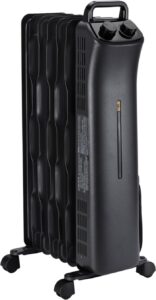
Amazon Basics Oil Space Heater – 7-Fin Portable Radiator with Thermostat, 1500W
Product Overview The Amazon Basics Oil Space Heater delivers steady radiant warmth for small to medium-sized rooms. With 7 oil-filled…


