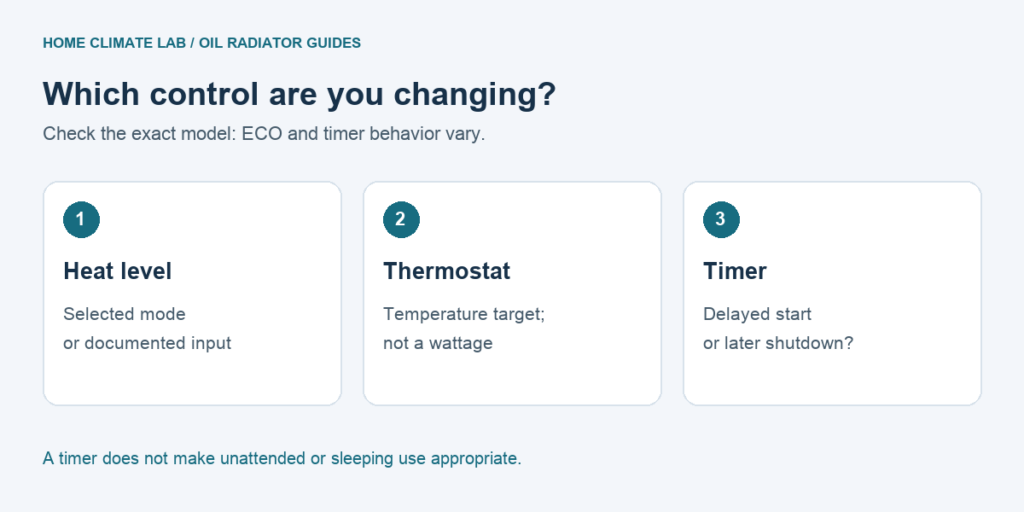
An oil-filled radiator’s heat level, thermostat and timer control different things. Heat level selects a heating mode or input level; the thermostat sets a temperature target; the timer controls when an action occurs. ECO combines controls in a model-specific way—it is not a universal low-power setting.
Start with the exact model’s manual, especially if the controls are labelled only with numbers or icons. This guide helps you interpret those controls and decide what to check next. It is not a universal button sequence or a repair procedure.
Identify which control you are changing
| Control | Question it answers | What not to assume |
|---|---|---|
| Heat level | Which heating mode or documented input is selected? | Low is half of high. |
| Thermostat target | What temperature is the control trying to maintain? | The number guarantees that temperature throughout the room. |
| ECO | How does this model adjust heating automatically? | A fixed wattage or a guaranteed saving percentage. |
| Timer | Does this setting delay start or stop operation later? | Every timer is an off countdown. |
Before changing anything, note the active mode, target and timer indication. That simple record prevents a common mix-up: changing a temperature target when the real question is whether a different mode or delayed start is active.
What a documented ECO cycle looks like
The Pelonis PH-14A manual gives a concrete example. Its ECO setting automatically chooses HI or LO to maintain the selected temperature. The documented target range is 65–85°F. When the sensed room temperature reaches the target, the element stops; it resumes when the room temperature falls below the target.
That explains why an otherwise normally operating PH-14A can pause without being switched off. It does not prove that another model’s pause has the same cause. For the PH-14A’s buying tradeoffs and owner experiences, see the exact-model review.
A target is not a room-wide temperature measurement
Treat the chosen number as the control target, then judge comfort at the place you use. A setting alone cannot establish the temperature at a distant chair, near a draft, or in an adjoining space. Nor does it tell you whether the displayed number is the target or a current reading; check the manual’s display explanation.
Record what you see rather than repeatedly changing several settings at once. Useful notes include the mode, displayed number, whether the element appears to be heating according to the documented indicator, and whether the room is becoming comfortable. Keep ordinary placement and clearances; do not cover or manipulate a sensor to force the heater to continue.
A dial marked with a scale is not necessarily calibrated in degrees. Do not turn a setting of 3 into an invented 73°F target. Follow that model’s thermostat-setting procedure. A digital control can offer more selectable numbers, but the number of steps does not establish better accuracy.
Read the timer’s starting condition
On PH-14A, the manual distinguishes a delayed start set from standby from a shutdown timer set while operating. That is why the same timer button can mean different things depending on the starting state. Confirm the intended action in your own model’s instructions before relying on the display.
A scheduled action also does not confirm that the room will reach your target by then. Avoid using a timer to extend operation into sleep or unattended periods. CPSC advises turning portable heaters off while sleeping; the timer and thermostat are not substitutes for the operating precautions.
Separate an ordinary pause from a problem
- Comfortable room, no fault indication: compare the pause with the thermostat behavior described in the manual. A heat cycle may be doing its intended job.
- Room still cold: check which mode, target and timer are selected before deciding the heater has failed. A full setpoint does not guarantee enough heating capacity for the space.
- Error indication, damaged cord, overheating signs or repeated unexplained shutdown: stop using it and follow the manufacturer’s support instructions. Do not bypass a safety cutout or keep restarting it to obtain heat.
If a setting behaves differently from its manual, record the model and symptom for support. Do not apply a reset procedure from a similar-looking heater or reinterpret an error code as normal thermostat cycling.
Choose the mode first, set the target according to the manual, and confirm what the timer will actually do. If your next question is the bill, use the oil-filled radiator cost guide. It separates electrical input from time spent heating, without assigning a saving percentage to the word ECO.