A 600W oil-filled radiator costs $0.12 per hour at an illustrative electricity rate of $0.20/kWh; a 1500W unit costs $0.30 per hour while drawing its full rated input. Those are continuous-input calculations. A thermostat can interrupt heating, so hours switched on and hours drawing full power are not necessarily the same.
This guide helps you budget for a portable electric oil-filled radiator. It does not estimate a fuel-oil boiler bill, assume overnight use, or claim that one heater supplies the same comfort as another.
Read the input rating before choosing a cost figure
Find the electrical input on the exact unit’s label or in its manual. If a setting has a documented wattage, use it. A control marked low does not automatically mean half of maximum input, and an ECO label does not supply a fixed wattage.
The EIA distinguishes power from energy use: watts describe the rate of electricity use; kilowatt-hours include how long it is used. The Virginia Tech energy-use worksheet gives the calculation: watts × hours ÷ 1,000, then multiply those kilowatt-hours by your rate.
Session cost = input watts ÷ 1,000 × hours at that input × price per kWh. Use the usage-based electricity rate on your bill. Fixed account charges are separate. For time-of-use pricing, calculate each tariff period separately.
What 600W, 900W, 1200W and 1500W cost
Every dollar figure below uses $0.20/kWh as an example, with continuous operation at the stated input. These are arithmetic scenarios, not measured consumption or settings available on every radiator.
| Input | kWh in 1 hour | Cost in 1 hour | Cost in 4 hours |
|---|---|---|---|
| 600 W | 0.6 | $0.12 | $0.48 |
| 900 W | 0.9 | $0.18 | $0.72 |
| 1200 W | 1.2 | $0.24 | $0.96 |
| 1500 W | 1.5 | $0.30 | $1.20 |
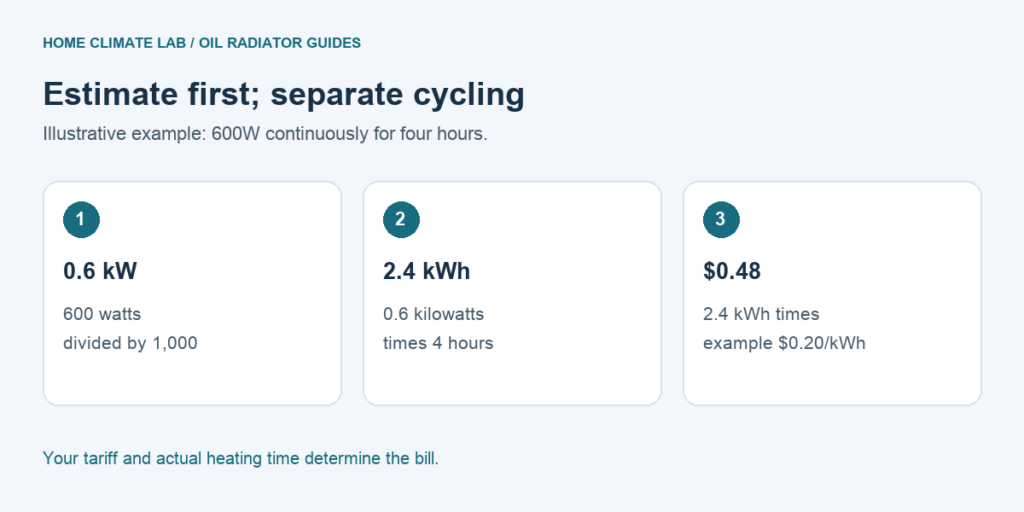
For example, 600W for four hours is 2.4 kWh and $0.48. Repeating that session on 30 days would be 72 kWh and $14.40. A 1500W unit operating continuously for those same hours would use 180 kWh and cost $36. These figures compare consumption, not equivalent room-heating performance.
If your rate is $0.30/kWh, multiply the table’s costs by 1.5. If you pay in another currency, use that currency’s rate directly in the formula; the arithmetic does not require converting it to dollars.
Allow for cycling without inventing a discount
Once the thermostat is satisfied, an element may stop heating and restart later. Some controls also select between power levels. The thermostat-settings guide explains why the selected mode matters before you estimate runtime.
Consider a purely hypothetical four-hour session with a 1500W element: two hours drawing 1500W and two hours with the element off would use 3 kWh for heating, or $0.60 at the example tariff. Four hours continuously at 1500W would be 6 kWh and $1.20. The first scenario is not an assumed 50% duty cycle for your heater. Controls and standby consumption are excluded.
For changing power levels, add the energy from each interval rather than applying one guessed discount to the whole session. Without reliable interval information, keep the full-input estimate as your budgeting scenario and label actual usage unknown. A warm radiator surface or a lit display alone cannot tell you how many kilowatt-hours were used.
Stored warmth was paid for earlier
The Australian Government’s heating guide explains that the oil is sealed inside an electric oil-filled heater and is not consumed as fuel. The element heats the oil and the appliance releases heat into the room. This is different from burning heating oil.
Warmth remaining after the element switches off comes from energy already put into the heater. Do not subtract an extra “free heat” allowance after accounting for the electricity it used. Likewise, a higher input for a shorter time and a lower input for longer can use the same energy: 1500W for two hours and 600W for five hours both equal 3 kWh. That equality does not establish equal comfort at each moment.
Make the budget match the way you use the room
Write down the model, documented input, planned attended hours and tariff. Keep the calculation separate from a claim about replacing central heating: adding a radiator while leaving other heating unchanged adds electricity consumption. Establish what other consumption actually falls before calling the change a saving.
Choose controls and heating capacity around the room’s needs, using the oil-filled radiator shortlist for model-specific tradeoffs. Lower input is cheaper for the same operating time, but it may not do the job you need.
Budget for sessions when you are awake and present. CPSC guidance says to plug portable electric heaters directly into a wall outlet, keep them away from combustibles and turn them off for sleep. A low hourly cost is not a reason to extend use beyond the operating instructions.