Amazon Basics B0828YLCY7 Review: Manual-Control Tradeoffs
At a Glance
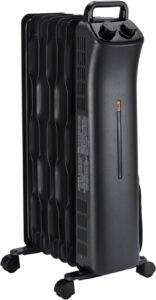
KEY FEATURES
- Manual-control oil-filled radiator; B0828YLCY7
- 600/900/1500 W settings and mechanical thermostat
- 120 V AC / 60 Hz; caster wheels and handle
- No remote or built-in timer shown in this version’s manual
PROS
- Useful room warmth reported by matching Manual Control owners
- Quiet operation appreciated by several owners
- Easy setup and portability reported
CONS
- Unnumbered thermostat requires trial-and-error adjustment
- Low-contrast markings and always-lit indicator can confuse
- Several owners report reduced power after startup
- Rear-wheel support, humming and eventual failures also reported
Price and availability subject to change
The Amazon Basics B0828YLCY7 Manual Control is a conditional choice for attended room warmth when you prefer physical knobs to a digital interface. Satisfied owners like the heat and portability. The more important buying limits are hard-to-read controls, an unnumbered thermostat and reports that high-setting power falls after startup.
Make sure you are comparing the manual version
The Amazon listing identifies B0828YLCY7 as Manual Control; Digital & Remote Control is a separate variation. This review uses original accounts labelled Manual Control. Complaints about a digital display, blue screen light or remote operation do not describe the controls reviewed here.
The manufacturer manual reproduced on Manuals+ specifies 600/900/1500 W settings, a MIN–MAX thermostat and 120 V AC / 60 Hz supply. The indicator stays illuminated while plugged in, even when switched off. It is not a dependable visual signal that the heater is actively heating.
Warmth is the appeal; finding the setting is the work
One Manual Control owner describes strong room warmth and a sturdy feel, but calls the unmarked thermostat a guessing game. Another likes the lasting warmth and quiet operation while finding temperature adjustment frustrating. That combination suits someone willing to adjust by comfort, rather than someone expecting to select an exact degree.
Readability deserves its own check. An owner with declining vision found the low-contrast markings and black pointers difficult to see. The same owner found setup and carrying straightforward, yet the always-lit indicator caused confusion. Do not equate fewer controls with easier use for every reader.
What the lower-power reports do—and do not—show
One owner reports a drop toward 900 W after startup; another describes a similar result from a different measurement setup. A third reports roughly 860 W. These accounts raise a practical concern if you need sustained high heat, but they do not establish the cause or prove every unit follows the same pattern.
The documented maximum remains 1500 W. We have not tested continuous output, diagnosed a protective control or verified a universal 900 W operating limit. Nor do the accounts justify calling the product falsely advertised. One of the reporting owners still liked it in a smaller office but found it inadequate after moving to a larger room. Treat room suitability as uncertain, not as a fixed square-foot promise.
Wheels, noise and service life have contrary evidence
A satisfied owner liked the casters and portability. Another describes poor rear-wheel support and a leaning unit. Check assembly and stability against the supplied instructions; do not keep using an unstable heater because a reviewer chose to do so.
Several matching accounts describe quiet heat, but one reports a hum. We do not adopt that account’s advice to keep the heater running continuously or use it for unattended pipe protection. For unfamiliar sounds, use the oil-radiator noise guide rather than assuming fanless means silent.
A repeat buyer reports replacing units after several years. That is neither a lifespan promise nor a failure rate. Check the seller, condition and current return terms; historical bargain comments do not establish today’s value.
A dry-room heater, used while awake
The manual excludes bathrooms, laundry areas and outdoor use, and warns that surfaces become hot. Customer anecdotes do not override those restrictions. Stop using a damaged or malfunctioning heater and seek service or a return; do not copy a review’s repair, reset or smart-plug workaround.
The CPSC advises switching portable heaters off when sleeping, keeping them at least three feet from combustible materials, and plugging directly into a wall outlet—not an extension cord or power strip. Follow the supplied instructions and turn it off before leaving it unattended.
For routine upkeep, the electric-heater cleaning and storage guide includes this B0828YLCY7 manual’s exterior-cleaning instructions and explains the boundary between owner cleaning and service.
If remote adjustment matters more than simple knobs, the Amazon Basics–Pelonis PH-14A comparison explains the control tradeoff. Neither model is presented as an overnight-use or reliability winner.
Pros & Cons Analysis
Benefits and limitations from the evidence discussed below
Pros
- A matching owner describes comfortable heat in a room with glass doors and a sturdy-feeling unit. This is a favorable comfort experience, not a transferable coverage test.
- Another owner likes quiet, lasting warmth despite disliking the thermostat. The useful benefit is comfort without a running fan, qualified by the humming report on the other side.
- One owner found assembly straightforward and liked the handle; another praised the casters. That supports convenient repositioning, while the rear-wheel complaint prevents a blanket claim about every assembly.
Cons
- One owner and another find the dial difficult to set consistently. If selecting a specific temperature is central to your routine, this interface is a poor match.
- Visibility is a separate limitation: An owner struggles with markings and indicator behavior; another also dislikes the lack of a clear heating-status light. Check whether you can read the controls where the heater will stand.
- Sustained input is uncertain: One owner, another and a third report power reduction. These are independent accounts from a selected sample, not our measurements or a verified design explanation.
- A rear-wheel complaint contrasts with favorable portability reports. Inspect stability and seek a return or service if the unit cannot stand correctly; improvised supports are not recommended.
- A humming report and a repeat buyer’s failures after years limit claims of silence and longevity. Neither establishes how frequently those outcomes occur.
Our Verdict
Choose B0828YLCY7 Manual Control only if you want attended supplemental warmth, prefer knobs and accept finding the thermostat position by feel. The positive heat and portability accounts explain its appeal, but difficult markings and uncertain sustained output deserve more weight than an old budget award.
Skip it if you need precise temperature selection, easily read controls, guaranteed silence or dependable full-power output for a demanding room. It is not a bathroom, sleeping-use or unattended frost-protection recommendation. No current offer price, editorial score or hands-on performance result is claimed.
Frequently Asked Questions
Does this review cover the digital version?
No. It covers B0828YLCY7 Manual Control. The Digital & Remote Control variation has different controls and must not supply display or remote claims for this model.
Why is the light on when the heater is off?
The checked manual says the indicator remains lit while the heater is plugged in. It does not by itself show that the heating element is operating.
Is it actually a 900 W heater?
The documented maximum is 1500 W. Several owners report lower input after startup, but their observations do not establish a universal 900 W specification or the cause of the change.
Can I use it in a bathroom or while sleeping?
The manual excludes bathrooms and laundry areas. CPSC guidance says to switch portable heaters off when sleeping. A protective shutoff does not override those limits.
Can a smart plug fix the thermostat?
No smart-plug setup is recommended here. An owner’s automation experiment does not establish manufacturer approval. Connect the heater directly to a suitable wall outlet.
Technical Specifications
| Model | Amazon Basics B0828YLCY7, Manual Control (US) |
|---|---|
| Electrical supply | 120 V AC / 60 Hz |
| Maximum rated input | 1500 W |
| Heat settings | I 600 W / II 900 W / III 1500 W |
| Thermostat adjustment | Mechanical MIN–MAX dial; no numbered °F setpoint |
| Timer range | No built-in timer shown in this manual |
| Remote control | No remote shown for this manual-control version |
| App control | No app operation shown in this manual |
| Mobility | Caster wheels; handle |
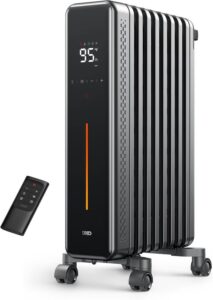
Dreo DR-HSH011 Review: Quiet Heat, Remote and Control Tradeoffs
The Dreo DR-HSH011 is a candidate for an occupied room where fan noise is unwelcome and remote adjustments are useful. Positive owners like its steady warmth and wheels. The strongest reason to hesitate is the control experience: a precise-looking setpoint can still require adjustment, and display behavior is not consistent across the sampled accounts.
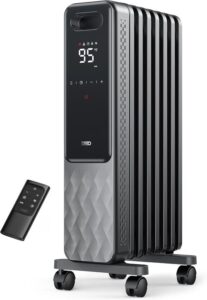
Dreo DR-HSH010 Review: Useful Warmth, ECO Mode Caveats
The Dreo DR-HSH010 suits someone who wants to warm an occupied, enclosed room without a fan running. Its remote is convenient, but temperature control deserves more attention than the digital display suggests. Owners report both comfortable steady heat and frustrating overshoot or start-up behavior.
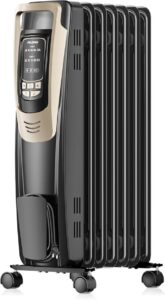
Pelonis PH-14A Review: Warmth, Remote Control and Thermostat Limits
The Pelonis PH-14A is a digital oil-filled radiator with a remote, not a basic dial-only heater. It is worth considering for an occupied room if strong background warmth matters more than fine temperature adjustment. Its main limitation is the coarse thermostat range, especially if you prefer a cool room.
Comfort Zone CZ7007J Review: Simple 1200W Heat and Its Limits
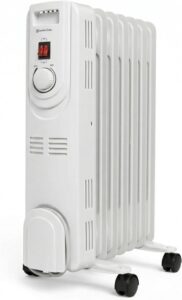
The Comfort Zone CZ7007J is for someone who wants a mechanical thermostat and modest supplemental warmth without learning digital controls. Its 1200 W maximum is lower than the 1500 W radiators in this comparison set. That limits heat input as well as electrical demand; it does not make unsuitable wiring safe.


