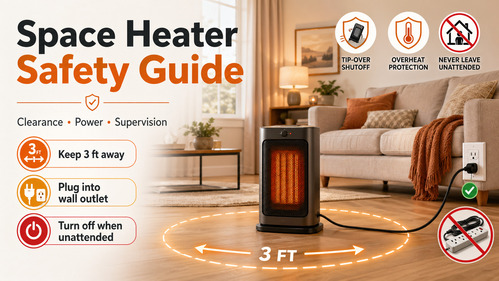
A space heater safety guide is really about three things: clearance, power, and supervision.
Space heaters are useful when one room feels cold, your home office is drafty, or you don’t want to crank up the whole heating system. The problem is that they’re high-wattage appliances, and small mistakes — like using an extension cord or placing one near curtains — can turn into real fire risks.
This guide breaks down the habits that actually matter. You’ll learn where to place a heater, how to plug it in, what safety features to look for, and when not to use one at all.
Oil-filled heaters are among the safest types. See our best oil filled radiator heaters for top safe models.
Space heater safety guide: the rules that matter most
Most space heater problems aren’t mysterious. They usually come from the same few mistakes: the heater is too close to something flammable, plugged into the wrong setup, left running unattended, or used in a place it wasn’t designed for.
That said, modern heaters are safer than older open-element models. Many include tip-over switches, overheat protection, timers, and cooler housings. Still, those features are backup protection — not permission to ignore the basics.
| Safety Rule | Why It Matters | Practical Example |
|---|---|---|
| Keep 3 feet of clearance | Reduces fire risk near combustibles | Keep away from curtains, bedding, sofas, paper, and clothes |
| Plug directly into the wall | Prevents overheated cords and overloaded strips | No extension cords, power strips, or outlet adapters |
| Use on a flat, hard surface | Prevents tipping and blocked airflow | Floor only — not beds, tables, chairs, or thick rugs |
| Turn off when unattended | Lets you catch problems before they spread | Off when sleeping, leaving the room, or leaving home |
| Inspect before use | Catches damaged cords, plugs, and housings | Stop using it if the plug is hot, cracked, loose, or smells burnt |
⚠️ Safety Warning:
A space heater is not a set-it-and-forget-it appliance. Even a model with safety shutoffs should be treated like something that needs attention while it’s running.
For bedroom use, our quiet oil heaters for bedroom guide covers safe overnight options.
Keep the heater 3 feet from anything that can burn
The 3-foot rule is the most repeated space heater safety tip because it solves a huge part of the problem. Space heaters don’t need to touch something to start trouble. Radiant heat, blocked airflow, or a draped blanket can all create dangerous heat buildup.
In practice, think beyond obvious items like curtains. Laundry baskets, pet beds, throw blankets, paper stacks, cardboard boxes, and upholstered furniture all count.
| Item Near Heater | Risk Level | Safer Move |
|---|---|---|
| Curtains or drapes | High | Move heater to an open wall area |
| Bedding or pillows | High | Keep heater away from beds entirely |
| Clothing or towels | High | Never dry clothes on or near a heater |
| Rugs or carpet | Medium to high | Use a hard, level floor surface |
| Furniture | Medium | Leave clear airflow around all sides |
| Paper, books, boxes | High | Keep storage piles away from heat |
Here’s the thing: if the heater feels like it’s “almost touching” something, it’s probably too close. Give it boring, empty floor space. That’s the safest setup.
Plug it directly into a wall outlet
Space heaters pull a lot of power. A typical 1500W heater draws about 12.5 amps on a 120V circuit, which is close to the practical limit for many household outlets and circuits.
That’s why extension cords, power strips, plug timers, and cheap smart plugs can be risky. They add extra connection points, extra resistance, and more chances for heat buildup.
| Power Setup | Safe? | Why |
|---|---|---|
| Direct wall outlet | Best option | Lowest resistance and safest standard setup |
| Extension cord | Not recommended | Can overheat if not rated for high wattage |
| Power strip | No | Can overload and melt under sustained heater load |
| Surge protector | No | Not designed for continuous high heat appliance draw |
| Multi-outlet adapter | No | Can overload the outlet and create hot connections |
| Loose wall outlet | No | Poor contact can create heat and arcing |
❌ Common Mistake:
Plugging a heater into a power strip because the cord won’t reach.
If the cord doesn’t reach a safe open area, don’t stretch the setup. Move the heater, use a different outlet, or choose a room where you can place it safely.
Also, don’t run the cord under a rug. It hides damage, traps heat, and makes it easier to step on the cord without noticing.
Buy a heater with real safety features
A safer space heater starts before you plug it in. Look for third-party certification and automatic shutoff features. These don’t make a heater risk-free, but they do give you important protection when something goes wrong.
The big three are simple: certification, overheat protection, and tip-over shutoff.
| Safety Feature | Priority | What It Does |
|---|---|---|
| UL, ETL, or CSA certification | Essential | Shows the heater was tested by a recognized safety lab |
| Tip-over shutoff | Essential | Cuts power if the heater gets knocked over |
| Overheat protection | Essential | Turns the heater off if internal temperatures get too high |
| Cool-touch housing | Important | Reduces burn risk, especially around kids and pets |
| Timer | Helpful | Prevents the heater from running longer than intended |
| ALCI or GFCI-style protection | Important near damp areas | Helps reduce shock risk in appropriate models and outlets |
Before You Buy — Safety Checklist ✓
- ✅ UL, ETL, or CSA safety mark
- ✅ Tip-over automatic shutoff
- ✅ Overheat protection
- ✅ Stable base
- ✅ Clear manual with placement rules
- ✅ No recall notices for that model
- ✅ Timer or thermostat if you’ll use it often
On the flip side, be careful with no-name heaters sold through random online listings. If the safety certification is unclear, the manual is vague, or the product page makes unrealistic claims, skip it.
Example: The Dreo DR-HSH011 includes tip-over shutoff and ETL certification.
Another safe choice: PELONIS PH-14A with multiple safety sensors.</p>
Budget option: Amazon Basics oil-filled heater with essential safety features.
Use the right heater for the room
Different heater types behave differently. Some heat fast but make fan noise. Some warm slowly but feel steadier. Some heat your body directly but don’t do much for the air in the room.
Use this space heater safety guide as a reminder that “safe” also means “appropriate for the situation.” A heater that works fine in a home office may be a bad fit for a damp bathroom, crowded bedroom, or garage with paint cans nearby.
| Heater Type | Best Use | Main Safety Note |
|---|---|---|
| Ceramic fan heater | Quick warmth in offices or small rooms | Keep vents clear and away from fabrics |
| Oil-filled radiator | Quiet, steady heat in bedrooms or living spaces | Surfaces can still get hot, especially the fins |
| Infrared/radiant heater | Direct warmth for one person or spot | Keep extra distance from bedding, curtains, and skin |
| Panel heater | Gentle supplemental heat | Follow wall-clearance and mounting instructions closely |
| Propane, kerosene, or gas heater | Only where approved and properly ventilated | Carbon monoxide risk if used incorrectly indoors |
For bedroom comfort, see best space heaters for bedrooms. For steady quiet heat, an oil-filled radiator heater guide can help you understand why radiators feel different from fan heaters.
For heating large rooms safely, use proper zone heating strategies.
Don’t leave it running while you sleep or leave the room
This is the rule people hate because it’s inconvenient. But it matters.
A space heater can’t tell you if a blanket slipped off the bed, a pet knocked something over, or a cord started heating behind furniture. Safety shutoffs help, but they’re not a substitute for someone being awake and nearby.
| Situation | Recommended Action | Why |
|---|---|---|
| Leaving the room | Turn it off | You won’t notice smoke, smell, or overheating |
| Going to sleep | Turn it off before bed | Sleeping counts as unattended use |
| Leaving home | Turn off and unplug | No one is there if something fails |
| Using around pets | Supervise closely | Pets can bump heaters or drag blankets nearby |
| Using around kids | Create a 3-foot kid-free zone | Reduces burn and tip-over risk |
💡 Practical Tip:
Warm the room before bedtime, then turn the heater off. Oil-filled radiators are especially good for this because they keep releasing heat for a while after shutting down.
If you’re relying on a space heater all night because the room is dangerously cold, that’s a bigger heating problem. Weatherstripping, insulation, a safer permanent heater, or landlord/building maintenance may be needed.
Be extra careful in bathrooms, garages, and offices
Some rooms create extra risk. Bathrooms add moisture. Garages add flammable materials. Offices add overloaded outlets, cords, paper, and under-desk placement.
That doesn’t mean a heater can never be used there. It means the rules need to be stricter.
| Location | Main Risk | Safer Approach |
|---|---|---|
| Bathroom | Water and shock risk | Only use a heater specifically approved for bathroom use |
| Garage or workshop | Paint, gasoline, solvents, dust | Keep far from flammable liquids and avoid dusty airflow |
| Bedroom | Bedding, sleep, soft surfaces | Preheat the room and turn heater off before sleeping |
| Home office | Power strips, cords, paper clutter | Use a direct outlet and keep floor space clear |
| Kids’ room | Tip-over, burns, unattended use | Avoid portable heaters when possible |
The catch is that “small room” doesn’t automatically mean “safe room.” A bathroom may be tiny, but water makes it risky. A garage may be open, but flammable liquids make it risky too.
Safe setup checklist before every use
Before turning the heater on, do a quick scan. It takes less than a minute, and it catches most problems before they matter.
Safe Setup Checklist ✓
- ✅ Heater is on a flat, hard, stable floor
- ✅ At least 3 feet from curtains, bedding, furniture, paper, and clothes
- ✅ Plugged directly into a wall outlet
- ✅ No extension cord, power strip, or outlet adapter
- ✅ Cord is visible, not under a rug or furniture
- ✅ Vents are clear and not dusty
- ✅ Kids and pets are kept away
- ✅ Smoke alarms are working
- ✅ Heater turns off when you leave or sleep
At the same time, trust your senses. If you smell melting plastic, see flickering lights, hear buzzing from the outlet, or notice the plug getting hot, stop using the heater immediately.
For energy planning, check how much space heaters cost to run before using one for long daily sessions.
What to do if something seems wrong
Small warning signs are easy to ignore. Don’t. A heater that smells strange, trips breakers, runs hot at the plug, or shuts off repeatedly is telling you something.
| Warning Sign | Possible Cause | What to Do |
|---|---|---|
| Burning plastic smell | Overheating wiring or melted component | Unplug and stop using |
| Hot plug or outlet | Loose outlet, overloaded circuit, damaged cord | Stop use and check with an electrician |
| Breaker keeps tripping | Circuit overloaded | Move heater to another circuit or reduce load |
| Heater shuts off repeatedly | Blocked airflow or overheat protection | Clean vents and check placement |
| Frayed or cracked cord | Physical damage | Replace the heater or have it professionally repaired |
| Sparks or buzzing | Electrical fault | Unplug immediately and do not reuse |
⚠️ Don’t “fix” a heater cord with tape.
A damaged cord is not a cosmetic problem. If the insulation is cracked, frayed, melted, or patched, the heater should not be used.
Bottom Line
A good space heater safety guide comes down to a few non-negotiables: keep 3 feet of clearance, plug directly into a wall outlet, place the heater on a hard flat surface, and turn it off when you leave or sleep. Get those right, and you remove most of the common risks.
Space heaters can be helpful, especially for chilly bedrooms, drafty offices, and rooms that need supplemental warmth. Just don’t treat them like permanent heating systems. Use them intentionally, check the setup every time, and unplug them when they’re not in use.