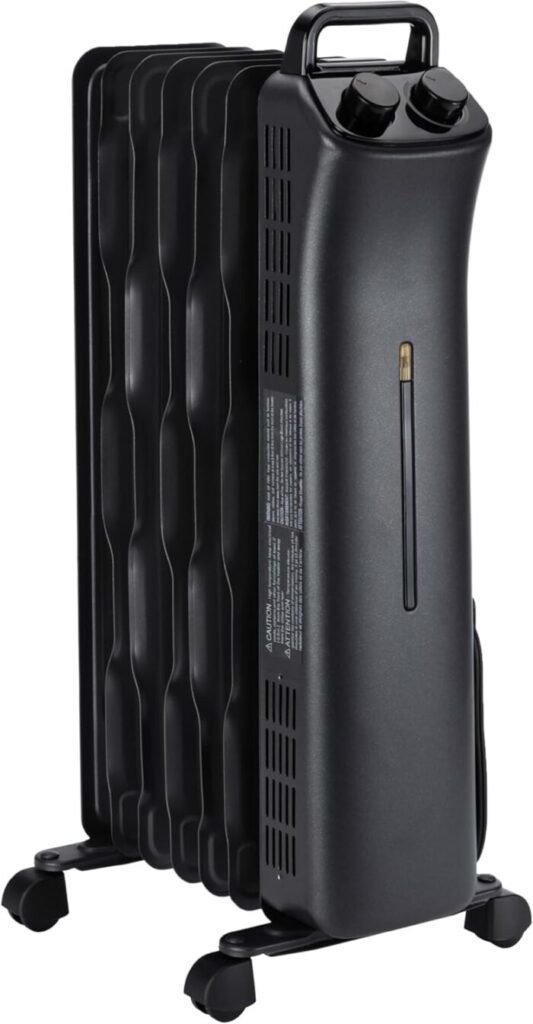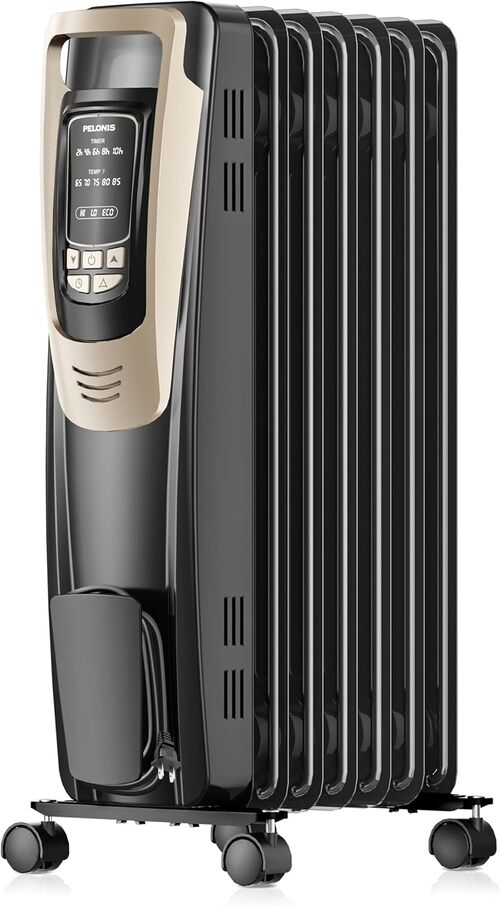
Choose by the controls you want to use every day. Amazon Basics B0828YLCY7 Manual Control uses a power knob and a thermostat dial; Pelonis PH-14A adds digital temperature presets and a remote. Neither has evidence here establishing superior room coverage, lower running cost or safer overnight operation.
This comparison covers those two US versions, not the entire Amazon Basics or Pelonis lineup. It uses manufacturer documentation and selected original owner accounts, not our own hands-on testing. The similarly named Pelonis NY1507 and PHO15A2AGW are not treated as interchangeable with PH-14A.
Manual adjustment versus digital presets
The Amazon Basics manufacturer manual, reproduced on Manuals+ identifies B0828YLCY7 and describes a MIN–MAX thermostat knob. The Pelonis PH-14A manual shows HI, LO and ECO modes, a remote, and digital temperature selection. A digital setting is more explicit than a dial position, but it is not proof of better temperature accuracy.
| Decision | Amazon Basics Manual Control | Pelonis PH-14A |
|---|---|---|
| Temperature selection | Adjust by feel using a MIN–MAX dial | 65–85 °F in five presets |
| Adjust from your chair | On-unit knobs; no remote shown in this version’s manual | Remote included; owners describe line-of-sight limits |
| Timer | No built-in timer shown | 2/4/6/8/10-hour choices |
| Maximum rated input | 1500 W | 1500 W |
| Main control limitation | Unnumbered dial and hard-to-read markings reported | Coarse settings, overshoot and loud beeps reported |
What the owner evidence changes
Amazon Basics owners describe useful room warmth alongside frustration with dialing in comfort. The important distinction is not simply “manual equals easy”: markings and the power light can be confusing. Pelonis owners appreciate remote adjustments, but some find even the lowest setting too warm. The cards below explain those tradeoffs separately rather than treating the samples as a controlled head-to-head test.
Several Amazon Basics accounts report power falling after startup. Those are owner measurements from their own units, not a verified operating rule for every unit or proof that Pelonis sustains greater heat output. Do not convert either model’s rated wattage into a guaranteed square-foot coverage claim.
Neither is a sleeping-use recommendation
The CPSC advises turning portable heaters off when sleeping. It also calls for at least three feet from bedding, curtains and other combustible materials, and a direct wall outlet rather than an extension cord or power strip. Follow the exact heater’s manual and turn it off before leaving it unattended. A thermostat or timer does not override these requirements.
Fanless does not mean completely silent: the samples include clicks, beeps and humming. Use the oil-radiator noise guide for documented sounds and stopping conditions, not a promise that every unfamiliar noise is harmless.
Compare real costs before calling either a value winner
We have not verified comparable current offers, so this page does not award a cheapest-buy winner. Compare the exact version, seller, condition and return terms at purchase. If either heater draws 1.5 kW continuously for one hour, it uses 1.5 kWh; at an illustrative $0.16/kWh, that costs $0.24. Actual consumption depends on operation and cycling, not the brand name. The running-cost guide explains the calculation.