If your patio heater gas not flowing problem showed up out of nowhere — or your propane patio heater is not getting gas at all — you’re not alone. You turn the knob, hit the igniter, maybe hear the click, and still get no real flame, no heat, and no clear sign of what failed.
The frustrating part is that this issue can show up in a few different ways. Sometimes no gas reaches the pilot at all. Sometimes the pilot lights, but the burner never kicks in. Other times the heater lights, but the flame is weak and the heat output is nowhere near normal.
The good news is that most gas flow problems follow a predictable pattern. Once you work from the tank forward — instead of guessing at random — it gets a lot easier to narrow down what’s actually wrong and what’s safe to try yourself.
Quick answer
If your patio heater isn’t getting enough gas, the most common causes are:
- a tripped regulator
- a nearly empty or faulty propane tank
- a kinked or leaking hose
- a blocked pilot tube or burner port
- a dirty or misaligned thermocouple
- a weak or failing regulator assembly
In most cases, the fastest place to start is the simplest one — reset the regulator, open the tank slowly, and inspect the hose and pilot area before touching anything else.
Patio heater gas not flowing — what it usually means
When people say a patio heater has no gas flow, they usually mean one of three things.
The first is that the heater won’t light at all because gas doesn’t seem to reach the pilot. The second is that the pilot lights, but the flame won’t move up to the main burner. The third is that the heater lights, but the flame is small and weak, so the heater barely produces warmth.
That difference matters, because each symptom points to a slightly different cause. For a full breakdown of ignition, pilot, thermocouple, and fuel issues together, see our complete propane patio heater troubleshooting guide. No pilot at all often means an empty tank, a closed valve, a regulator issue, or a blocked pilot path. A pilot that lights but doesn’t bring the burner to life usually points more toward a dirty burner, weak pressure, or a thermocouple issue. Weak heat often comes down to low gas pressure, hose restriction, or a failing regulator.
So before you assume the whole heater is shot, start with the basic fuel path and work forward in order.
At a glance — what your symptom usually means
| What you see | Most likely cause | What to try first |
|---|---|---|
| Nothing lights at all | Empty tank, closed valve, tripped regulator, blocked pilot | Swap tank, reset regulator, check pilot area |
| Igniter clicks but no flame | No gas reaching pilot, dirty pilot tube, bad gas flow | Reset regulator and clean pilot area |
| Pilot lights but burner won’t light | Blocked burner ports, low pressure, thermocouple issue | Clean burner area and inspect thermocouple |
| Heater lights but heat is weak | Low gas pressure, hose restriction, bad regulator | Check hose, tank level, and regulator |
| Flame is yellow or uneven | Dirty burner, clogged air intake, incomplete combustion | Clean burner ports and air path |
| Gas smell near heater | Leak at hose or fitting | Turn off gas immediately and test with soapy water |
If your issue is that the heater isn’t sparking at all, that’s a different problem — see why a patio heater igniter won’t spark.
Start with the fastest checks first
Before you start taking parts apart, do the easy checks that solve a lot of patio heater problems.
1. Make sure the tank actually has fuel
A propane tank can feel like it has “some” gas left and still not have enough pressure to run the heater properly. If you’re unsure, swap in a known full tank instead of guessing.
2. Confirm the tank valve is open
It sounds obvious, but this gets missed more often than people admit — especially after a tank change or after the heater’s been sitting unused for months.
3. Check the regulator connection
If the regulator isn’t seated properly on the tank, gas flow can be restricted right from the start. Make sure the connection is straight, snug, and not cross-threaded.
4. Look for hose kinks or damage
A hose that’s pinched, sharply bent, cracked, or flattened can choke gas flow enough to cause weak flame or no burner action at all.
5. Stop immediately if you smell strong gas
If you get that rotten-egg gas smell, shut everything off right away. Don’t keep clicking the igniter, and don’t try to “see if it works anyway.”
Patio heater gas not flowing after a tank change
One of the most common reasons a heater suddenly seems to have no gas is a regulator that has gone into lockout mode.
This often happens right after changing the propane tank or opening the tank valve too fast. Modern regulators are built to react to sudden pressure surges. When that happens, they can restrict gas flow so heavily that the heater acts like it’s empty.
How to reset the regulator
| Step | What to do | Why it matters |
|---|---|---|
| 1 | Turn the heater off | Resets the system safely |
| 2 | Close the propane tank valve | Stops pressure at the source |
| 3 | Disconnect the regulator | Lets the lockout clear |
| 4 | Wait 30 to 60 seconds | Gives the regulator time to reset |
| 5 | Reconnect the regulator securely | Restores proper pressure path |
| 6 | Open the tank valve very slowly — about 1/4 turn | Prevents the regulator from tripping again |
| 7 | Wait 30 seconds, then light the heater normally | Lets pressure equalize before ignition |
If the heater suddenly works after this, the regulator was probably the issue.
A good habit going forward is to turn the heater off before shutting off the propane tank, then open the tank slowly the next time you reconnect it.
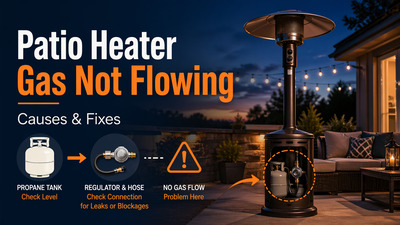
How gas is supposed to move through a patio heater
A lot of troubleshooting gets easier when you picture the path the gas takes:
- Propane tank
- Tank valve
- Regulator
- Hose
- Control valve
- Pilot / ignition area
- Main burner
- Heat at the top emitter
If the gas stops anywhere along that chain, the heater won’t work right. That’s why it helps to troubleshoot in the same order — from the tank forward.
If the pilot lights but the burner doesn’t
This version of the problem is especially common. The pilot comes on, so you know some gas is getting through, but the main burner never really lights, or it lights weakly and dies out.
That usually points to one of these:
- blocked burner ports
- a clogged burner orifice
- weak gas pressure
- dirty pilot assembly
- thermocouple issues
- a failing regulator
In plain terms, the heater is getting some gas — just not enough, or not in the right way, to feed the main burner properly.
A lot of outdoor heaters sit unused for long stretches, and that gives dust, cobwebs, bugs, and rust plenty of time to build up. Spider webs in the pilot area are more common than most people think.
Burner and pilot blockages can choke gas flow
Patio heaters live outside, so they collect dirt fast. Dust settles into the pilot area. Moisture causes corrosion. Insects find their way into tiny openings. Over time, that buildup can seriously affect how the heater starts and burns.
You might notice:
- clicking ignition but no flame
- a weak or unstable pilot
- a burner that lights only on one side
- yellow flame instead of a stronger blue flame
- a heater that starts, then fades out
Cleaning checklist
| Part | What to look for | Safe cleaning method |
|---|---|---|
| Pilot area | Dust, webs, debris | Compressed air or soft brush |
| Burner ports | Blocked holes, soot, rust | Soft brush, careful clearing |
| Air intake | Dirt buildup, nesting debris | Brush and air only |
| Emitter screen area | Heavy dirt or corrosion | Dry cleaning only |
Keep it gentle. This is not the moment for soaking parts, jamming random wire into gas openings, or getting aggressive with tools.
Hose, tank, and connection problems
Sometimes the problem has nothing to do with the burner at all. The issue is lower down — between the tank and the heater.
Hose problems
A damaged hose can restrict gas flow or leak. Look for cracks, flattening, dry rot, sharp bends, rubbing wear, or damaged fittings.
Tank problems
A propane tank can be full and still be the problem. A faulty valve or bad cylinder can make the heater act like gas isn’t getting through properly. If you can, test the heater with another known-good tank before replacing heater parts.
Connection problems
If the regulator doesn’t connect squarely or feels awkward threading onto the tank, don’t force it. Back it off and reconnect it carefully.
Thermocouple issues — especially if the heater lights then dies
The thermocouple is a safety part that senses heat from the pilot flame. If it doesn’t detect enough heat, it shuts the gas path down.
That means a dirty, bent, or failing thermocouple can make it seem like a fuel problem when the real issue is the heater deciding it’s not safe to keep running.
Signs the thermocouple may be involved include:
- the pilot lights, then goes out when you release the knob
- the burner starts briefly, then shuts down
- the heater works only after several tries
- the flame looks unstable near the pilot
That’s often mistaken for a gas flow issue, but it’s usually related to pilot stability — see why a patio heater pilot light keeps going out.
Sometimes the fix is simple — cleaning the tip or adjusting it slightly so it sits closer to the pilot flame. Other times it needs replacement.
Patio heater gas not flowing — what you can do yourself
| Usually OK for DIY | Better left to a pro or part replacement |
|---|---|
| Resetting the regulator | Repairing a leaking gas valve |
| Swapping to a full propane tank | Opening sealed gas controls |
| Inspecting hose for kinks or cracks | Fixing internal fuel path damage |
| Cleaning dust and webs from pilot area | Repairing corroded burner assemblies |
| Testing fittings with soapy water | Using damaged hoses or regulators “for now” |
| Replacing an obviously bad hose/regulator assembly | Anything involving active gas leaks you can’t pinpoint |
What not to do
When people get impatient, they usually make the problem worse.
Don’t:
- open the propane tank too fast after reconnecting it
- keep clicking the igniter while gas may be building up
- use a lighter to test for leaks
- ignore yellow flames, hissing, or visible hose damage
- force a bad regulator connection
- keep using a cracked hose “just one more time”
That last one is how a small heater problem turns into a bigger safety problem.
When replacement makes more sense
If you’ve reset the regulator, cleaned the burner and pilot, tested with a full tank, and inspected the hose — and the heater still struggles with weak flame or inconsistent gas delivery — the regulator assembly or internal gas valve may be failing.
At that point, replacing the unit may be more practical than continuing to replace individual parts.
You can compare current options in our guide to the best propane patio heaters.
Bottom line
If your patio heater gas not flowing issue is driving you crazy, don’t jump straight to the worst-case scenario. Most of the time, the problem comes down to a regulator reset, a bad connection, a dirty pilot or burner area, or a hose problem somewhere between the tank and the heater.
The easiest way to fix it without wasting time is to follow the gas path in order — tank, regulator, hose, pilot, burner. That keeps you from guessing, helps you catch the common stuff first, and makes it much easier to know when a simple cleanup is enough and when it’s time to replace a part or call for help.