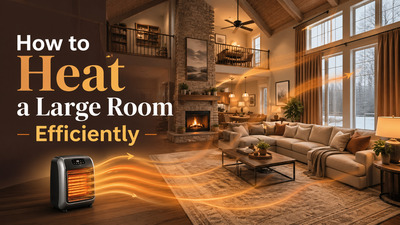
Learning how to heat a large room efficiently means understanding heat loss, room volume, heater type, and how you actually use the space.
Large rooms are frustrating because heat doesn’t behave politely. Warm air rises, cold drafts sneak in, windows leak heat, and one small plug-in heater can feel impressive up close but useless across the room.
This guide breaks it down into the stuff that actually matters. You’ll learn how to size your heating, pick the right type of heater, reduce heat loss, improve air circulation, and avoid wasting money on warmth you never feel.
Our best oil filled radiator heaters can handle medium to large rooms efficiently.
Why large rooms are harder to heat
A large room isn’t just “a small room but bigger.” In practice, it has more air to warm, more surface area losing heat, and often more windows, exterior walls, or high ceilings.
Here’s the thing: a standard portable electric heater usually maxes out at 1500W. That’s normal for a household outlet, but it also means there’s a real ceiling on how much heat one plug-in heater can produce.
| Large Room Challenge | Why It Matters | What Helps |
|---|---|---|
| High ceilings | Warm air collects above where people sit | Ceiling fan in reverse, better air circulation |
| Big windows | Glass loses heat faster than insulated walls | Thermal curtains, sealing gaps |
| Open layout | Heat spreads into areas you may not use | Zone heating, closing doors, curtains |
| Poor insulation | Heat escapes as fast as you add it | Draft sealing, rugs, insulation upgrades |
| Cold exterior walls | They pull warmth from the room | Radiant heat, better placement, curtains |
The main point is simple: don’t only think about the heater. Think about where the heat goes after the heater makes it.
💡 Pro Tip: If a large room never feels warm, the heater may not be the main problem. Drafts, high ceilings, bare floors, and poor window coverage can waste a surprising amount of heat.
How to Heat a Large Room Efficiently: Start With Size
Before buying anything, measure the room. Square footage matters, but ceiling height matters too. A 300 sq ft room with 8 ft ceilings is not the same as a 300 sq ft room with 14 ft ceilings.
A common electric heating rule is around 10 watts per square foot for standard rooms. That said, large rooms with poor insulation, big windows, or high ceilings often need more.
| Room Size | Typical Need | Realistic Portable Heater Setup | Expectation |
|---|---|---|---|
| Up to 150 sq ft | 750-1500W | One ceramic, oil-filled, or panel heater | Can work as primary heat |
| 150-250 sq ft | 1500W | One strong 1500W heater | Good if insulated well |
| 250-400 sq ft | 1500W+ | One heater as supplemental heat | May need zone heating |
| 400-600 sq ft | Multiple heat sources | Two heaters or fixed heating system | One plug-in heater will struggle |
| 600+ sq ft | Professionally sized system | Heat pump, HVAC, radiant floor, or multiple zones | Portable heaters are usually backup only |
The catch is that many “large room” heater claims are based on ideal conditions. If your room is drafty, has old windows, or opens into a hallway, expect less performance.
For related product picks, you can link naturally to best space heaters for large rooms.
Best heating types for large rooms
Different heaters don’t magically make more heat if they use the same wattage. But they do distribute heat differently, and that changes how comfortable the room feels.
In practice, the best heater depends on whether you want fast warmth, quiet background heat, direct personal warmth, or a long-term whole-room solution.
| Heating Type | Best For | Strength | Weakness |
|---|---|---|---|
| Ceramic fan heater | Quick warmth in occupied areas | Fast heat and good air movement | Fan noise and heat fades quickly |
| Oil-filled radiator | Bedrooms, offices, all-day steady heat | Silent, stable, comfortable warmth | Slow warm-up |
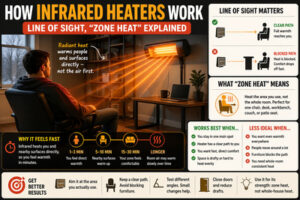
| Infrared heater | Drafty rooms, workshops, spot heating | Warms people and objects directly | Directional, not ideal for whole-room air heat |
| Dual-method heater | Large rooms needing faster coverage | Combines radiant warmth and airflow | Usually costs more |
| Heat pump / mini-split | Long-term large-room heating | Much lower running cost than resistance heat | Higher upfront cost |
| Radiant floor heating | Remodels, additions, high-comfort spaces | Even heat from the floor up | Expensive to install later |
For a large bedroom or home office, an oil-filled radiator can be excellent if you preheat the room and let it maintain temperature. For quick comfort while you’re sitting on the sofa or working at a desk, a ceramic or infrared heater may feel better. For bedroom-sized spaces, oil heaters for bedroom provide quiet warmth.
❌ Common Mistake: Buying a heater only because it says “large room” on the box.
A 1500W heater is still a 1500W heater. Look at how it spreads heat — fan, oscillation, radiant direction, thermostat quality — not just the marketing claim.
Improve insulation before adding more heat
If you’re trying to figure out how to heat a large room efficiently, insulation is usually the boring answer that actually works.
You don’t always need a major renovation. Small fixes can make a big difference, especially around windows, doors, floors, and unused openings.
| Heat Loss Area | Quick Fix | Why It Helps | Cost Level |
|---|---|---|---|
| Drafty doors | Door draft stopper or sweep | Stops cold air entering at floor level | Low |
| Old windows | Weatherstripping or window film | Reduces air leaks and cold glass effect | Low |
| Bare floors | Large rug or carpet | Makes the room feel warmer underfoot | Low-Medium |
| Large windows | Thermal curtains | Reduces nighttime heat loss | Medium |
| Exterior walls | Wall insulation upgrade | Reduces major heat loss | High |
That said, don’t block heaters or radiators with furniture. A sofa in front of a heat source can trap warmth where you don’t need it and leave the rest of the room cold.
Large Room Heat-Retention Checklist ✓
- ✅ Close doors to unused rooms
- ✅ Seal obvious window and door drafts
- ✅ Use thermal curtains at night
- ✅ Add rugs on cold floors
- ✅ Keep furniture away from heat sources
- ✅ Check whether warm air is collecting near the ceiling
Use airflow to bring heat back down
Warm air rises. In a large room with high ceilings, that can mean your ceiling feels cozy while your sofa still feels cold.
On the flip side, you don’t want a fan blasting cold air across the room. The goal is gentle circulation — enough to mix the air, not enough to create a draft.
| Airflow Method | Best Use | How to Use It |
|---|---|---|
| Ceiling fan in reverse | High ceilings | Run clockwise on low speed to push warm air down |
| Oscillating heater | Medium-large rooms | Spread warm air across a wider area |
| Small circulation fan | Oil-filled radiators | Place nearby, not too close, to move warm air gently |
| Open interior doors carefully | Connected spaces | Only open doors if you want to share heat |
In practice, this is why a fan-forced heater can feel stronger than an oil-filled radiator, even at the same wattage. It moves the warmth toward you faster.
💡 Pro Tip: If you use an oil-filled radiator in a large room, start it earlier than you think. These heaters are better at maintaining comfort than rescuing a freezing room in five minutes.
Try zone heating instead of heating everything
Zone heating means warming the part of the room you actually use. This is one of the most practical ways to manage a large room without wasting energy.
For example, if you sit at a desk in one corner, don’t try to heat the entire open-plan space to the same temperature. Heat the desk zone, block drafts, and use a blanket or heated throw if needed.
| Situation | Best Zone Heating Setup | Why It Works |
|---|---|---|
| Large bedroom | Oil-filled radiator + timer | Maintains steady comfort overnight or before bed |
| Living room seating area | Infrared or ceramic heater near seating zone | Warms people faster without heating unused corners |
| Home office corner | Small ceramic heater + draft sealing | Targets where you sit most of the day |
| Open-plan room | Two lower-intensity zones instead of one hot corner | Improves comfort and reduces cold pockets |
| Workshop or garage | Infrared heater aimed at work area | Direct warmth matters more than air temperature |
At the same time, don’t let the rest of your home get so cold that damp becomes a problem. Heating only one room can save money, but completely cold rooms can encourage condensation and mold in some homes.
💰 Money Saver: Zone heating works best when you lower your main thermostat slightly — not when you turn the rest of the home into an icebox. Aim for comfort where you spend time while keeping the building healthy.
Estimate the running cost before you run it all day
Portable electric heaters are simple, but they’re not always cheap. A 1500W heater uses 1.5 kWh per hour when running at full power.
Here’s a rough cost guide using $0.16 per kWh. Your actual rate may be higher or lower.
| Daily Use | Energy Used | Cost per Day | Monthly Cost |
|---|---|---|---|
| 2 hours/day | 3 kWh | ~$0.48 | ~$14 |
| 4 hours/day | 6 kWh | ~$0.96 | ~$29 |
| 8 hours/day | 12 kWh | ~$1.92 | ~$58 |
| 12 hours/day | 18 kWh | ~$2.88 | ~$86 |
| 24 hours/day | 36 kWh | ~$5.76 | ~$173 |
Thermostats and timers help because the heater doesn’t run constantly once the room reaches temperature. However, when it is heating, it still pulls its rated wattage.
Safe setup matters more in large rooms
Large rooms can trick you into placing heaters in risky spots — near curtains, under desks, behind sofas, or on extension cords because the outlet is far away.
Don’t do that. A powerful portable heater needs space, airflow, and a proper outlet.
| ✅ Do This | ❌ Don’t Do This |
|---|---|
| Plug directly into a wall outlet | Don’t use extension cords or power strips |
| Keep at least 3 feet from fabrics | Don’t place near curtains, bedding, or papers |
| Use on a flat, stable surface | Don’t put it on furniture or thick rugs |
| Choose tip-over and overheat protection | Don’t buy no-name heaters without safety marks |
| Turn off when leaving the room | Don’t leave it running unattended for hours |
The safest heater is the one that fits the room and is used correctly. So, if your only outlet forces you to run a cord across the room, rethink the setup before plugging anything in.
⚠️ Safety Warning: Never plug a 1500W space heater into a cheap extension cord or power strip. These heaters draw a lot of current, and overloaded cords can overheat.
Follow space heater safety guidelines when running multiple units.
When a portable heater isn’t enough
Sometimes the honest answer is that one plug-in heater won’t solve the problem. If the room is huge, poorly insulated, or used daily through winter, a permanent heating upgrade may cost less over time.
A mini-split heat pump is often the most efficient electric option because it moves heat instead of creating it directly. Radiant floor heating can also be excellent in remodels, especially where comfort and even heat matter.
| Long-Term Option | Best For | Why Consider It | Main Drawback |
|---|---|---|---|
| Mini-split heat pump | Large bedrooms, open-plan rooms, additions | Efficient heating and cooling in one system | Higher upfront cost |
| Radiant floor heating | Renovations and premium comfort spaces | Even warmth from the floor up | Installation cost and disruption |
| Improved central HVAC zoning | Whole-home heating problems | Better control room by room | May require duct or system upgrades |
| Wall-mounted electric heater | Rooms needing frequent supplemental heat | Saves floor space and can be sized better | May need electrical work |
If you’re learning how to heat a large room efficiently for one winter, portable heating plus insulation fixes may be enough. If you’re solving the same problem every year, a permanent system is worth pricing out.
Considering multiple heaters? See our Pelonis vs DREO comparison.
Bottom Line
The best way to approach how to heat a large room efficiently is to stop thinking about the heater as the whole solution. Room size, ceiling height, insulation, airflow, and where people actually sit all matter just as much as wattage.
Start by sealing drafts, using curtains or rugs where needed, and choosing a heater that matches your use case. For quick warmth, pick ceramic or infrared. For quiet steady comfort, use an oil-filled radiator. For long-term daily heating, consider a heat pump or a better fixed system. Once you control heat loss and direct warmth where you need it, a large room becomes much easier — and cheaper — to keep comfortable.
The Dreo DR-HSH011 offers 1500W for rooms up to 400 sq ft.
Budget option: Amazon Basics handles 200-300 sq ft rooms.